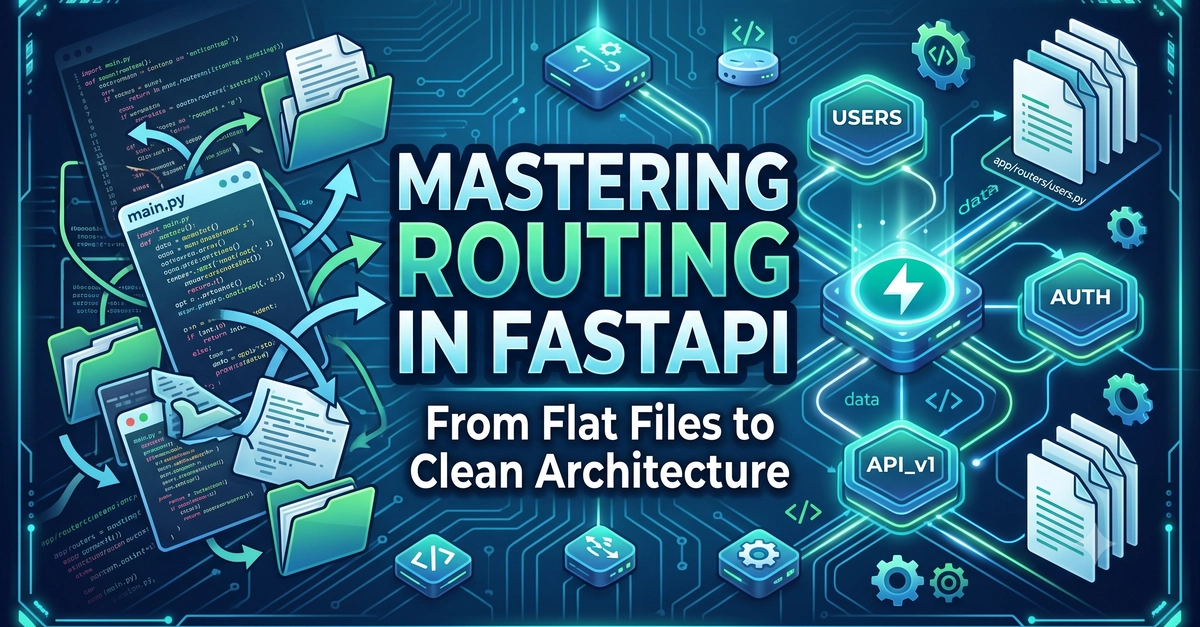
The Problem with Monolithic FastAPI Apps
Starting an API with FastAPI is deceptively simple. A few @app.get() and @app.post() decorators in a single main.py file make it easy to get going. But as your project grows, this approach quickly becomes unmanageable. The main.py file balloons into an 800-line monolith. Team members face constant Git merge conflicts. It becomes unclear where authentication logic ends and billing logic begins. This is a common pitfall that hinders scalability and maintainability.
Introducing APIRouter: The Solution for Modular Routing
FastAPI provides a powerful solution: APIRouter. Think of APIRouter as a miniature FastAPI application. It doesn't run independently but allows you to group related path operations together. These groups can then be mounted onto your main FastAPI application, creating a structured and organized project. This modular approach is key to building scalable and maintainable APIs from the outset.
Structuring Your FastAPI Project with APIRouters
A well-structured project is crucial for managing complexity. A typical modular directory structure using APIRouter looks like this:
my_project/
├── app/
│   ├── __init__.py
│   ├── main.py
│   ├── api/
│   │   ├── __init__.py
│   │   ├── v1/
│   │   │   ├── __init__.py
│   │   │   ├── endpoints/
│   │   │   │   ├── __init__.py
│   │   │   │   ├── users.py
│   │   │   │   ├── items.py
│   │   │   ├── routers.py
│   │   ├── v2/
│   │   │   ├── ...
│   ├── core/
│   │   ├── config.py
│   │   ├── security.py
│   ├── models/
│   │   ├── __init__.py
│   │   ├── user.py
│   │   ├── item.py
│   ├── schemas/
│   │   ├── __init__.py
│   │   ├── user.py
│   │   ├── item.py
│   ├── crud/
│   │   ├── __init__.py
│   │   ├── user.py
│   │   ├── item.py
│   ├── database.py
│   ├── dependencies.py
├── tests/
│   ├── ...
├── Dockerfile
├── requirements.txt
└── README.md
In this structure, the api/v1/endpoints/ directory would contain individual Python files for different sets of related routes, such as users.py and items.py. The api/v1/routers.py file would be responsible for collecting these individual endpoint routers and creating a main router for version 1 of your API. This keeps related logic physically together, making it easier to find and manage.
Implementing APIRouters in Practice
Let's walk through a practical example of setting up an APIRouter. First, define your router in a dedicated file, for instance, app/api/v1/routers.py:
from fastapi import APIRouter

from app.api.v1.endpoints import users, items

api_router_v1 = APIRouter()

api_router_v1.include_router(users.router, prefix="/users")
api_router_v1.include_router(items.router, prefix="/items")
Next, within the endpoint files (e.g., app/api/v1/endpoints/users.py), define your individual routers and their path operations:
from fastapi import APIRouter, HTTPException, Depends
from sqlalchemy.orm import Session

from app import crud, schemas, models
from app.database import SessionLocal

router = APIRouter()

def get_db():
    db = SessionLocal()
    try:
        yield db
    finally:
        db.close()

@router.post("/", response_model=schemas.User)
def create_user(user: schemas.UserCreate, db: Session = Depends(get_db)):
    db_user = crud.get_user_by_email(db, email=user.email)
    if db_user:
        raise HTTPException(status_code=400, detail="Email already registered")
    return crud.create_user(db=db, user=user)

@router.get("/{user_id}", response_model=schemas.User)
def read_user(user_id: int, db: Session = Depends(get_db)):
    db_user = crud.get_user(db, user_id=user_id)
    if db_user is None:
        raise HTTPException(status_code=404, detail="User not found")
    return db_user
Finally, in your main application file (app/main.py), you instantiate your FastAPI app and include the main router:
from fastapi import FastAPI

from app.api.v1.routers import api_router_v1

app = FastAPI()

app.include_router(api_router_v1, prefix="/api/v1")

@app.get("/")
def read_root():
    return {"message": "Welcome to the API"}
This setup clearly separates concerns. User-related endpoints are in users.py, item-related endpoints in items.py. The routers.py file acts as an orchestrator for version 1, and main.py is the entry point that mounts the versioned API.
Benefits of Using APIRouters
Adopting APIRouter offers several significant advantages:
- Improved Organization: Grouping endpoints by functionality makes the codebase easier to navigate and understand.
- Reduced Merge Conflicts: Developers working on different feature sets are less likely to conflict on the same files.
- Enhanced Maintainability: Isolating logic for specific features simplifies updates, bug fixes, and refactoring.
- Code Reusability: Routers can be reused across different parts of your application or even in other projects.
- Scalability: The modular structure naturally supports the growth of the API without becoming unwieldy.
- Clearer Versioning: It facilitates the implementation of API versioning (e.g.,
/api/v1,/api/v2) by allowing you to manage entire versions as distinct router groups.
Beyond Flat Files: Towards Clean Architecture
The adoption of APIRouter is a foundational step towards implementing cleaner architectural patterns. While this article focuses on routing, a truly clean architecture would further separate concerns within each endpoint module. This involves distinguishing between:
- Presentation Layer: FastAPI endpoints, request/response schemas (Pydantic models).
- Application Layer: Business logic, use cases, orchestrating data flow.
- Domain Layer: Core business entities and rules, independent of external concerns.
- Infrastructure Layer: Database interactions, external API calls, authentication services.
By using APIRouter to group related endpoints, you create logical boundaries that align with the presentation layer. Within these boundaries, you can then apply principles like dependency injection (as demonstrated with Depends) to inject application and infrastructure services, keeping your endpoint logic focused and testable.
The surprising detail here is not the existence of APIRouter itself, which is a core FastAPI feature, but how many developers initially overlook its importance, opting for the simpler, yet ultimately more problematic, monolithic approach. Embracing modular routing from day one is an investment that pays dividends as the project scales.
Conclusion
Moving away from a single, monolithic main.py file is essential for any FastAPI project that aims for long-term success. APIRouter provides the tools to achieve modularity, leading to better organization, reduced conflicts, and improved maintainability. By structuring your project with routers, you lay the groundwork for a scalable API that can evolve alongside your application's needs and complexity.