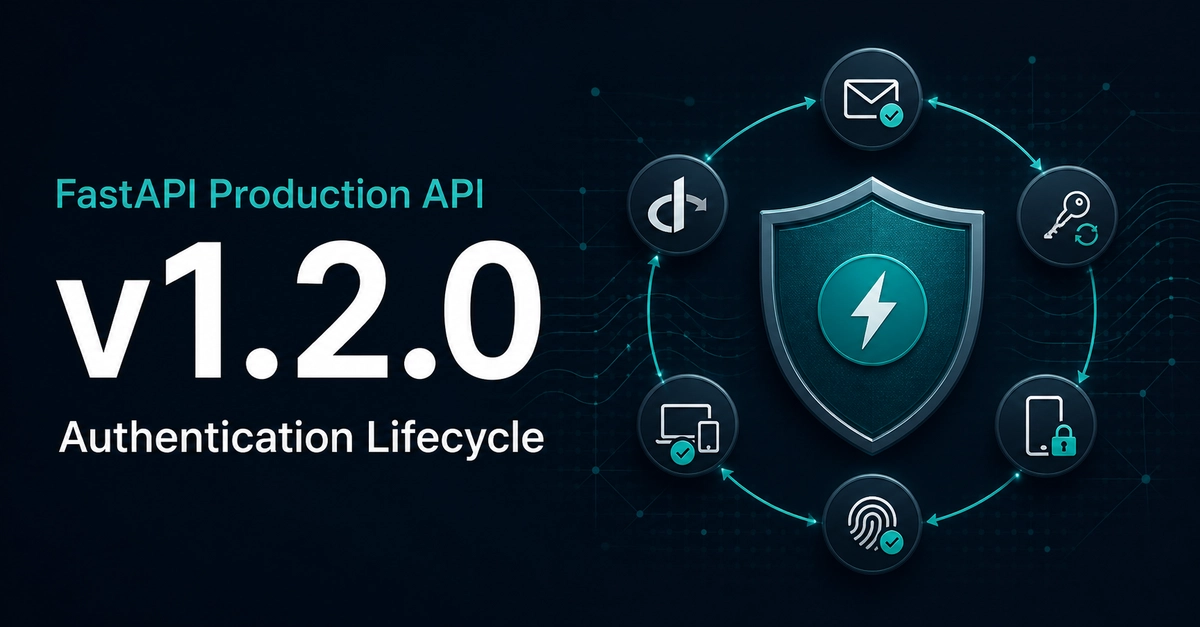
Beyond the Basics: What a Real Authentication Lifecycle Entails
Most tutorials stop at the login screen: accept credentials, issue a JWT, and protect a few endpoints. This is a starting point, not a complete authentication lifecycle. Building production-ready authentication for applications, particularly those using frameworks like FastAPI, requires addressing a more complex set of challenges. These aren't theoretical; they are the hard questions that arise when users interact with your system over time, and their security needs evolve.
The core issue is that authentication isn't a one-time event. It's a continuous process that must handle edge cases, security vulnerabilities, and user lifecycle events. Consider the common scenario of email verification. A naive approach might involve sending a reusable secret link. This is a security risk. A robust system must verify an email address without storing a reusable secret that could be compromised. Similarly, when a user needs to reset their password, what happens to all their existing active sessions? Simply invalidating the password hash is insufficient if refresh tokens or other session identifiers remain valid.
Furthermore, users expect to manage their security. This means providing visibility into active sessions and devices. Can a user see where they are logged in and, crucially, revoke access for a lost or stolen device? This requires a mechanism to track active sessions and their associated identifiers, allowing for granular revocation.
Token management itself presents challenges. Refresh tokens, vital for maintaining user sessions without constant re-authentication, need careful handling. How do you prevent a rotated refresh token from being replayed by an attacker who might have intercepted a previous, valid token? This implies a need for token rotation strategies that include mechanisms to detect and reject replay attempts.
When implementing multi-factor authentication (MFA), such as Time-based One-Time Passwords (TOTP), the storage of secrets and recovery codes is paramount. Storing TOTP secrets insecurely or making recovery codes easily discoverable negates the security benefits of MFA. Best practices dictate secure, encrypted storage for these sensitive artifacts.
Finally, integrating with external identity providers via protocols like OpenID Connect (OIDC) introduces its own set of complexities. Simply trusting email address matching from an OIDC provider is not sufficient for robust security. A more secure approach is needed to link an OIDC identity without relying solely on potentially unverified email addresses.
FastAPI Production API v1.2.0: A Practical Implementation
These are not hypothetical problems. They are the issues addressed in the development of FastAPI Production API v1.2.0. This release focuses on providing a backward-compatible authentication lifecycle that goes significantly beyond basic login functionality. It aims to equip developers with the tools to build secure, user-centric authentication systems within the FastAPI framework.
The implementation tackles the aforementioned challenges head-on. For email verification, it employs a time-limited, single-use token system that does not require storing reusable secrets. When a password reset occurs, the system invalidates not only the password hash but also all active refresh tokens and session identifiers, ensuring that compromised credentials do not grant continued access. Users can view a list of their active devices and sessions, with a clear option to revoke access for any they no longer recognize or trust.
To combat refresh token replay, the API incorporates a mechanism that assigns a unique identifier to each refresh token. When a refresh token is used, its identifier is logged, and subsequent attempts to use the same identifier are rejected. This prevents an attacker who has obtained an old refresh token from using it after a new one has been issued.
For TOTP secrets and recovery codes, the solution leverages secure, encrypted storage. TOTP secrets are stored in an encrypted format, and recovery codes are presented to the user once upon setup, with the expectation that the user will store them securely offline. The system does not retain a plaintext copy of recovery codes.
When linking OIDC identities, the API uses a combination of OIDC-provided unique identifiers and a verification step, rather than relying solely on email matching. This ensures a more secure and reliable linkage between the user's application account and their external identity provider.
The Significance for Developers
The implications for developers are significant. Building a secure authentication system from scratch is a notoriously difficult and time-consuming task, fraught with potential security pitfalls. Relying on a well-vetted, production-ready library or framework component like FastAPI Production API v1.2.0 allows developers to focus on their core application logic rather than reinventing complex security primitives.
This approach provides a solid foundation for applications that handle sensitive user data or require a high degree of security. It abstracts away much of the complexity associated with managing user sessions, token rotation, and multi-factor authentication, enabling faster development cycles without compromising security posture. The backward-compatible nature of the release means existing FastAPI applications can integrate these advanced authentication features incrementally.
What nobody has addressed yet is how widely such robust, opinionated authentication lifecycles will be adopted by frameworks and libraries. Will this become a de facto standard, or will developers continue to piece together fragmented solutions?
For founders, this translates to reduced development time, lower security risks, and a more trustworthy product for their users. For security professionals, it means a more predictable and auditable authentication surface. For creators, it enables them to build richer, more secure user experiences without becoming authentication experts overnight.