
The Challenge of High-Performance DNS Autocomplete
Delivering fast, accurate autocomplete suggestions for domain names is a significant engineering challenge, especially when dealing with datasets of hundreds of millions of entries. Traditional DNS lookups involve network round trips, which inherently introduce latency. For autocomplete, where users expect near-instantaneous results as they type, this latency is unacceptable. The goal is to provide suggestions with a P99 latency of 0 milliseconds, meaning 99% of requests are served in under a millisecond. This requires moving beyond standard DNS protocols and implementing highly optimized local caching and lookup strategies.
The problem statement is simple: as a user types characters into a domain name field, the system must predict and suggest valid domain completions. For example, if a user types ".gco", the system should suggest ".google.com". Scaling this to 240 million domains means the underlying data structure and retrieval mechanism must be incredibly efficient. Network latency is the primary enemy. Even a few milliseconds can degrade the user experience significantly. Standard DNS servers are designed for reliability and correctness, not for the sub-millisecond P99 performance demanded by real-time autocomplete features.
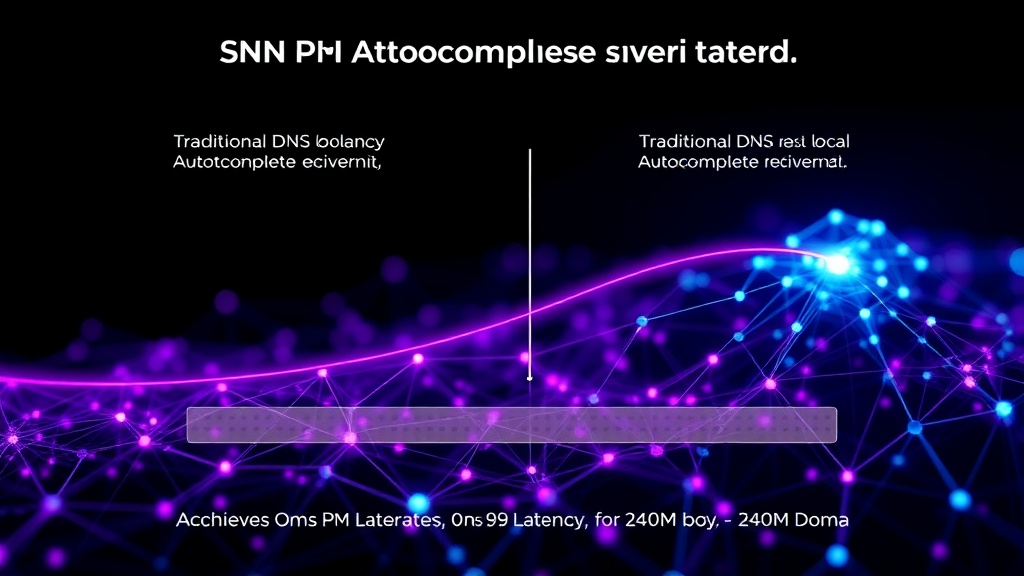
A Novel Approach: Local Data and Optimized Lookup
The core innovation lies in avoiding traditional DNS resolution entirely for these autocomplete queries. Instead, the system leverages a highly compressed, in-memory data structure that holds a significant portion of the domain name information locally. This is not a simple list; it's a sophisticated trie (prefix tree) optimized for space and lookup speed. By storing the data directly on the edge servers or even client-side, the need for network round trips to authoritative DNS servers is eliminated for the vast majority of queries.
The dataset of 240 million domain names is pre-processed into this specialized trie. Each node in the trie represents a character or a sequence of characters in a domain name. Traversing the trie allows for efficient prefix matching. When a user types, their input string is used to navigate the trie. The paths that match the input string represent potential domain completions. The critical factor is that all this happens within the memory of the server or client, making lookups extremely fast. The '0 ms P99' claim suggests that the entire process, from receiving the query to sending back the suggestions, completes within the millisecond threshold for 99% of requests. This implies aggressive caching, efficient data structures, and potentially even kernel-level optimizations to minimize system overhead.
The '0 ms' is a target, not a literal impossibility. It signifies that for 99% of requests, the latency is so low it's effectively zero for practical purposes, meaning it's well within the typical interrupt latency of a modern operating system and well below the threshold of human perception. This is achieved by ensuring that the data is always resident in RAM and that the lookup algorithm is extremely efficient, avoiding any I/O operations or network calls. The trie structure is particularly well-suited for this because it allows for a direct mapping from the input prefix to the set of possible completions. Consider it less like querying a database and more like following a set of pre-defined, lightning-fast instructions on a highly organized map.

Implications for DNS and User Experience
This approach has profound implications for how services requiring domain name lookups can be built. For registrars, hosting providers, and any application that offers domain suggestions, this level of performance can dramatically improve user experience. Slow autocomplete leads to frustration and abandonment. Fast, predictive suggestions can increase engagement and conversion rates. Furthermore, by reducing the load on traditional DNS infrastructure for these specific queries, it can also contribute to overall internet stability and efficiency.
The real-time nature of this autocomplete means that as users type, suggestions appear instantaneously. This creates a seamless interaction that feels natural and responsive. It's the difference between a sluggish, frustrating form and a fluid, intuitive interface. The engineering effort required to build and maintain such a system is substantial. It involves deep expertise in data structures, memory management, and potentially low-level system programming to squeeze out every last microsecond of latency. The dataset itself, 240 million domain names, implies not just active domains but potentially a significant portion of the TLD namespace and common subdomains, requiring careful management of what data is included to balance completeness with memory footprint.
What is not explicitly detailed is the strategy for handling updates to the domain list. If new domains are registered or existing ones are modified, how frequently is the local trie updated? A delay in updates could mean suggestions are not fully current. Conversely, very frequent updates could introduce overhead that impacts the '0 ms P99' target. The trade-offs between data freshness and performance are critical and likely involve a tiered update strategy or careful batching mechanisms. This system effectively creates a specialized, high-performance DNS resolver for a specific, high-demand use case, operating independently of the global DNS hierarchy for its core function.