The First Data Set: Beautifully Wrong
When measuring how a search engine scales with thread count, a developer initially produced a seemingly perfect data set. The tests, running from 1 to 10 threads in sequential order, showed a clear, elegant curve. The highlight was a record-breaking run of 11 threads completing in 5.2 seconds. This data was so compelling it was prepared for a companion article detailing the optimal number of search threads.
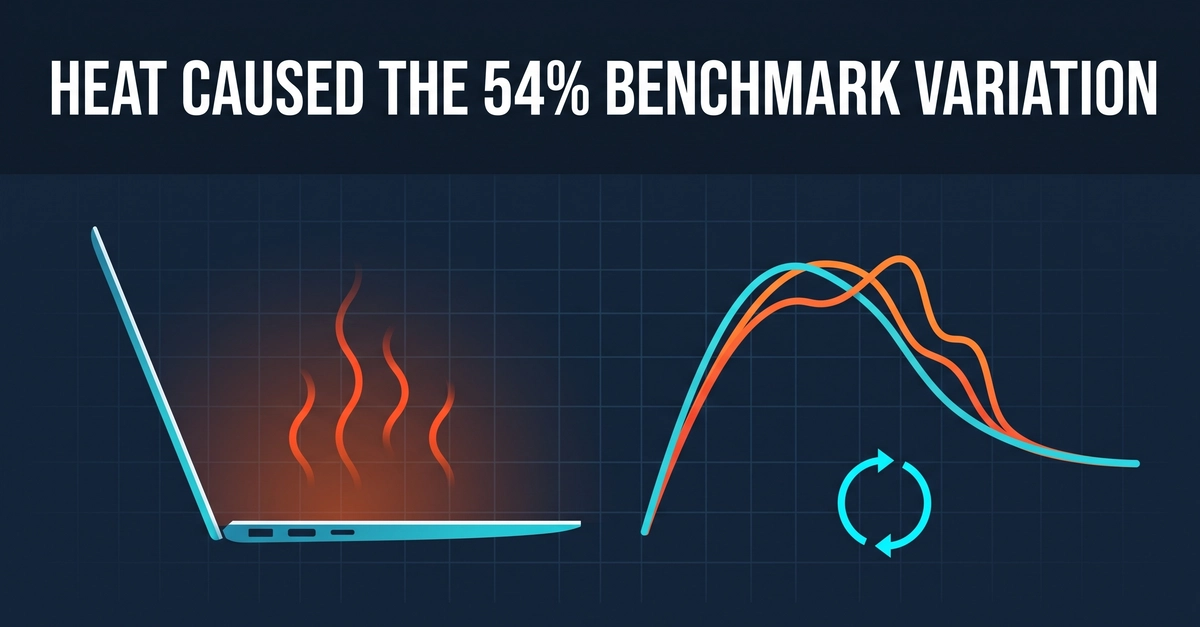
However, a routine sanity check before publication revealed a significant discrepancy. Re-running the same tests under identical conditions yielded results up to 54% different. The 4-thread run, which previously took 11.0 seconds, now clocked in at 9.0 seconds. More alarmingly, the record-setting 11-thread run jumped from 5.2 seconds to 8.0 seconds. The previous performance record could not be reproduced. This stark difference, occurring without any rogue background processes, pointed to a more insidious culprit: the hardware itself.
The surprising detail here is not the magnitude of the performance difference, but the cause. It wasn't a software bug or an environmental factor like network latency. It was the fundamental physical limitation of the machine's thermal management system, or rather, its absence. The beautiful, clean curve was an illusion, a temporary state of performance that masked a critical underlying issue.
The Culprit: Thermal History on a Fanless Machine
The investigation quickly focused on the fanless Mac. Unlike machines with active cooling systems, fanless designs rely on passive heat dissipation through their chassis. This works well for typical, bursty workloads. However, sustained, computationally intensive tasks, such as running benchmarks that push the CPU to its limits, can cause the internal temperature to rise steadily. Without fans to expel heat, the processor must inevitably slow down to prevent damage. This phenomenon is known as thermal throttling.
The issue with the initial benchmark run was the sequential nature of the tests. Starting with 1 thread and progressively increasing to 10, the Mac's CPU experienced a gradual build-up of heat. Each subsequent test iteration ran on a chassis that was already warmer than the previous one. The early tests, benefiting from a cooler starting temperature, reported artificially fast times. By the time the tests reached higher thread counts, the CPU was already operating under thermal duress, leading to slower, but more representative, execution times.
The crucial insight is that the *order* of measurement fundamentally altered the results. The first data set, while appearing consistent and logical, was fundamentally flawed because it did not account for the cumulative thermal load. Imagine trying to measure the boiling point of water, but each time you add heat, the pot is already slightly warm from the previous attempt. The final temperature reading wouldn't reflect the true boiling point from a cold start.
This cumulative effect means that a fanless laptop's performance can vary significantly based on its recent operational history. A benchmark run immediately after the machine has been idle will yield different results than one performed after hours of heavy computation. For consistency, especially in performance-sensitive testing, the machine must be returned to a known thermal state before each measurement. This often means allowing significant cool-down periods between tests, or using hardware with active cooling that can manage sustained loads more effectively.
The Implications for Benchmarking and Development
This experience has profound implications for anyone conducting performance benchmarks, particularly on thermally constrained hardware like fanless laptops. Relying on sequential testing without accounting for thermal history is a recipe for inaccurate data. The entire first data set, which took hours to collect, had to be discarded because it did not reflect the true, sustained performance of the search engine.
For developers, this means that benchmark results obtained on fanless machines, especially those involving sustained CPU load, should be treated with extreme caution. If your application or workload involves long-running computations, the performance you observe might be significantly better than what you would experience in real-world, continuous operation. This is not a problem that affects only high-performance computing; even seemingly modest tasks, when run repeatedly or for extended durations on such hardware, can trigger thermal throttling.
The solution involves a rigorous testing methodology. Ideally, tests should be randomized or performed with sufficient cool-down periods between iterations to ensure each measurement starts from a baseline thermal state. Alternatively, using hardware with robust active cooling systems provides a more stable platform for performance testing. If randomized testing isn't feasible, at the very least, the final data set should be validated by re-running tests at random intervals and checking for consistency. The benchmark results from the companion article were eventually re-collected using this more rigorous approach.
What nobody has addressed yet is the broader impact of this phenomenon on the vast ecosystem of software and hardware reviews. Many reviews and comparisons rely on standardized benchmarks run on widely available consumer hardware. If a significant portion of that hardware is passively cooled and susceptible to thermal variations, the published performance figures could be systematically skewed, leading to flawed comparisons and purchasing decisions.
This situation underscores a fundamental truth in computing: performance is not just about raw specifications or algorithmic efficiency; it is also deeply intertwined with the physical constraints of the hardware. For developers and testers, understanding and accounting for these physical realities is as critical as optimizing code. The fanless Mac's 54% performance swing serves as a potent reminder that even the most meticulously planned tests can be undone by unacknowledged environmental factors, turning a benchmark into a masquerade.