
The AI Investment Gold Rush
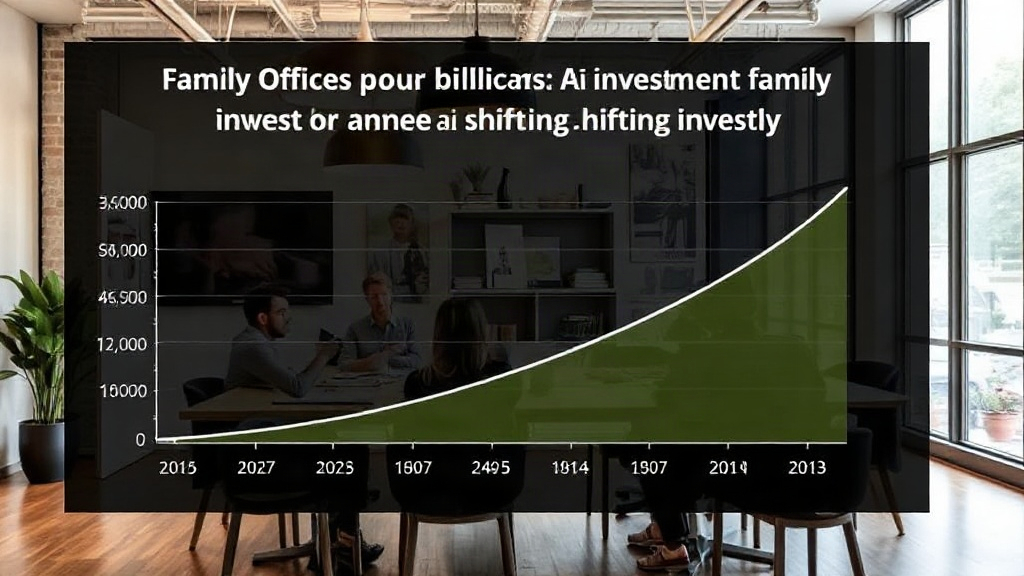
Family offices, the private wealth management advisory firms that serve ultra-high-net-worth families, are increasingly directing substantial capital towards artificial intelligence. This trend signifies a maturing interest in AI beyond traditional venture capital and private equity, with these sophisticated investors actively seeking exposure to the technology's transformative potential across various sectors. While the exact figures are often private, anecdotal evidence and industry reports indicate a significant surge in AI-focused allocations within family office portfolios over the past 18-24 months.
These investors are not merely dabbling; they are making significant commitments, viewing AI as a foundational technology that will reshape industries and create long-term value. This contrasts with earlier investment cycles where AI was often a component of broader technology funds. Now, AI itself is the primary thesis. The allure lies in AI's ability to drive efficiency, unlock new business models, and provide a competitive edge across sectors as diverse as healthcare, finance, manufacturing, and consumer goods.
Why the Sudden Urgency?
Several factors are converging to create this heightened demand. Firstly, the demonstrable successes of AI in recent years, from large language models to sophisticated predictive analytics, have moved the technology from a theoretical promise to a tangible reality. Family offices, often characterized by a long-term investment horizon and a desire for diversification, see AI as a critical area to capture future growth. They are less concerned with short-term market fluctuations and more focused on identifying companies that will define the next decade.
Secondly, the increasing accessibility of AI tools and platforms means that its impact is no longer confined to tech giants. Startups and established companies across the board are integrating AI, creating a broader universe of investment opportunities. Family offices, with their agility and direct access to deal flow, are well-positioned to identify and invest in these emerging players. They can often move faster than larger institutional investors, securing allocations in promising, early-stage companies.
The desire to stay ahead of the curve is a powerful motivator. Family offices understand that AI is not just another technology trend but a fundamental paradigm shift. Those who fail to invest adequately risk being left behind as competitors leverage AI to gain market share and operational efficiencies. This sense of urgency drives a more proactive approach to sourcing and evaluating AI deals.
Investment Strategies and Focus Areas
Family offices are employing diverse strategies to gain AI exposure. Some are investing directly into venture capital funds that specialize in AI. Others are participating in later-stage growth equity rounds for established AI companies. A growing number are also making direct investments into startups, often leveraging their extensive networks for deal sourcing and due diligence. This direct approach allows for greater control and potentially higher returns, though it also requires significant internal expertise.
Within the broad AI landscape, specific areas are attracting particular attention. Generative AI, due to its potential to automate content creation, software development, and customer interaction, is a major focal point. AI in healthcare, particularly in drug discovery, diagnostics, and personalized medicine, is another hotbed of activity, appealing to family offices with a philanthropic bent or a specific interest in life sciences. Furthermore, AI applications in cybersecurity, supply chain optimization, and advanced robotics are also seeing increased capital inflow. The common thread is AI's ability to solve complex problems and create significant economic value.
The investment thesis often centers on AI's ability to enhance productivity and create defensible moats for companies. Family offices are looking for AI solutions that provide a clear competitive advantage, whether through proprietary algorithms, unique datasets, or highly efficient operational integration. They are discerning investors, capable of looking beyond the hype to identify genuine technological innovation and scalable business models.
Navigating the Challenges
Despite the enthusiasm, family offices face challenges. The sheer volume of AI companies seeking funding can be overwhelming, making it difficult to conduct thorough due diligence. Valuations in the AI space have also become increasingly frothy, demanding a critical assessment of entry points and potential returns. Furthermore, the rapid pace of AI development means that technologies can become obsolete quickly, requiring a deep understanding of the underlying technological trends and market dynamics.
Talent acquisition is another hurdle. Many family offices are building internal teams with AI expertise or partnering with specialized advisors to navigate the technical complexities. The ethical implications and regulatory landscape surrounding AI also require careful consideration. However, the potential rewards are seen as outweighing these risks for many.
Whether this intense clamor for AI investments represents a permanent shift in family office allocation strategies or a cyclical surge driven by current market enthusiasm remains to be seen. However, the current trajectory clearly indicates that AI is no longer a niche investment area but a core component of sophisticated wealth management for the foreseeable future. The capital being deployed today is likely to shape the AI landscape for years to come.