The Problem with Scattered Signup Logic
Signup forms seem straightforward, but managing user creation in production reveals complexity. Developers often find themselves copying and pasting email validation logic into every route that handles user creation: the primary signup endpoint, invite-a-friend features, or even admin-initiated user additions. This leads to duplicated code, increased maintenance overhead, and a significant risk of errors. Eventually, one of these scattered checks will be forgotten, allowing invalid or unverified email addresses into the system.
The most effective solution to this common problem is to consolidate the validation logic into reusable middleware. This approach ensures that email verification is applied consistently across all relevant routes, simplifying development and enhancing reliability. Instead of repeating the same checks, routes can simply import and use the centralized middleware.
Consider a typical signup route without middleware:
app.post('/signup', async (req, res) => {
  const { email, password } = req.body;

  // Inline email validation logic
  if (!email || !email.includes('@')) {
    return res.status(400).json({ message: 'Invalid email address' });
  }

  // ... other signup logic ...
});
This pattern repeats for every route that requires email validation. The redundancy is evident, and maintaining this scattered logic becomes a significant burden as the application grows.
Creating the Email Verification Middleware
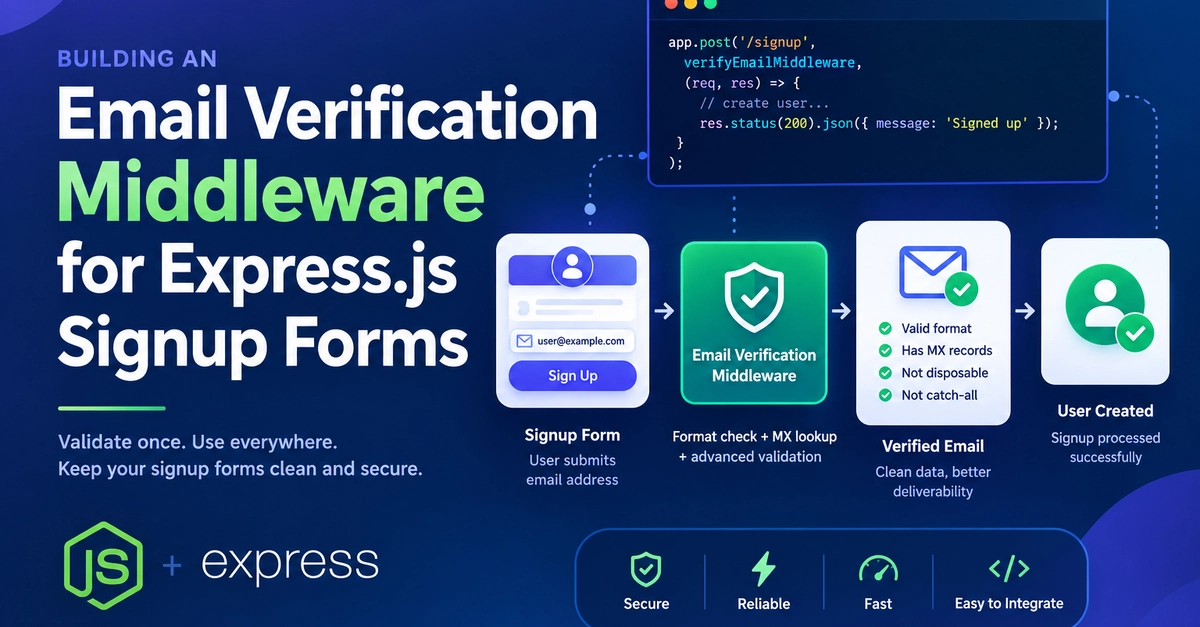
The solution involves creating a dedicated middleware function that encapsulates the email validation process. This middleware can then be applied to any route that needs to verify the format and validity of an email address before proceeding. This promotes the DRY (Don't Repeat Yourself) principle, making the codebase cleaner and more maintainable.
Here’s how you can structure the middleware. We’ll assume a basic Express.js setup. The middleware will receive the request object, response object, and the `next` function. It will check for an `email` property in the request body. If present, it performs the validation; otherwise, it passes control to the next middleware or route handler.
First, let's define the middleware function. This example uses a simple check for the presence of '@' and '.' characters, but in a production environment, you would likely use a more robust regular expression or an external email verification service.
const express = require('express');
const router = express.Router();

function validateEmail(req, res, next) {
  const email = req.body.email;

  if (!email) {
    return res.status(400).json({ message: 'Email is required' });
  }

  // Basic regex for email format validation
  const emailRegex = /^[a-zA-Z0-9._%+-]+@[a-zA-Z0-9.-]+\.[a-zA-Z]{2,}$/;
  if (!emailRegex.test(email)) {
    return res.status(400).json({ message: 'Invalid email format' });
  }

  // If validation passes, proceed to the next middleware or route handler
  next();
}

module.exports = validateEmail;
This middleware first checks if an email is provided in the request body. If not, it sends a 400 Bad Request response. If an email is present, it then uses a regular expression to check for a common email format. If the format is invalid, another 400 response is sent. Only if both checks pass does the middleware call `next()`, allowing the request to proceed to the intended route handler.
Integrating Middleware into Express Routes
Integrating this middleware into your Express.js application is straightforward. You simply import the middleware function and include it in the route definition before your final handler. This is where the benefit of middleware truly shines.
For instance, to protect the `/signup` route, you would do the following:
const express = require('express');
const router = express.Router();
const validateEmail = require('./middleware/validateEmail'); // Assuming middleware is in this path

router.post('/signup', validateEmail, async (req, res) => {
  const { email, password } = req.body;

  // At this point, we know the email is valid and present.
  // Proceed with user creation logic here...
  console.log(`Creating user with email: ${email}`);
  res.status(201).json({ message: 'User created successfully' });
});

module.exports = router;
Notice how the inline validation logic is completely removed from the `/signup` route handler. The `validateEmail` middleware is placed as the second argument to `router.post()`. If `validateEmail` calls `next()`, the request proceeds to the anonymous `async (req, res)` function. If `validateEmail` sends a response (due to validation failure), the route handler is never reached. This pattern can be replicated for any other routes requiring email validation, such as `/invite` or `/admin/add-user`.
Enhancements and Production Considerations
While the provided middleware offers a solid foundation, production applications often require more sophisticated email verification. This can include:
- Advanced Regex: Employing more comprehensive regular expressions to catch a wider range of invalid formats, although perfect email validation via regex is notoriously difficult.
- Domain Existence Checks: Verifying that the domain part of the email address actually exists and has MX (Mail Exchanger) records.
- Disposable Email Address (DEA) Detection: Identifying and blocking emails from temporary or disposable email services, which are often used for spam or fraudulent signups.
- External Verification Services: Integrating with third-party email verification APIs (e.g., ZeroBounce, Hunter.io, Kickbox). These services perform deep checks, including syntax validation, MX record lookup, SMTP checks, and even role account detection, providing higher accuracy.
When integrating external services, the middleware would make an API call, await the result, and then either proceed or return an error based on the service's response. This adds an asynchronous step to the middleware, requiring careful handling of Promises and potential network latency.
The surprising detail here is not the complexity of building a basic validator, but the vast array of edge cases and potential for abuse that simple inline validation overlooks. Relying solely on client-side validation is insufficient; server-side middleware is essential for robust security and data integrity.
Conclusion
By abstracting email validation into a reusable Express.js middleware, developers can significantly reduce code duplication, improve maintainability, and ensure consistent validation across their application. This approach is a fundamental step towards building more robust and secure signup flows, preventing common errors and enhancing the overall user experience by ensuring data quality from the outset.