The Core Concept: Events Over Commands
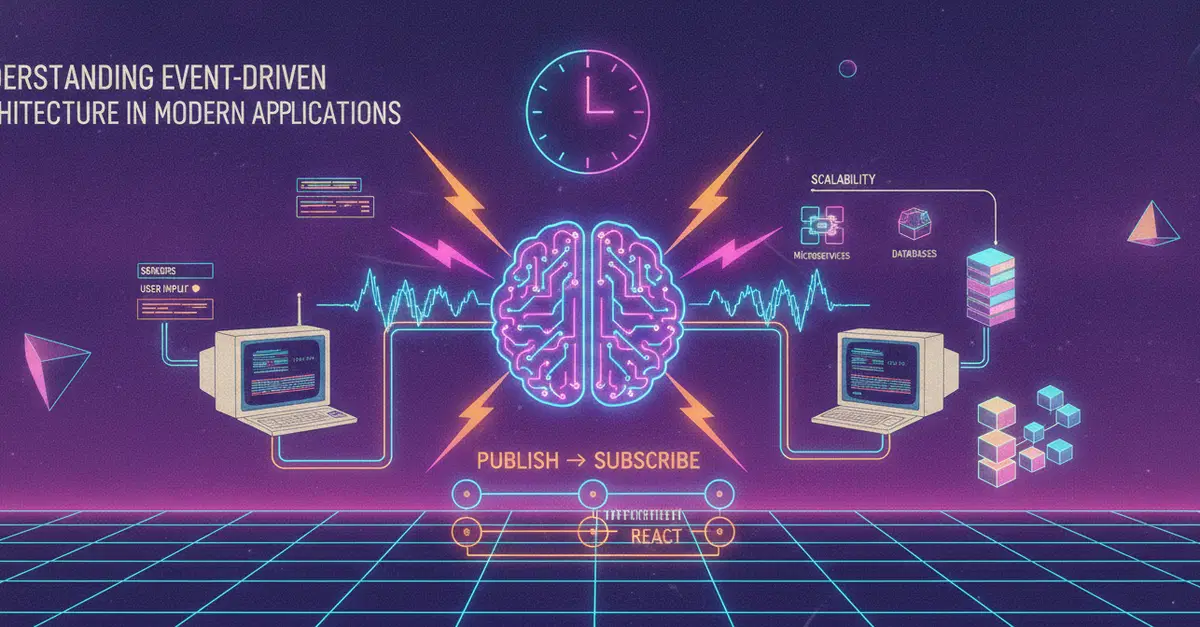
Modern software development increasingly demands systems that are not just fast, but also adaptable and resilient. Traditional request-response models, where a client explicitly asks a server for something and waits for a direct answer, can create bottlenecks and tightly coupled dependencies. Event-Driven Architecture (EDA) offers a powerful alternative. Instead of a direct command, services communicate by emitting and reacting to events – immutable facts about something that has happened.
Consider the difference. In a request-response flow, a user action might trigger a server to perform a series of tasks and then return a result. With EDA, the user action simply generates an event. Other services, interested in that specific event, can then independently subscribe and react to it. This decoupling is fundamental.
What Constitutes an Event?
An event is a record of an occurrence. It’s a statement of fact that something has transpired. Examples are plentiful across application domains:
- A user registers for an account.
- A product is added to a shopping cart.
- An order is placed.
- A payment is processed.
- A sensor reading exceeds a threshold.
- A file is uploaded.
Each event typically carries data relevant to the occurrence. For instance, a USER_REGISTERED event might include the new user’s ID, registration timestamp, and perhaps an email address. Crucially, the service that emits the event doesn’t need to know, or even care, which other services will consume it. It simply announces, “This happened.”
Key Components of an EDA
Event-Driven Architecture typically involves several key components:
Event Producers
These are the sources of events. They detect changes or occurrences and generate event messages. A web server handling a user signup, a payment gateway confirming a transaction, or an IoT device reporting a status change are all examples of event producers. They are responsible for publishing events to an event broker or directly to interested consumers, though the former is more common for scalability and decoupling.
Event Consumers (Subscribers)
These are services that subscribe to specific types of events. When an event they are interested in occurs, they receive it and perform a corresponding action. For example, an email service might subscribe to USER_REGISTERED events to send a welcome email, while a CRM system might subscribe to the same event to create a new customer record. Consumers operate asynchronously, meaning they don't block the producer or other consumers.
Event Channels (Brokers/Buses)
This is the middleware that facilitates communication between producers and consumers. Event channels act as intermediaries, receiving events from producers and routing them to the appropriate consumers. Popular examples include message queues (like RabbitMQ, ActiveMQ), streaming platforms (like Apache Kafka, Amazon Kinesis), and pub/sub systems (like Google Cloud Pub/Sub, Azure Service Bus Topics). These channels ensure that producers and consumers don't need direct connections, providing a layer of abstraction and resilience.
Benefits of Event-Driven Architecture
Adopting EDA brings significant advantages:
Decoupling and Modularity
Services in an EDA are loosely coupled. Producers don't need to know about consumers, and consumers don't need to know about producers. This makes it easier to add, remove, or update services without impacting others, fostering a more modular and maintainable system. If your order processing service needs to be replaced, only the event producer and the new service need to be aware of the change; other services reacting to order events remain unaffected.
Scalability and Elasticity
EDA naturally supports horizontal scaling. If a particular event type becomes high-volume, you can simply deploy more instances of the consumer service to handle the load. The event channel can buffer events, ensuring no data is lost during peak times or temporary service outages. This makes applications more elastic, able to scale up or down automatically based on demand.
Resilience and Fault Tolerance
When a consumer service fails, the event channel can hold onto the events until the service recovers or until an alternative consumer can pick them up. Producers can continue emitting events without interruption. This inherent resilience prevents cascading failures that can plague tightly coupled systems.
Real-time Responsiveness
EDA excels in scenarios requiring immediate reactions to changes. Applications can be designed to respond to events as they happen, enabling real-time data processing, live updates, and dynamic adjustments to system behavior. This is crucial for modern applications dealing with high-velocity data streams or user interactions.
When to Consider EDA
EDA is particularly well-suited for:
- Microservices architectures where services need to communicate asynchronously.
- Applications requiring high scalability and availability, such as e-commerce platforms, financial trading systems, or IoT data processing.
- Systems needing to integrate disparate applications or components.
- Real-time analytics and monitoring dashboards.
- Complex workflows involving multiple steps and potential retries or human intervention.
While powerful, EDA introduces its own complexities, such as managing event consistency, debugging distributed flows, and handling potential duplicate events. However, for applications demanding agility, scalability, and resilience, the benefits often outweigh these challenges.