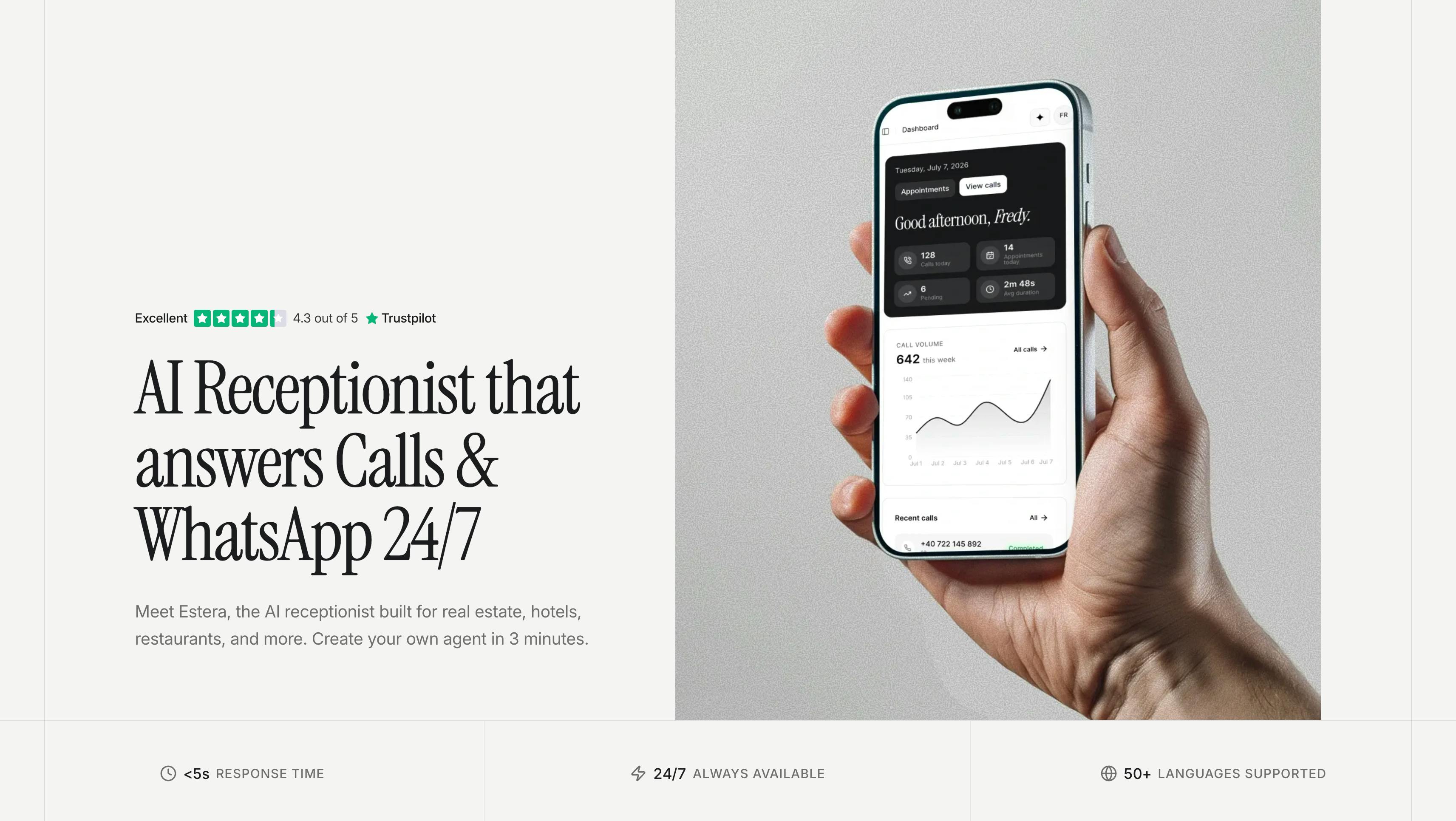
Introducing Estera: The AI Receptionist
Estera has launched an AI-powered receptionist designed to manage inbound customer communications across both phone calls and WhatsApp. The service aims to provide businesses with a consistent, 24/7 front-line support system, freeing up human staff from repetitive inquiries and ensuring no customer query goes unanswered, regardless of the time or channel.
The core proposition of Estera is to automate the initial point of contact for businesses. In an era where customer expectations for immediate service are high, a dedicated AI receptionist can serve as a crucial first line of defense. This technology seeks to emulate the role of a human receptionist by greeting callers, understanding their needs, and routing them appropriately, or even handling simple requests directly.
The platform integrates with existing business phone systems and WhatsApp Business API. This allows Estera to operate within a company's established communication infrastructure. For voice calls, the AI is trained to understand natural language, respond to common questions, take messages, and schedule appointments. On WhatsApp, it can handle similar inquiries, provide instant responses to FAQs, and manage customer interactions via text.
Key Features and Functionality
Estera’s AI receptionist is built with several key features intended to mimic and enhance the capabilities of a human receptionist.
24/7 Availability
One of the primary benefits highlighted is the AI's round-the-clock availability. Unlike human receptionists who work set hours, Estera operates continuously, ensuring that businesses can offer support and information to customers at any time, across different time zones. This constant availability can be a significant advantage for businesses with a global customer base or those operating in industries that demand continuous service.
Multi-Channel Support
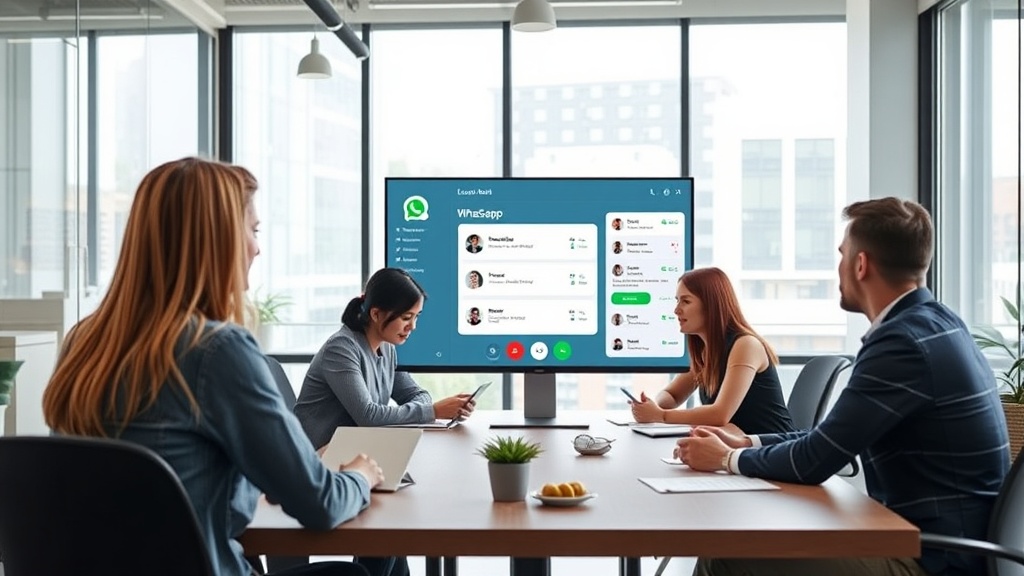
Estera supports both traditional phone calls and the increasingly popular WhatsApp messaging platform. This dual-channel approach allows businesses to meet customers where they are. Many customers prefer messaging for quick queries, while others may still opt for a phone call for more complex issues or personal preference. By covering both, Estera aims to provide a comprehensive communication solution.
The AI's ability to switch context between different communication channels is a critical aspect of its design. For instance, if a customer initially contacts via WhatsApp with a question that requires more detailed explanation or a voice conversation, the AI could potentially facilitate a smooth handover or offer to schedule a callback. This seamless integration across touchpoints is key to maintaining a positive customer experience.
Natural Language Understanding (NLU)
At its heart, Estera relies on advanced Natural Language Understanding (NLU) to interpret customer requests. This allows the AI to move beyond simple keyword matching and understand the intent behind a user’s query, even if phrased unconventionally. The system is designed to learn and improve over time, becoming more adept at understanding a wider range of requests and nuances in human language.
The NLU capability is crucial for the AI to effectively triage calls and messages. It needs to discern the urgency and nature of a request to provide the most appropriate response or redirection. For example, it should be able to differentiate between a customer seeking basic product information and one experiencing a critical service issue that requires immediate escalation to a human agent.
Integration and Scalability
Estera is built to integrate with existing business tools and workflows. This includes CRM systems, calendar applications, and other customer support software. The goal is to ensure that the AI receptionist functions as an extension of the business’s operations rather than an isolated tool. This integration allows for data synchronization, such as updating contact information or logging interactions directly into a CRM.
The platform is also designed to be scalable, accommodating businesses of all sizes, from small startups to larger enterprises. As a company grows and its volume of customer interactions increases, Estera can scale its capacity to handle the demand without a proportional increase in human resources. This scalability is a key economic driver for adopting AI-powered solutions.
The Competitive Landscape and Market Opportunity
The market for AI-powered customer service solutions is rapidly expanding. Numerous companies offer chatbots, virtual assistants, and automated customer support platforms. Estera enters this competitive space by focusing on the specific role of an AI receptionist that bridges both voice and messaging channels. This dual-channel strategy aims to capture a segment of the market that may be underserved by single-channel solutions.
Companies like Dialpad, RingCentral, and many others offer AI-powered voice solutions, while platforms like Intercom and Zendesk focus heavily on messaging and ticketing. Estera’s differentiator appears to be its unified approach to these two primary customer contact methods. The challenge for Estera will be to demonstrate superior performance and integration capabilities compared to specialized solutions and to convince businesses that a single AI receptionist can effectively manage both voice and text interactions.
The increasing reliance on digital communication, coupled with the ongoing need for efficient customer service, presents a significant opportunity for Estera. As businesses continue to seek ways to optimize operations and enhance customer satisfaction, AI solutions that can reliably handle front-line interactions are likely to see strong demand. The success of Estera will likely hinge on its ability to deliver a robust, reliable, and easy-to-integrate AI receptionist that genuinely reduces operational overhead and improves the customer experience.