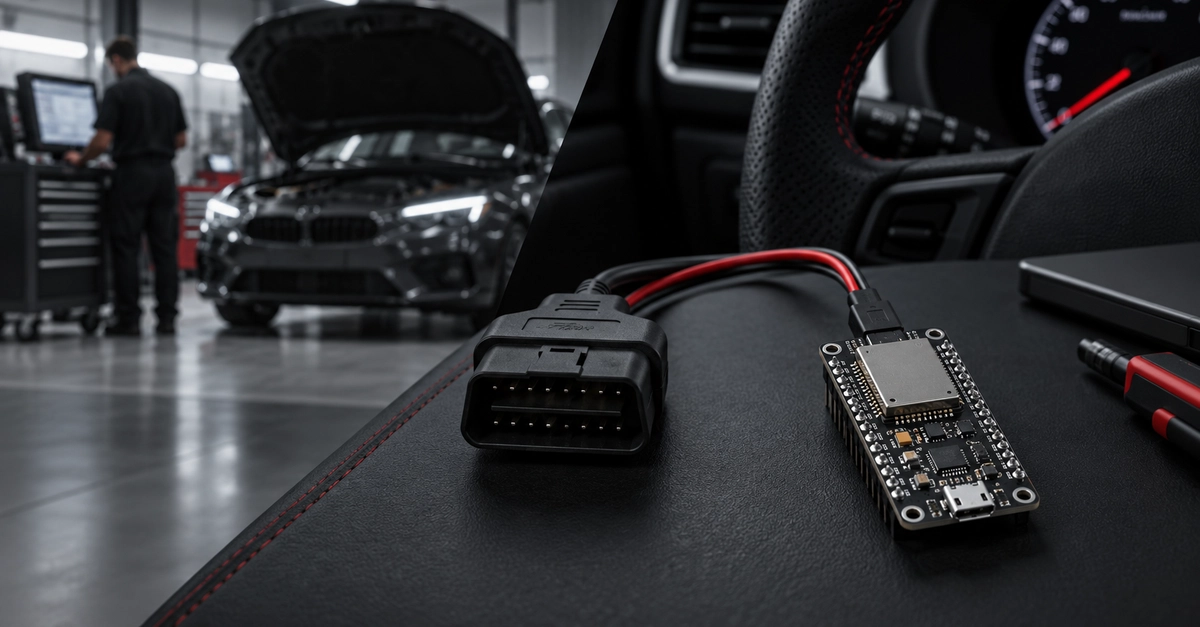
The $180 Diagnostic Hookup
Intermittent car warning lights are a special kind of automotive frustration. They appear without warning, often when you're already running late, and vanish just as mysteriously. This is exactly the problem a car owner faced, leading them to call their local dealership. The service advisor's response was predictable: "Yeah, we can get you in next Thursday. Diagnostic fee is $180. That just covers us plugging in." The sheer cost for what amounts to plugging a computer into the car's diagnostic port was the trigger.
This scenario highlights a common pain point for car owners: the high cost of basic diagnostics at dealerships. While specialized tools and trained technicians are necessary for complex repairs, a simple diagnostic scan often feels like an overpriced service. The advisor's nonchalant mention of "plugging in" underscored the perceived disconnect between the service offered and its hefty price tag.
DIY Diagnostics with an ESP32
Frustrated by the dealership's quote, the car owner turned to their personal electronics toolkit. The solution involved an ESP32-C3 microcontroller, a SN65HVD230 CAN transceiver board, and a pre-made OBD-II pigtail. The total cost for these components was negligible, reportedly less than the cost of gasoline for the trip to the dealership. The ESP32-C3, a popular choice for hobbyists and developers, offers Wi-Fi and Bluetooth connectivity, ample processing power, and a wide range of GPIO pins, making it suitable for various embedded projects. The SN65HVD230 board acts as the bridge between the microcontroller's logic-level signals and the robust, differential signaling of the Controller Area Network (CAN) bus found in most modern vehicles. The OBD-II pigtail provides the physical connection to the car's diagnostic port.
The process of setting up the ESP32 for automotive diagnostics involves understanding the OBD-II standard and the vehicle's specific CAN bus implementation. Modern vehicles use CAN bus to communicate between various Electronic Control Units (ECUs), managing everything from engine performance and emissions to braking systems and infotainment. The OBD-II port, standardized in the mid-1990s, provides a common interface to access this data. The ESP32, programmed with the appropriate libraries and protocols, can read diagnostic trouble codes (DTCs) and real-time data streams from the car's ECUs.
The Eleven-Second Diagnosis
The most striking part of this DIY diagnostic effort was its speed. While the dealership quoted $180 for a diagnostic that would presumably take some time to perform, the ESP32-based solution achieved the same goal in just eleven seconds. This rapid turnaround time underscores the efficiency of custom-built diagnostic tools for specific, recurring issues. The microcontroller, once programmed and connected, could quickly poll the relevant ECUs for fault codes. The intermittent warning light, a symptom that might have taken a dealership technician a significant amount of time to diagnose through trial and error or by relying on expensive proprietary software, was identified almost instantaneously by the ESP32.
This rapid diagnosis isn't magic; it's the result of targeted programming and readily available hardware. The ESP32, running custom firmware, can be instructed to specifically look for certain fault codes or monitor particular sensor values that are indicative of the problem. Unlike a general-purpose diagnostic tool that might require a technician to manually scroll through menus or interpret complex data, a dedicated DIY solution can be optimized for speed and relevance. The eleven-second figure serves as a powerful testament to the capabilities of low-cost microcontrollers when applied to specific, well-defined problems.
Implications for Car Owners and DIYers
The success of this ESP32-based diagnostic highlights a broader trend: the increasing accessibility of automotive diagnostics for the average consumer. As cars become more digitized, the data generated by their systems is becoming more accessible, provided one has the right tools and knowledge. This opens up possibilities for car owners to perform their own maintenance and diagnostics, saving significant money on labor costs. It democratizes a portion of automotive repair that was once exclusively the domain of dealerships and specialized repair shops.
Furthermore, this case serves as an inspiration for other car owners facing similar issues. It demonstrates that a $180 diagnostic fee can often be circumvented with a relatively small investment in hardware and a willingness to learn. Projects like this can also foster a community of automotive DIYers who share knowledge, code, and custom solutions. The car is not a magic box; it's a complex network of sensors and actuators. Understanding its underlying network, like the CAN bus, and leveraging affordable microcontrollers can empower owners to take more control over their vehicle's maintenance and repair. The $180 fee for a simple scan is, in this context, an opportunity for innovation and cost savings.
The Unanswered Question: Wider Adoption?
What remains to be seen is how widely this DIY approach will be adopted. While this specific instance showcases a successful application for an intermittent warning light, the complexity of modern automotive systems means that not all diagnostics are so straightforward. Will more car owners invest the time to learn about CAN bus and microcontroller programming, or will the convenience of dealership diagnostics, despite the cost, continue to prevail? The gap between the $180 dealership fee and the DIY cost is a powerful motivator, but the technical barrier, though lower than ever, still exists for many.