The Silent Threat: Delegation Escalation
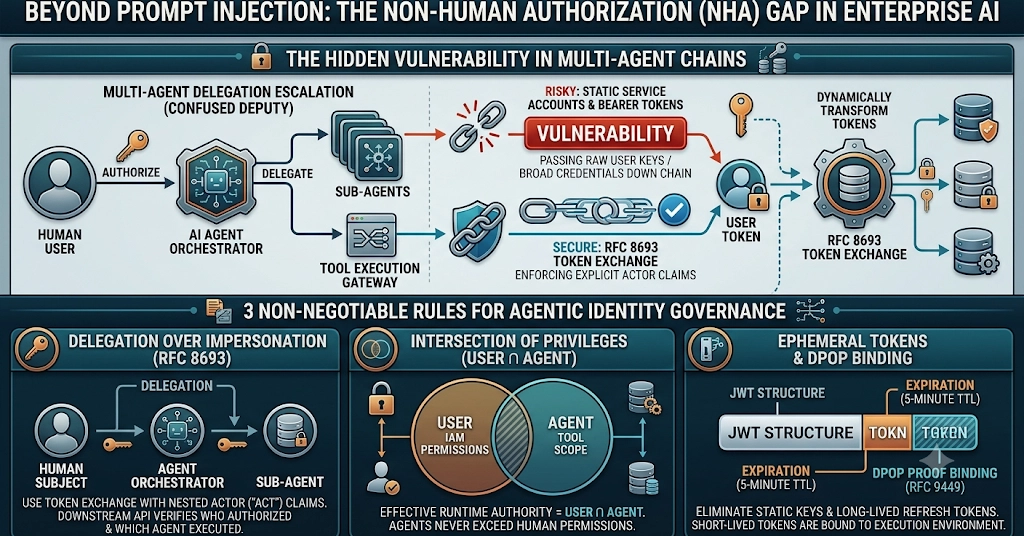
The current focus on prompt injection in enterprise AI, while important, overlooks a more fundamental and pervasive security risk: Delegation Escalation. This vulnerability emerges not from malicious user inputs, but from the very architecture of modern, multi-agent AI systems. When a primary AI agent, orchestrated to perform complex tasks, delegates work to subordinate agents or external tools via internal APIs or protocols like Message Queueing Telemetry Transport (MQTT), it often relies on static credentials or broad bearer tokens. This practice, common in traditional IT but ill-suited for dynamic AI interactions, creates a potent 'Confused Deputy' problem. The deputy (a sub-agent or tool) is given more authority than it should have, potentially acting on behalf of the orchestrator with permissions far exceeding its intended function, leading to unauthorized actions or data breaches.
Consider a scenario where a finance department's AI orchestrator, authorized by a human user with specific `read:finance` permissions, delegates a task to an automated reporting sub-agent. If this sub-agent is passed the same broad bearer token or a static user API key used by the orchestrator, it could, intentionally or unintentionally, use that token to access sensitive HR or operational data it was never meant to see. This isn't a matter of tricking the AI with clever prompts; it's a systemic failure in how authorization is managed across interconnected AI components.
Understanding the Non-Human Authorization Flow
To address Delegation Escalation, we must move beyond human-centric authorization models and embrace Non-Human Authorization (NHA). The core of this approach lies in properly managing the credentials and permissions passed between AI agents and tools. In a secure NHA flow, the process begins with human user authorization. A user authenticates to the primary AI Orchestrator and grants it a specific, bounded scope of permissions. For instance, a user might grant the orchestrator `read:finance` and `submit:expenses` permissions, but nothing else.
The critical step follows: Token Exchange. Instead of passing the original, broad user token down the chain, the primary orchestrator must use a mechanism like OAuth 2.1 RFC 8693 Token Exchange. This protocol allows the orchestrator to request a new, short-lived, and narrowly scoped token from an authorization server. This new token represents the delegated authority to the sub-agent but is explicitly tied to the sub-agent's identity and the specific task it needs to perform. Crucially, this token includes actor claims, which clearly identify both the original subject (the human user) and the actor performing the action (the sub-agent). This ensures that even if a sub-agent is compromised or behaves unexpectedly, its actions are auditable and its permissions are limited to the immediate task, preventing it from exploiting the broader privileges of the original user or orchestrator.
Why Traditional Service Accounts Fail
Traditional enterprise security relies heavily on static service accounts or long-lived API keys. These work adequately for predictable, machine-to-machine communication where the identity and scope of the caller are static and well-defined. However, multi-agent AI systems are inherently dynamic. An orchestrator might invoke dozens of different sub-agents and tools in a single user session, each with varying requirements. Passing a single, static service account credential down this chain is akin to giving every employee in a company a master key to the entire building. If one employee misuses their key, or if the key is stolen, the entire organization is compromised. In the AI context, this static credential becomes a single point of failure, allowing a compromised sub-agent to escalate its privileges and access sensitive data or perform unauthorized actions across the entire system. The Confused Deputy problem is almost guaranteed when static credentials are used for dynamic delegation.
Implementing Secure Delegation with OAuth 2.1 Token Exchange
The solution lies in adopting modern authorization protocols designed for dynamic, delegated access. OAuth 2.1, specifically the Token Exchange extension (RFC 8693), provides the necessary framework. When an orchestrator needs to delegate a task to a sub-agent, it doesn't pass its own credentials or the user's credentials directly. Instead, it acts as a client to an authorization server, requesting a new token. This request specifies the audience (the sub-agent), the requested scope (the minimal permissions needed for the task), and importantly, includes the original actor's assertion (the human user's identity and initial authorization). The authorization server then issues a new token that:
- Is specific to the sub-agent.
- Grants only the necessary permissions for the immediate task.
- Contains actor claims identifying both the originating user and the acting sub-agent.
This granular, context-aware approach ensures that each interaction is authorized and auditable. If a sub-agent attempts to perform an action outside its granted scope, the authorization server or the target resource can deny the request. This is the architectural shift required to build secure, scalable autonomous AI systems. It treats each AI agent, sub-agent, and tool as a distinct entity with its own authorization context, rather than a generic extension of the initial user's privileges.
Beyond Prompt Injection: The Future of Enterprise AI Security
While prompt injection attacks exploit weaknesses in how AI models interpret natural language inputs, Delegation Escalation exploits fundamental flaws in how these systems manage trust and authorization across their distributed components. As enterprises increasingly deploy complex, multi-agent AI workflows, securing the delegation of authority becomes paramount. Implementing OAuth 2.1 Token Exchange with explicit actor claims is not merely a best practice; it is a foundational requirement for building resilient, secure, and scalable enterprise AI. Ignoring this non-human authorization gap leaves organizations exposed to significant risks that static security models cannot adequately address.
What remains to be seen is the widespread adoption and robust implementation of these advanced authorization protocols by AI platform vendors and enterprise IT departments. The transition from legacy credential management to dynamic, token-exchange-based authorization requires significant architectural changes and a shift in security mindset. Without this evolution, the promise of autonomous AI agents in enterprise settings will be severely curtailed by the fear of unchecked delegation.