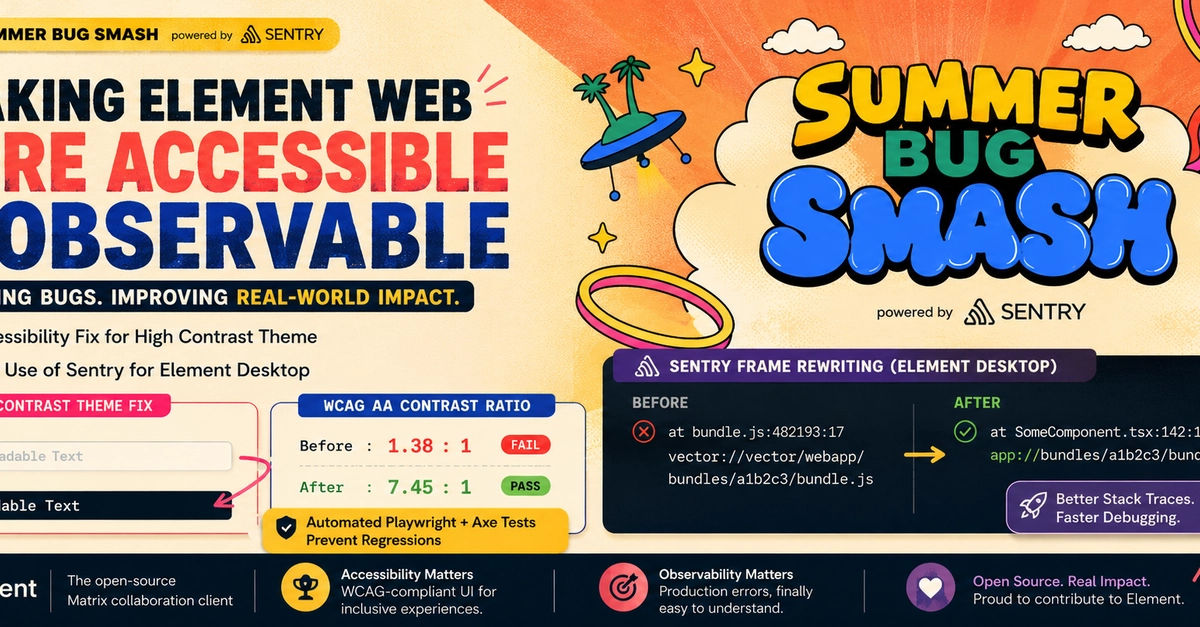
Element Web Enhances Accessibility and Observability
Element Web, the leading open-source client for the decentralized Matrix communication protocol, has undergone significant improvements focused on both user accessibility and developer observability. This initiative, part of DEV's Summer Bug Smash powered by Sentry, addresses critical issues including a high-contrast regression affecting visual accessibility and enhances the debugging capabilities within the platform.
Element Web is a large-scale TypeScript monorepo providing the web interface for Matrix. It supports a wide array of features, from real-time messaging and room management to integrations, moderation, and built-in accessibility tools. The project's complexity and architecture make it an ideal candidate for focused development sprints aimed at refining user experience and developer tooling.
Addressing High-Contrast Accessibility Regression
A key focus of the recent development effort was rectifying a regression in the high-contrast mode. High-contrast settings are vital for users with visual impairments, ensuring readability and usability of the interface. When this feature malfunctions, it can render the application difficult or impossible to use for a significant user base.
The bug involved an issue where certain elements within the UI were not displaying correctly when the high-contrast theme was enabled. This could lead to elements blending into the background, missing crucial visual cues, or generally disrupting the intended user experience for those relying on this accessibility feature. The fix involved careful inspection of the UI components and their associated styling to ensure they adhered to high-contrast requirements. This meticulous work ensures that Element Web remains usable and inclusive for a broader range of users.
Improving Sentry Debugging for Enhanced Observability
Beyond direct user-facing accessibility, the project also prioritized improving the developer experience through enhanced observability, specifically by refining Sentry integration. Sentry is a popular error tracking and performance monitoring tool that provides developers with insights into application stability and performance in production environments.
The improvements focused on making Sentry debugging more effective for the Element Web codebase. This involved ensuring that errors captured by Sentry provided sufficient context for developers to quickly diagnose and resolve issues. For a large, complex application like Element Web, detailed error reporting is paramount. This can include correctly mapping errors back to the specific TypeScript source code, providing accurate stack traces, and enriching error events with relevant user or application state information. By improving Sentry's debugging capabilities, the development team can more rapidly identify and fix bugs, leading to a more stable and reliable application for all users.
This dual focus on accessibility and observability reflects a mature approach to software development. It acknowledges that a robust application requires not only a user-friendly interface but also efficient tools for its creators. The work done during the Summer Bug Smash directly contributes to both these pillars, making Element Web a stronger, more inclusive, and more maintainable platform.
The Broader Context: Web Accessibility and Legal Compliance
The ongoing emphasis on web accessibility, as highlighted by the impending deadlines for regulations like the European Accessibility Act (EAA) and the US Department of Justice's ADA Title II rule, underscores the critical importance of such initiatives. The EAA, enforced since June 2025, mandates accessibility for products and services sold to EU customers, regardless of the company's location. In the US, public bodies must meet WCAG 2.1 Level AA by April 2026, with private sector lawsuits on the rise.
These regulations carry significant financial implications. EAA penalties can reach 5% of annual turnover for large companies, and ADA complaints can result in substantial settlement costs even before remediation. The widely recognized standard, WCAG 2.1 AA, is achievable, but common shortcuts like accessibility overlay widgets often fail to meet legal requirements and can even complicate a company's legal standing. The work on Element Web, therefore, is not just about improving user experience but also about ensuring compliance with evolving legal landscapes.
By proactively addressing accessibility regressions and strengthening debugging tools, Element Web demonstrates a commitment to building a robust and inclusive platform that is prepared for future demands and legal standards. This approach ensures that the client remains a leading choice for secure, decentralized communication, catering to a diverse user base while providing developers with the tools they need to maintain and improve the system.