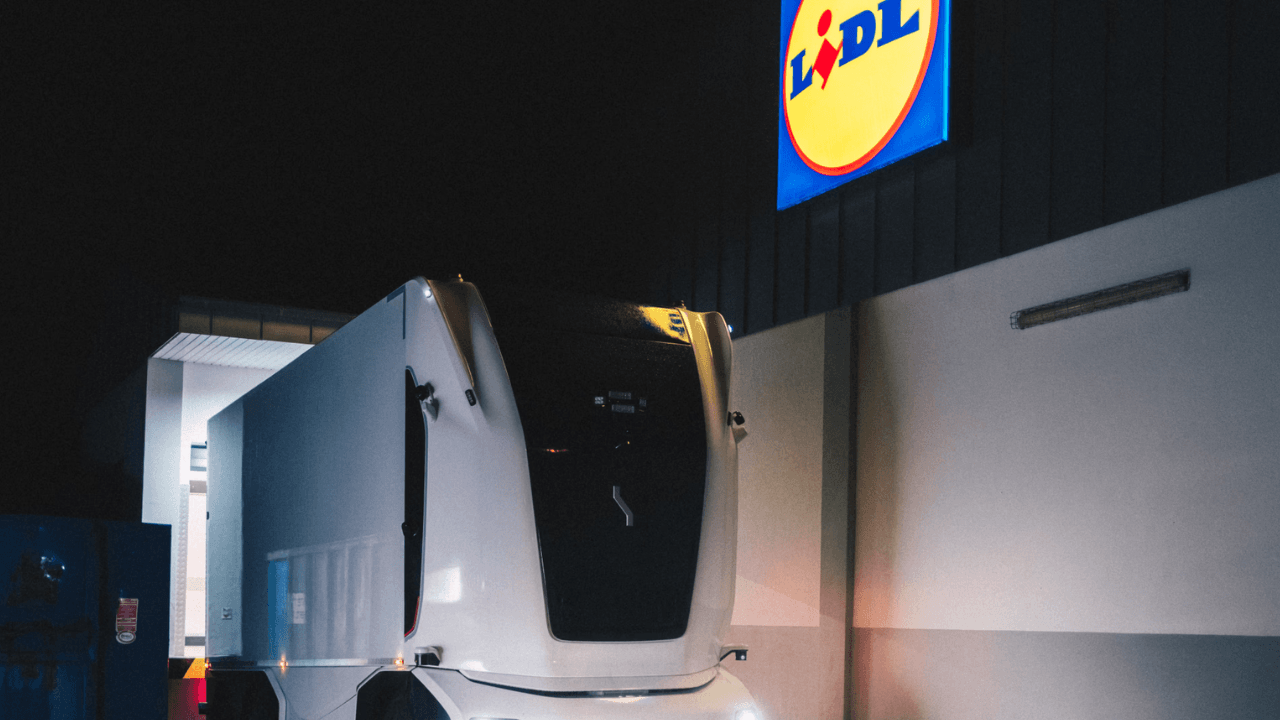
Autonomous Logistics in Action
Einride, the Swedish company pioneering autonomous, electric trucking, has partnered with German food retailer Lidl to deploy Germany’s first cab-less, SAE Level 4 autonomous truck in daily operations. This marks a significant step in the adoption of autonomous vehicles for commercial logistics within Germany. The truck will operate on a dedicated route for Lidl’s logistics network, transporting goods between a distribution center and a store in the Jönköping region of Sweden. While the initial deployment is in Sweden, the announcement signifies a crucial milestone for autonomous trucking in the broader European market, with Germany being a key player in the automotive and logistics sectors.
The vehicle in question is Einride’s Gen 2 autonomous electric truck, specifically designed to operate without a human driver onboard. This cab-less design is central to Einride’s strategy, allowing for a more optimized and potentially more cost-effective logistics solution. The truck’s autonomous capabilities are managed by Einride’s proprietary software platform, which handles navigation, control, and remote monitoring. The operational deployment with Lidl means the truck is not just a demonstration or test vehicle; it is integrated into a real-world supply chain, performing actual transport tasks as part of a regular schedule. This transition from testing to daily operations on public roads, even on a controlled route, underscores the maturity of the technology and the growing confidence of major retailers in autonomous solutions.
Technological Underpinnings and Operational Safety
The deployment leverages Einride’s SAE Level 4 autonomous technology, meaning the vehicle can handle all driving tasks under specific operational design domains (ODDs) without human intervention. For this particular operation, the ODD is defined by the fixed route, speed limits, and the controlled environment of the logistics network. Safety is paramount, and the vehicle is equipped with a comprehensive suite of sensors, including lidar, radar, and cameras, to perceive its surroundings. These sensors provide redundant data streams, allowing the autonomous system to make informed decisions even in complex scenarios. A remote operator is available to monitor the vehicle’s progress and can intervene if necessary, though the goal is for the autonomous system to manage all situations within its ODD.
Einride’s platform includes a central control center where human operators can oversee multiple autonomous trucks simultaneously. This remote oversight is crucial for managing exceptions, ensuring compliance with traffic laws, and providing a layer of safety beyond the vehicle’s onboard systems. The integration with Lidl’s existing logistics infrastructure aims to streamline operations, reducing the need for manual loading and unloading processes and potentially shortening delivery times. The choice of a cab-less design also offers potential benefits in terms of vehicle packaging and efficiency, as the space typically occupied by a driver’s cab can be reconfigured for cargo or other functions.
Market Implications and Future Outlook
This deployment is more than just a partnership; it’s a signal to the broader logistics industry. For Lidl, integrating autonomous trucks could lead to significant cost savings and increased efficiency in its supply chain. Reduced labor costs, optimized routing, and the potential for 24/7 operation are all attractive propositions. For Einride, this represents a critical validation of its technology and business model. Moving from pilot projects to sustained, daily operations with a major retailer like Lidl demonstrates a clear path to commercial viability. The involvement of a company like Lidl, a prominent player in the European retail landscape, lends credibility to the autonomous trucking sector.
The successful operation of this cab-less truck on public roads in a market as significant as Germany (even if the initial route is in Sweden, the announcement targets the German market's interest) paves the way for wider adoption. It addresses regulatory hurdles and public perception by showcasing a practical, safe application of the technology. What remains to be seen is the scalability of this solution. Can these cab-less trucks be deployed on more complex, varied routes, and in different weather conditions? The current deployment is on a fixed, presumably well-mapped route, which is a controlled environment. Expanding to dynamic, unpredictable road networks will require further advancements in AI and sensor technology, as well as continued regulatory evolution.
The collaboration between Einride and Lidl highlights a growing trend: established companies leveraging cutting-edge technology to optimize their operations and gain a competitive edge. This isn't just about replacing human drivers; it's about fundamentally rethinking logistics to be more efficient, sustainable, and cost-effective. The cab-less design, in particular, is a bold move that challenges traditional truck design and operational paradigms. It suggests a future where logistics vehicles are purpose-built for automation from the ground up, rather than retrofitting existing designs. This initial deployment is a concrete example of that future beginning to materialize, offering a glimpse into the next era of freight transportation.