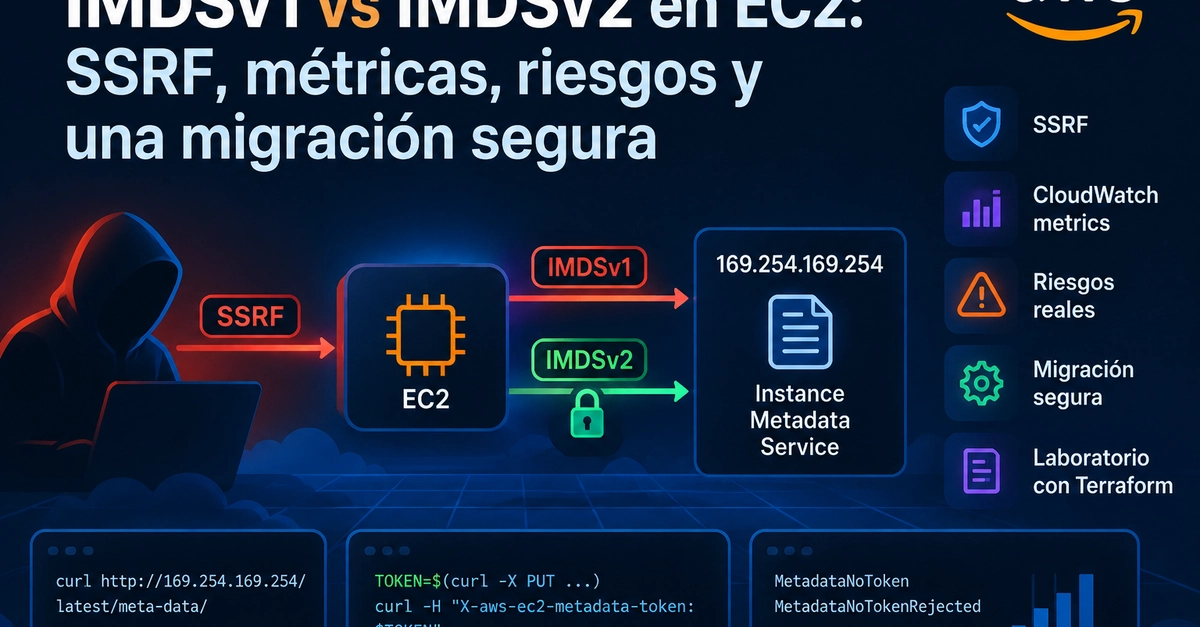
The Hidden Dangers of EC2 Instance Metadata Service v1
The Capital One breach in 2019 was a stark reminder: the EC2 Instance Metadata Service (IMDS) is a critical component of cloud security. When compromised, it can lead to severe data leaks, affecting millions. At the heart of this risk lies IMDSv1, a protocol that, while convenient, presents significant security vulnerabilities, primarily through Server-Side Request Forgery (SSRF). Migrating to IMDSv2 is not merely a best practice; it's a necessary step to fortify your AWS infrastructure.
IMDS provides access to instance-specific data such as instance ID, public keys, security groups, and crucially, IAM role credentials. IMDSv1 allows direct, unauthenticated access to this sensitive information. This lack of authentication is precisely what attackers exploit. By tricking an application running on an EC2 instance into making a request to the IMDS endpoint (typically 169.254.169.254), an attacker can exfiltrate these credentials. Imagine a poorly secured web application that accepts user-provided URLs. An attacker could submit a URL pointing to the IMDS endpoint, and if the application fetches content from that URL, the attacker could potentially gain access to temporary credentials. These credentials can then be used to access other AWS services, leading to a full-blown compromise, as seen in the Capital One incident.
Understanding the IMDSv1 Vulnerability: SSRF Explained
Server-Side Request Forgery (SSRF) is a web security vulnerability that allows an attacker to induce the server-side application to make HTTP requests to an arbitrary domain of the attacker's choosing. In the context of EC2, IMDSv1 is particularly susceptible. If an application on your EC2 instance makes an outbound request based on user input (e.g., fetching an image from a URL provided by a user, or making an API call to an external service), an attacker can manipulate this input to point to the IMDS endpoint (169.254.169.254). Since IMDSv1 does not require any form of authentication or session management for these requests, the instance's metadata, including temporary credentials, is returned directly to the attacker.
The implications are dire. With valid IAM credentials, an attacker can perform any action permitted by the instance's IAM role. This could range from reading sensitive data from S3 buckets to launching new resources, modifying security configurations, or even escalating privileges within your AWS account. The Capital One breach, where an attacker leveraged a misconfigured web server and IMDSv1 to access sensitive customer data, serves as a chilling case study. The attacker didn't need to break into Capital One's network directly; they exploited a vulnerability in an application running on an EC2 instance to steal the keys to the kingdom.
Introducing IMDSv2: Enhanced Security Features
AWS introduced IMDSv2 to address the security shortcomings of IMDSv1. IMDSv2 mandates a session-oriented approach, requiring a two-step process to retrieve metadata. First, a client must establish a session by making a PUT request to the IMDS endpoint with a specific `x-aws-ec2-metadata-token-ttl-seconds` header. This request returns a temporary metadata token. Second, subsequent requests to retrieve metadata must include this token in the X-aws-ec2-metadata-token header. This token has a limited TTL (Time To Live), meaning it expires and must be refreshed periodically.
This token-based authentication significantly mitigates SSRF risks. An attacker attempting to exploit an SSRF vulnerability would first need to find a way to not only trick the server into making a request to the IMDS endpoint but also to capture the ephemeral token returned by the initial PUT request. This two-step process is much harder to exploit through simple SSRF attacks. Furthermore, IMDSv2 allows you to configure a mandatory access string, requiring requests to include a specific header, adding another layer of defense.
Migration Strategies: Moving from IMDSv1 to IMDSv2
Migrating from IMDSv1 to IMDSv2 is a crucial security hardening step. AWS provides flexibility to manage this transition.
Console-Based Migration
For existing instances, you can modify the metadata access configuration directly from the EC2 console. Navigate to your instance, select 'Actions' > 'Security' > 'Modify Instance Metadata Access'. Here, you can disable IMDSv1 and enforce IMDSv2. This change takes effect immediately and applies to new requests made to the IMDS endpoint.
Instance Launch Configuration
When launching new EC2 instances, you can specify the IMDS settings during the launch process. You can choose to disable IMDSv1 entirely and require IMDSv2, or allow both. It is strongly recommended to disable IMDSv1 and enforce IMDSv2 for all new instances.
Programmatic Configuration
For infrastructure as code (IaC) deployments using tools like CloudFormation or Terraform, you can define the IMDS configuration within your templates. This ensures that all newly provisioned instances adhere to your security policies. For example, in CloudFormation, you would use the MetadataOptions property within the AWS::EC2::Instance resource.
Considerations for Applications
The primary challenge during migration often lies with applications that rely on IMDSv1 for fetching credentials. These applications must be updated to support IMDSv2. This typically involves modifying the application code to perform the two-step token acquisition and then using the token in subsequent metadata requests. AWS provides SDKs that abstract much of this complexity, but existing applications might require code changes. If an application cannot be immediately updated, a transitional period where both IMDSv1 and IMDSv2 are enabled might be necessary, but the goal should always be to fully transition to IMDSv2.
Assessing the Risk: What If You Don't Migrate?
Maintaining IMDSv1 enabled on your EC2 instances leaves a significant security gap. Any application vulnerability that allows for SSRF can potentially lead to the exfiltration of temporary IAM credentials. This risk is amplified in environments where applications handle untrusted user input or make outbound network requests based on external data. The cost of a data breach, reputational damage, and potential regulatory fines far outweighs the effort required for migration. AWS has been urging customers to migrate, and while they have not yet mandated it universally, the trend is clear: IMDSv1 is a legacy feature with unacceptable risks in modern cloud environments.
The question is not if an attacker will find a way to exploit IMDSv1 in your environment, but when. By disabling IMDSv1 and enforcing IMDSv2, you significantly raise the bar for attackers, protecting your sensitive instance metadata and IAM credentials from common SSRF-based attacks.