The Core Problem: A Duplicate ID
A system designed to track in-flight work units with unique IDs accepted a duplicate entry. This seemingly minor infraction went unnoticed by the initial writer and downstream processes, leading to a cascade of issues.
The system operates on a simple premise: each unit of work is assigned a unique identifier (ID). One component, the writer, mints these IDs, ensuring they are distinct. All subsequent operations and checks rely on this uniqueness. The rule is clear: IDs must be unique. However, a scenario arose where two distinct work units were assigned the same ID, L391, but on different days.
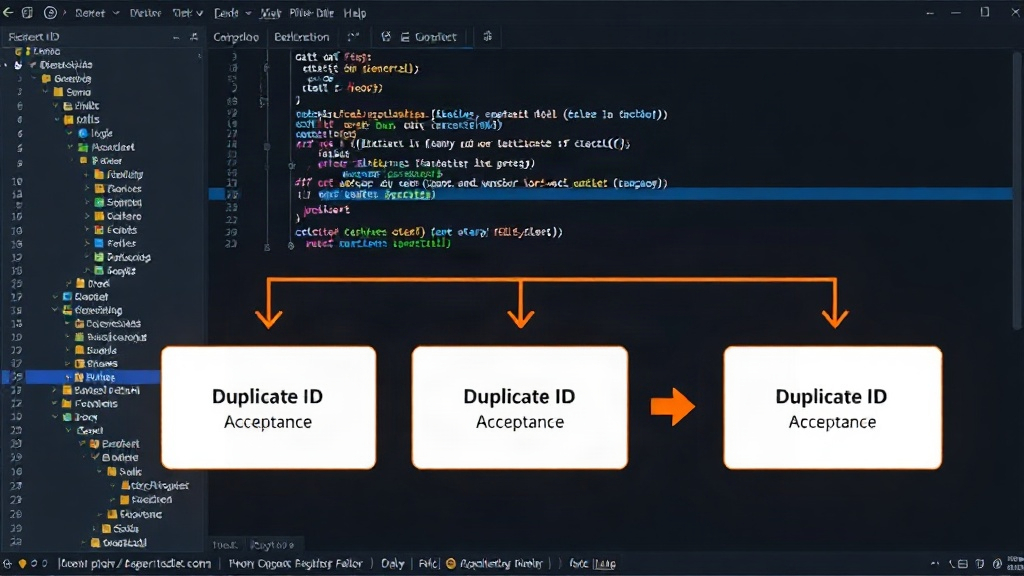
The first entry for L391 was added and presumably processed. A day later, another unit was also assigned L391. The crucial failure occurred at the add stage: the registry accepted the second L391 entry without protest. This bypasses the intended uniqueness constraint.
The Immediate Impact: Silent Acceptance
The immediate consequence was that neither the writer nor the initial processing steps flagged the duplicate ID. The add operation for the second L391 completed successfully, leaving the system with two work units bearing the same identifier. This lack of immediate error is a key factor in why the problem persisted.
When the first L391 unit was processed for landing (marked as complete or moved to the next stage), the system correctly identified and landed it. However, the second L391 remained in an in-flight state. The system's logic, which expected a unique ID for each in-flight item, did not detect the anomaly at this stage either. The land operation for the first L391 also succeeded, printing a landing confirmation, further masking the underlying data integrity issue.
The Delayed Symptom: An Unrelated Failure
The true impact of the duplicate ID surfaced much later, manifesting as an error in a different part of the system. An unrelated unit of work was attempting to proceed, but it was blocked by an overlap check. This check determined that the unit conflicted with another unit that had already been 'landed'.
The overlap check was functioning correctly, given the data it was presented with. It saw that a unit with a specific identifier (which, unbeknownst to it, was the first L391) had already landed. Therefore, it correctly refused the new unit based on the existing landed item. The failure here was not in the overlap check itself, but in the fact that the system had allowed a duplicate ID to exist and be processed, leading to this correct-but-problematic refusal.
The critical point is that the error did not appear where the duplicate ID was introduced or initially processed. It surfaced downstream, in a component that relied on the integrity of the registry's state. This delayed and indirect symptom made debugging significantly more challenging. The team was faced with an overlap error, but the root cause—the duplicate ID—was buried in the system's history.
Why This Happens and How to Prevent It
This failure highlights a common pitfall in distributed systems and data management: the assumption of data integrity at every step. While the writer component was intended to mint unique IDs, a race condition or a bug in its logic, or perhaps a flaw in how uniqueness was enforced by the underlying storage, allowed the duplicate. The downstream systems, designed with the expectation of unique IDs, eventually encountered a state that violated this assumption.
Preventing such issues requires a multi-layered approach to ID generation and validation:
- Robust ID Generation: Ensure the ID minting process itself is highly resilient to race conditions and errors. Using universally unique identifiers (UUIDs) or other cryptographically secure random number generators can significantly reduce the probability of collisions, though not eliminate it entirely for extremely high-volume systems.
- Strict Enforcement at Ingestion: The registry's ingestion point (the
addoperation) must have a hard check for existing IDs. If a duplicate is detected, it should immediately reject the new entry with a clear error, not silently accept it. This is the most critical point of failure in this scenario. - Periodic Auditing: Implement background jobs or scheduled checks that scan the registry for duplicate IDs. This acts as a safety net for any IDs that might have slipped through the primary validation.
- Idempotency and Reconciliation: Design downstream processes to be idempotent where possible, meaning they can be run multiple times without changing the outcome beyond the initial run. For critical state changes like 'landing', robust reconciliation mechanisms can help detect and correct inconsistencies.
- Clear Error Propagation: Ensure that errors, even those that seem minor at ingestion, are logged and potentially alerted upon. A silent failure at the
addstage is far more dangerous than a loud, immediate rejection.
The incident serves as a stark reminder that even seemingly simple components like ID assignment require rigorous design and validation. The consequence of a duplicate ID was not an immediate crash, but a delayed, confusing failure in a separate system, underscoring the importance of end-to-end data integrity checks and robust error handling in complex software architectures.