Droid ASC: A New Paradigm in Android Reverse Engineering
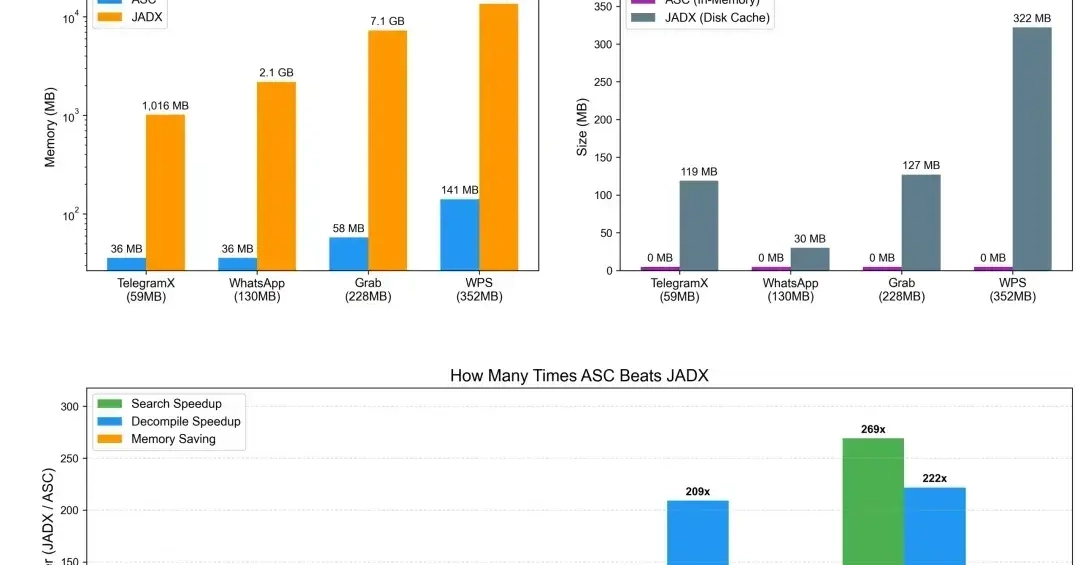
The landscape of Android reverse engineering and mobile security testing has a new, high-performance contender: Droid ASC. Developed with a focus on speed and efficiency, this open-source tool offers a significant leap forward from traditional decompilers like jadx. Droid ASC drastically reduces memory consumption, by up to two orders of magnitude, and eliminates the need for disk caching. This architectural shift enables decompilation in mere seconds and search operations in milliseconds, a critical advantage when dealing with large, complex Android applications.
Its performance gains are not accidental. Droid ASC leverages several key innovations. Zero indexing means the tool can start processing without needing to build an entire index of the application first. On-demand decompression ensures that only necessary components are decompressed as they are accessed, further saving resources. Crucially, it harnesses R8 optimization, the same technology used to shrink and obfuscate Android apps for production, to accelerate its own analysis processes. This combination makes Droid ASC particularly potent for tasks such as screening for sensitive information across vast codebases and mapping the API attack surface of mobile applications.
The tool is explicitly recommended for authorized testing scenarios, targeting professionals such as red teamers, Security Response Centre (SRC) operations, and those involved in emergency response. Its efficiency means faster turnarounds for vulnerability discovery and security assessments, crucial in time-sensitive situations.
Core Advantages and Technical Innovations
Droid ASC’s primary advantage stems from its fundamental departure from the memory and disk-intensive methods of older decompilers. By eliminating disk caching entirely and optimizing memory usage, it redefines what’s possible for analyzing large Android applications. Traditional tools often struggle with applications exceeding several hundred megabytes, requiring significant RAM and disk space. Droid ASC’s approach allows it to handle such applications with remarkable speed and a fraction of the resource footprint.
The concept of zero indexing is central to its speed. Instead of pre-processing the entire application to build an index, Droid ASC begins analysis immediately. This is akin to a search engine that starts delivering results as you type, rather than waiting for you to finish your query. On-demand decompression further refines this by only unpacking code and resources when they are actively being examined. This is particularly effective for large applications where only a subset of the code might be relevant for a specific security test.
Leveraging R8 optimization is a clever move. R8 is designed to make Android apps smaller and faster for end-users by performing code shrinking, obfuscation, and optimization. Droid ASC employs R8’s capabilities not for obfuscation, but for accelerating its own analytical processes. This internal use of optimization techniques allows it to process dex files and other application components much more rapidly than tools relying on more generic parsing methods.
Use Cases and Target Audience
The efficiency and speed of Droid ASC make it an ideal tool for several critical security functions. For red teams, it enables faster reconnaissance and identification of potential entry points within an application. The ability to quickly scan for hardcoded secrets, insecure API endpoints, or vulnerable third-party libraries can significantly shorten the initial phases of an engagement.
Security Response Centres (SRCs) and incident response teams will find Droid ASC invaluable during active investigations. When a new vulnerability is disclosed or a breach is detected, the capacity to rapidly analyze affected applications for specific indicators of compromise or vulnerable code snippets can be the difference between containing an incident and widespread damage. The millisecond search times mean that security analysts can quickly pivot from an alert to understanding the specific code responsible.
For emergency response scenarios, such as zero-day exploits in mobile apps, Droid ASC offers the speed needed to perform initial impact assessments and identify immediate mitigation strategies. Its performance allows for quicker analysis of the exploit mechanism and affected components, facilitating faster patch development or workarounds.
Comparison to Traditional Tools
To understand Droid ASC’s impact, consider the typical workflow with a tool like jadx. Analyzing a large Android application with jadx often involves a lengthy process of decompilation, which can consume gigabytes of RAM and take many minutes, sometimes hours, to complete. The resulting Java code is then stored on disk, and subsequent searches, while improved over time, still rely on indexed files that can be cumbersome to manage for very large projects. This process is a bottleneck for security professionals who need rapid insights.
Droid ASC fundamentally alters this by keeping the decompiled code in memory and processing it on demand. This approach is more akin to an interactive debugger or a live analysis environment than a batch processing tool. The reduction in memory usage is particularly striking. While jadx might require 4GB or more for large apps, Droid ASC can often perform similar tasks with less than 100MB, freeing up valuable system resources for other analysis tools or the operating system itself.
The elimination of disk caching means that Droid ASC avoids the I/O bottlenecks associated with reading and writing large decompiled files. This is a critical performance factor, especially on systems with slower storage or when dealing with frequent analysis of different application versions. The speed advantage is not just marginal; it represents a qualitative shift in the user experience and the practical applicability of reverse engineering tools in time-constrained security operations.
Future Implications and Recommendations
Droid ASC’s release signals a potential shift in how Android security professionals approach their work. By democratizing high-performance reverse engineering capabilities through an open-source model, it empowers smaller teams and individual researchers to perform deeper analysis without requiring enterprise-grade hardware. The tool’s focus on speed and resource efficiency makes it a compelling option for anyone regularly dissecting Android applications.
The developers recommend using Droid ASC strictly within authorized testing environments. This is standard practice for security tools that can be used for both defensive and offensive purposes. Its capabilities, when used responsibly, can significantly enhance the security posture of Android applications by enabling more thorough and efficient vulnerability discovery.
For developers and security teams, integrating Droid ASC into their existing workflows could mean faster identification of vulnerabilities during development and a more robust approach to post-release security monitoring. Its performance metrics suggest it could become a go-to tool for routine security audits and rapid incident response, making the analysis of complex Android applications more accessible and efficient than ever before.