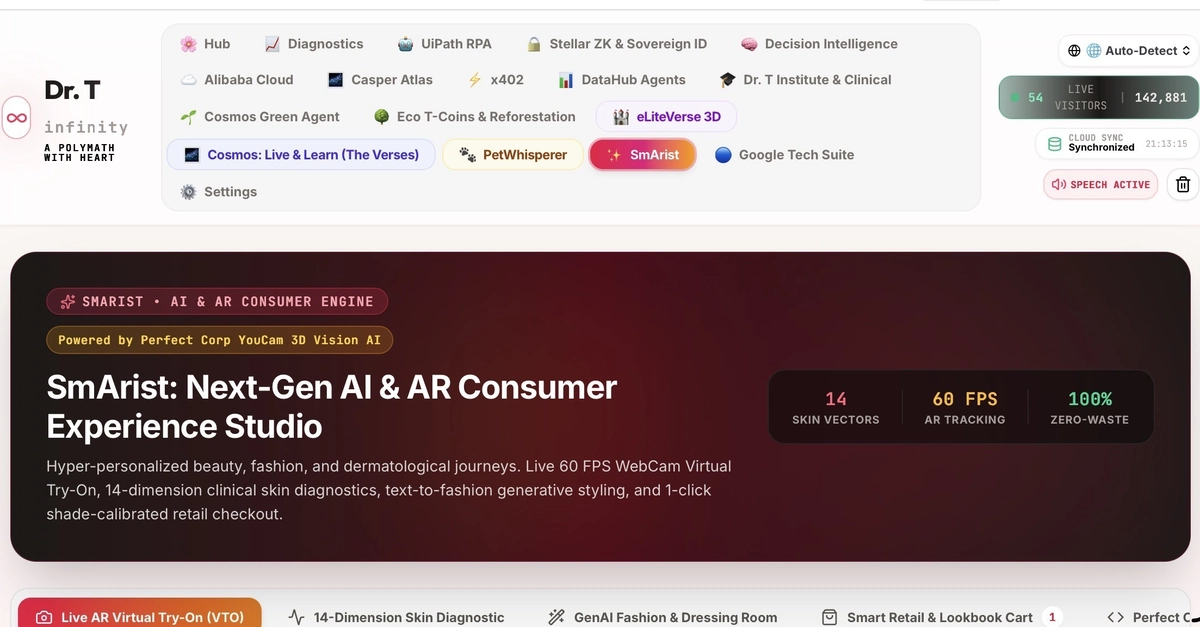
Dr. T: An Autonomous Clinical Intelligence Ecosystem
Dr. T is emerging as a sophisticated autonomous clinical intelligence, designed to function as a multilingual healthcare companion and a decentralized AI ecosystem. Its core mission is to seamlessly integrate human-centric patient care with advanced clinical informatics and the burgeoning field of machine-to-machine AI economies. This ambitious project seeks to redefine the interaction between patients, caregivers, and clinicians by leveraging AI to provide comprehensive support across various facets of healthcare.
The system operates on three primary pillars, each addressing a critical area within modern healthcare delivery. These pillars are designed to work in concert, offering a holistic approach to AI-driven health support.
Multilingual Clinical Triage & Empathetic Companion
One of Dr. T's most significant contributions is its capacity for real-time voice and language care. It delivers immediate medical guidance, offering empathetic mental wellness support, and performing clinical triage. Crucially, this functionality is available in multiple languages, breaking down communication barriers that often hinder effective healthcare delivery. This multilingual capability ensures that a broader population can access timely and appropriate medical advice and emotional support.
Beyond basic support, Dr. T is envisioned as a 'Personalized Health Soulmate.' This implies a deep level of adaptation to individual users. It adjusts its tone, cultural context, and medical communication styles to best suit patients, their caregivers, and healthcare professionals. This personalized approach aims to foster trust and improve engagement, making the AI a more effective and accepted partner in health management.

Clinical Automation & Diagnostic Intelligence
The second pillar focuses on automating clinical processes and enhancing diagnostic capabilities. A key feature here is its application in pharmacogenomics and precision medicine. Dr. T can predict adverse drug interactions and determine optimal metabolic dosing for medications by analyzing a patient's genetic profile. It specifically references its ability to process genotypes related to crucial enzymes like CYP2D6 and CYP2C19, which are vital for drug metabolism. This capability promises to significantly reduce medication-related adverse events and tailor treatments to individual genetic makeup.
Furthermore, Dr. T incorporates a FHIR Longitudinal Summarizer. This component is designed to ingest data from multiple hospital systems, creating a comprehensive, long-term summary of a patient's health journey. By aggregating information across disparate sources, it provides clinicians with a unified view of patient history, enabling more informed and efficient decision-making. This addresses a long-standing challenge in healthcare: the fragmentation of patient data across different providers and institutions.
Decentralized AI Ecosystem & Machine-to-Machine Economies
The third pillar positions Dr. T as a foundational element for a decentralized AI ecosystem. This aspect suggests a future where AI agents, including Dr. T instances, can interact and transact with each other. This could enable new models of healthcare service delivery, data sharing, and collaborative diagnostics. The concept of machine-to-machine AI economies implies that these autonomous agents could potentially provide services, share insights, or even manage resources amongst themselves, creating a more fluid and efficient healthcare network.
This decentralized approach also hints at enhanced data privacy and security. By operating within a decentralized framework, sensitive patient data might be managed more securely, with greater user control over its access and usage. This is particularly relevant in healthcare, where data breaches carry severe consequences.
The vision for Dr. T extends beyond simple patient interaction. It aims to be a pervasive intelligence layer, augmenting human expertise and optimizing clinical workflows. By automating routine tasks, providing rapid access to complex data, and enabling personalized patient engagement, Dr. T seeks to alleviate the burden on healthcare professionals and improve patient outcomes. The integration of pharmacogenomics and longitudinal data summarization points towards a future of highly personalized and preventative medicine, powered by intelligent AI systems.
The development of such an advanced AI companion raises significant questions about regulatory approval, data governance, and the ethical implications of AI in direct patient care. However, the potential benefits – improved access, personalized treatment, reduced errors, and more efficient healthcare systems – are substantial. Dr. T represents a significant step towards realizing the potential of AI to transform the healthcare landscape.