Introducing Dowe: A Unified Development Vision

Dowe has emerged with an ambitious goal: to provide a single, cohesive programming language for the entire software stack. The project, showcased on Hacker News as a 'Show HN' post, targets developers seeking to eliminate the fragmentation inherent in building applications across diverse environments – server-side, web frontends, desktop applications, and mobile platforms like Android and iOS. The core promise of Dowe is simplicity and efficiency. By offering a unified syntax and paradigm, it seeks to reduce the cognitive load on developers who typically must master multiple languages, frameworks, and toolchains to achieve full-stack development. This approach could dramatically streamline development workflows, decrease the learning curve for new projects, and improve code maintainability by reducing the need for context switching between vastly different programming models. At its heart, Dowe appears to be designed with modern software development challenges in mind. The language aims to abstract away platform-specific complexities, allowing developers to focus on business logic and user experience rather than the intricacies of cross-platform compatibility. This is a significant undertaking, as bridging the gap between server-side logic, browser-based interactivity, native desktop interfaces, and the distinct requirements of Android and iOS has historically required specialized skill sets and often, separate codebases.

Key Features and Design Philosophy

While specific technical deep-dives are still emerging, the announcement highlights Dowe's intent to cover the full spectrum of application development. This implies a language with features suitable for:
  • Server-Side Logic: Efficient execution, robust concurrency, and strong networking capabilities.
  • Web Frontends: Compiling to WebAssembly or generating JavaScript for interactive browser experiences.
  • Desktop Applications: Native or near-native performance and UI capabilities for Windows, macOS, and Linux.
  • Mobile Applications (Android & iOS): Cross-compilation to native code or leveraging platform-specific rendering for high-performance mobile UIs.
The challenge for any such ambitious language is not just theoretical elegance but practical implementation. Dowe must offer compelling performance, a rich ecosystem of libraries, and tooling that rivals established, mature platforms. The developer community often adopts new languages when they offer a clear advantage in productivity, performance, or developer experience, especially when tackling complex, multi-platform projects.
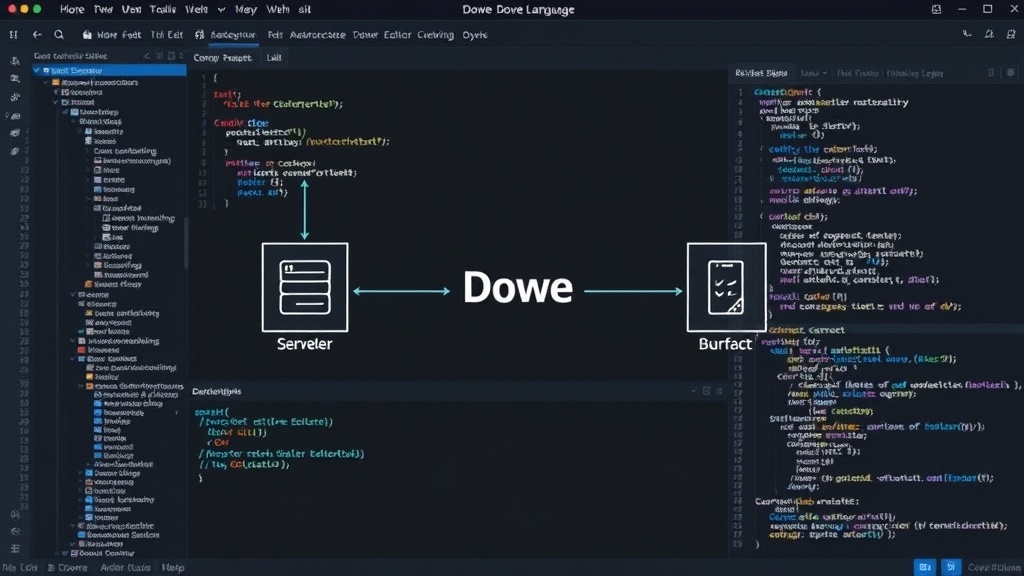
Conceptual diagram illustrating Dowe's unified architecture across server, web, desktop, and mobile targets.
The design philosophy seems to lean towards a strongly-typed, compiled language, which generally offers better performance and compile-time error checking compared to dynamically typed, interpreted languages. This is crucial for enterprise-grade applications and complex systems where reliability and performance are paramount. Furthermore, a unified approach to memory management and concurrency across all targets could simplify debugging and resource optimization significantly.

The Developer Experience and Ecosystem

A language's success hinges as much on its ecosystem as on its core features. Dowe will need to provide robust tooling, including compilers, debuggers, package managers, and integrated development environment (IDE) support. The ability to easily share code and logic across different application tiers is a primary selling point, but this requires a well-integrated build system and dependency management. Developers will be looking for how Dowe handles common tasks like data serialization, network requests, UI layout, and state management in a consistent manner across all supported platforms. Consider the common task of handling user authentication. In a traditional multi-language setup, this might involve separate implementations for the backend API, the web frontend's JavaScript logic, and the native mobile clients. Dowe aims to allow a single authentication module to be shared, drastically reducing redundant code and potential inconsistencies. This is akin to having a single blueprint that intelligently adapts to build a house, a shed, and a garage, rather than needing entirely separate architectural plans for each.

Challenges and Future Outlook

The path for a new full-stack language is steep. Dowe faces competition from established languages and frameworks that have already carved out significant niches in specific domains. For instance, JavaScript (with Node.js, React Native, Electron) and C# (with .NET MAUI) have made strides in cross-platform development. Python, Java, and Go dominate server-side, while Swift and Kotlin are preferred for native iOS and Android development, respectively. Dowe must demonstrate a clear and substantial advantage to entice developers away from these mature ecosystems. One of the most significant hurdles will be building community trust and adoption. Developers are often hesitant to invest heavily in a new language that lacks a proven track record, extensive documentation, and a large community for support. The 'Show HN' format is a good start for visibility, but sustained engagement and the development of robust libraries for common tasks will be critical. What remains to be seen is how Dowe scales. While the ambition is to cover all platforms, achieving high-fidelity, performant experiences on each can be a monumental task. Will Dowe's abstractions introduce performance overhead on sensitive platforms like iOS, or will it offer fine-grained control when needed? The initial reception from the developer community will provide early indicators. If Dowe can deliver on its promise of a truly unified, productive, and performant full-stack development experience, it could indeed simplify the lives of many engineers.