Molecular Computing Breakthrough
Researchers at Maynooth University have unveiled a novel DNA-based computer capable of performing 100-bit calculations without requiring any electrical power. This significant advancement leverages the inherent properties of DNA molecules to perform complex arithmetic and logical operations through self-assembly and molecular reactions. The system moves beyond theoretical concepts, demonstrating a functional computational device operating entirely at the molecular level.
Traditional computers rely on electrical signals to represent and manipulate data. This fundamentally limits their operation to environments where power is readily available and can introduce heat as a byproduct. In contrast, this DNA computer operates using biochemical processes, offering a potential pathway to computation in environments where electricity is impractical or impossible, such as within biological systems or in remote sensing applications.
The core innovation lies in the use of a 'scaffolded' DNA structure. This scaffold acts as a framework, guiding the self-assembly of specific DNA strands that encode computational logic. When the appropriate input molecules are introduced, they trigger a cascade of molecular reactions. These reactions are designed to mimic the logic gates found in electronic computers, allowing for arithmetic operations and, crucially, the processing of 100-bit data. This scale of computation, while modest by current electronic standards, represents a substantial leap for molecular computing, which has historically struggled with scalability and error rates.
The researchers have detailed their findings, showcasing how the system can be programmed by designing specific DNA sequences. The self-assembling nature of DNA means that the computer can be built at room temperature, further reducing its energy footprint and simplifying its construction. This approach is akin to having a set of instructions written in a molecular language that, when followed, results in a functioning computational machine. The implications for low-power computing and novel computational architectures are substantial.
How the DNA Computer Works
The computational process within this DNA system is driven by hybridization, a phenomenon where complementary DNA strands bind to each other. The Maynooth University team designed a system where specific input molecules initiate a chain reaction. Imagine a series of dominoes, but instead of falling, each domino is a DNA strand that can bind to another specific strand. The order and type of dominoes (DNA strands) are crucial for determining the computation performed.
The scaffold plays a critical role by holding these DNA strands in proximity, ensuring that the correct interactions occur in a controlled sequence. This is analogous to a microscopic assembly line where components are brought together in the right order for manufacturing. Without the scaffold, the DNA strands might interact randomly, leading to errors or incomplete computations.
For a 100-bit calculation, the system must be able to represent and manipulate binary information across 100 distinct positions. Each position can be thought of as a 'bit' that can hold a 0 or a 1. In this molecular computer, these bits are encoded in the presence or absence of specific DNA sequences or the binding state of certain strands. The molecular reactions then act as the 'logic gates' (AND, OR, NOT) that process these bits according to predefined algorithms.
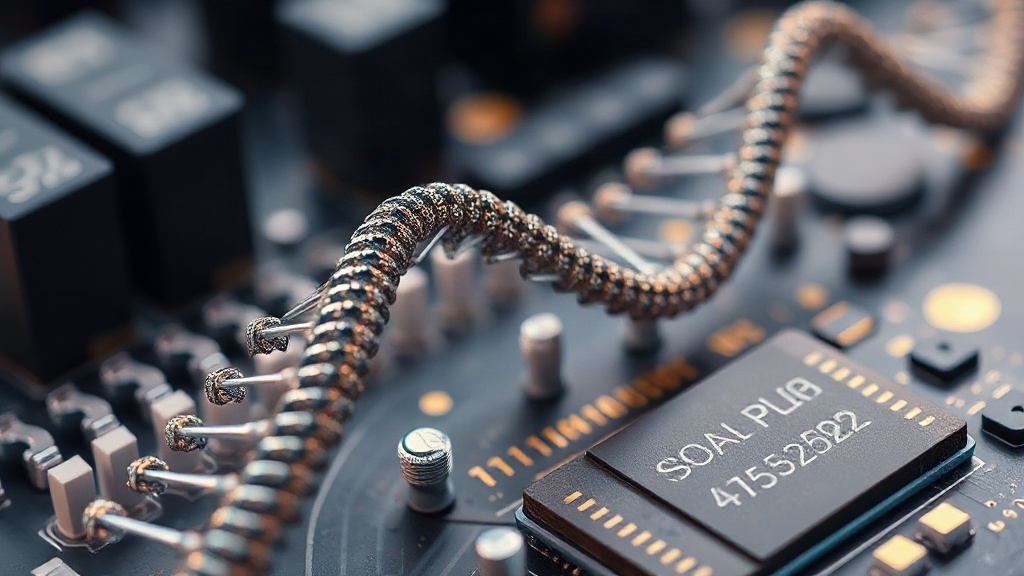
The actual computation involves the binding and unbinding of DNA strands. For instance, an arithmetic operation like addition might involve specific strands representing numbers, and their interaction on the scaffold would result in new strands representing the sum. The output of the computation is then read by analyzing the final state of the DNA molecules, perhaps by detecting the presence of specific resulting strands.
A key advantage of this method is its inherent parallelism. Unlike a traditional CPU that processes instructions sequentially, many molecular reactions can occur simultaneously within the DNA computer. This allows for potentially much faster processing for certain types of problems, especially those that can be broken down into many parallel molecular interactions.
Implications for Future Computing
The development of a 100-bit DNA computer that operates without electricity marks a significant milestone. It demonstrates that complex computations can be performed using biological molecules, opening up new frontiers in computing. One of the most immediate implications is the potential for ultra-low-power computing devices. Imagine sensors or embedded systems that can perform local data processing for years on a tiny amount of chemical fuel, or even powered by their immediate environment.
Furthermore, this technology could revolutionize how we approach computing within biological systems. DNA computers could be designed to operate inside living cells, monitoring biological processes, detecting diseases, or delivering targeted therapies. Their biocompatibility and ability to function in aqueous environments make them ideal candidates for such in-vivo applications. This is less like a microchip and more like a programmable biological machine.
The scalability of this technology remains a challenge. While 100 bits is a substantial achievement for molecular computing, it is still far from the capabilities of modern electronic computers, which handle billions of bits. However, the modular nature of DNA assembly suggests that scaling up is theoretically possible by increasing the complexity and number of interacting DNA strands. Researchers will need to address issues of error correction and the precise control of complex molecular interactions to achieve higher bit densities and computational power.
The ability to perform calculations without electricity also has profound implications for computing in extreme environments. Space exploration, deep-sea research, or disaster zones where power infrastructure is absent or compromised could benefit from robust, self-contained molecular computers. The research also points to a future where computation is not confined to silicon chips but is integrated into the very fabric of materials and biological systems.
Unanswered Questions and Future Directions
While this research is groundbreaking, several questions loom large for the future of DNA computing. The primary challenge is achieving fault tolerance and error correction at scale. Molecular interactions, by their nature, can be prone to errors. How can the system reliably perform trillions of operations without accumulating unacceptable levels of noise or incorrect results? Designing error-checking mechanisms at the molecular level is a complex but essential next step.
Another critical area for future research is the interface between DNA computers and the outside world. How do we efficiently input data and, more importantly, extract the results of complex computations in a way that is both rapid and accurate? Developing robust input/output mechanisms for molecular computers is key to their practical deployment.
The energy efficiency claim is also worth examining more closely. While electricity is avoided, the synthesis of the DNA strands themselves and the chemical reagents required for the reactions still represent an energy cost, albeit one that is likely orders of magnitude lower than electronic computation for specific tasks. Understanding the full lifecycle energy cost will be important for a comprehensive assessment of its sustainability.
Finally, the long-term stability and shelf-life of these molecular computers need to be investigated. Can the DNA structures remain functional and error-free over extended periods, or do they degrade, requiring frequent replacement? Addressing these questions will pave the way for truly practical and widespread applications of DNA-based computing, moving it from the laboratory bench to real-world problem-solving.