The Allure of the Self-Managed Cloud
In an era dominated by hyperscale cloud providers, the decision to build and manage one's own cloud infrastructure is, for most, counterintuitive. Yet, for some, the allure of complete control, deep understanding, and potential cost efficiencies drives them to rent dedicated servers and orchestrate their own Kubernetes clusters from the ground up. This isn't a journey for the faint of heart, nor is it typically the most pragmatic choice for businesses seeking rapid scalability and managed services. Instead, it's a path chosen by engineers who value mastery over convenience and seek a level of operational insight rarely found in abstracted cloud environments.
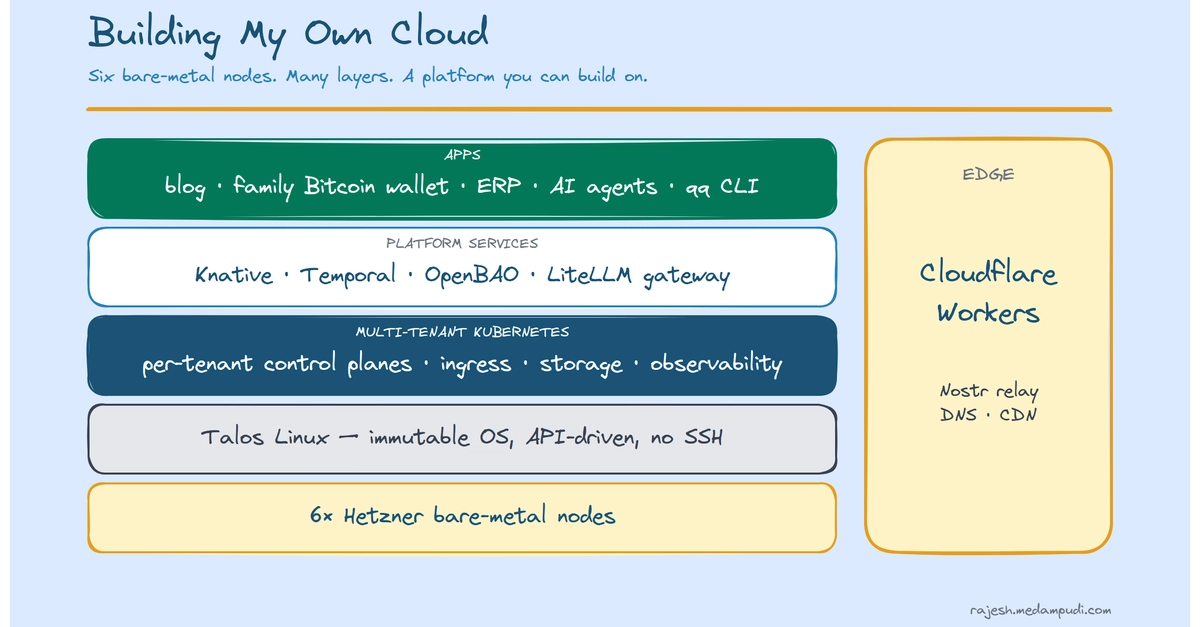
The author of one such endeavor rents six dedicated servers, collectively boasting substantial core counts, memory, and SSD storage – specifications that rivaled many production clusters a decade prior. The commitment extends beyond hardware: it involves running a fully self-managed Kubernetes stack, from the immutable operating system layer all the way up to the deployed workloads. This is not an EKS or GKE deployment; it's the entire stack, meticulously assembled and maintained by the individual. The typical reaction to hearing about such a project falls into two camps: the dangerously curious, eager to replicate the feat, and the pragmatically concerned, questioning the sanity of such an undertaking. This exploration focuses on the latter group, delving into the motivations and realities behind building a private cloud.
The Conventional Wisdom: Why the Cloud Wins
Let's be clear: by almost every conventional metric, the cloud is the superior answer for the vast majority of users. Managed Kubernetes services like AWS Elastic Kubernetes Service (EKS) and Google Kubernetes Engine (GKE) have matured significantly. EKS, in particular, has seen dramatic improvements over the last three years, offering a robust, scalable, and increasingly user-friendly platform for container orchestration. GKE has consistently been a strong contender, often exceeding expectations for its reliability and feature set. The broader cloud ecosystem also provides a wealth of mature serverless options, from compute functions to databases, abstracting away the complexities of infrastructure management. These services allow teams to focus on building applications rather than maintaining the underlying hardware and software stack. The pay-as-you-go model, coupled with auto-scaling capabilities, offers unparalleled flexibility and cost-efficiency for fluctuating workloads, making it the default choice for startups and enterprises alike.
The Counterpoint: When Self-Management Makes Sense
Despite the overwhelming advantages of cloud platforms, there are specific scenarios where building a private cloud infrastructure, even a small one, can be justified. The primary driver is often the pursuit of absolute control and a deep understanding of the entire technology stack. When an engineer manages their own Kubernetes, they gain intimate knowledge of networking, storage, compute, and the intricacies of the orchestration layer itself. This hands-on experience is invaluable for troubleshooting complex issues, optimizing performance at a granular level, and understanding the security implications of every component. For highly specialized workloads, or in situations where data sovereignty and compliance requirements are exceptionally stringent and cannot be adequately met by even the most configurable cloud offerings, a private cloud can provide a necessary degree of isolation and customization.
Furthermore, for individuals or small teams with predictable, high-utilization workloads, the long-term cost of renting dedicated hardware and managing it themselves can, in some cases, become more economical than paying for the equivalent resources on a public cloud, especially when egress costs and premium managed services are factored in. This is not about saving money in the short term, but about achieving a lower total cost of ownership over years of consistent operation. The surprising detail here is not the cost savings, which are often marginal and hard-won, but the intellectual capital gained. The process forces a deeper engagement with infrastructure than simply clicking through a cloud provider's console.
Operational Realities and the Developer's Role
The practicalities of running a self-managed cloud are substantial. It begins with the foundational elements: selecting and provisioning dedicated servers, often from a colocation provider. This is followed by installing and configuring an immutable operating system, ensuring it's hardened and secure. Then comes the core task: setting up Kubernetes. This involves choosing an installation method (e.g., `kubeadm`, k3s, or a custom build), configuring the control plane, setting up networking (CNI), and managing storage (CSI). Each step requires meticulous attention to detail and a robust understanding of distributed systems.
For developers, this means understanding not just their application code but also the environment it runs in. They might need to configure ingress controllers, manage persistent volumes, set up monitoring and logging stacks (like Prometheus and Grafana), and implement security policies at the cluster level. The mental model shifts from deploying to a managed service to operating a complex, self-contained system. This is where tools like Terraform become critical, even in a private cloud context. As one source highlights, before running any command against a real cloud account (or in this case, a private cluster), a clear mental picture of the infrastructure to be provisioned is essential. This involves understanding identity and access management – even within a private setup, you need a way to authenticate and authorize actions. For instance, creating dedicated IAM users (or their equivalent in a private IAM system) for automation pipelines, like using Terraform for deployment, is crucial. The root user, with its all-encompassing permissions, should never be used for day-to-day operations due to the risk of accidental account closure or critical misconfigurations. The plan output from tools like Terraform serves as a vital preview, detailing exactly which resources will be created, modified, or deleted, preventing costly surprises.
The Unanswered Question: Scalability vs. Control
While the benefits of control and deep understanding are clear, the question of true scalability remains. A cluster of six dedicated servers, while powerful, operates on a fundamentally different paradigm than a hyperscale cloud. Scaling beyond a certain point requires significant capital investment, physical space, power, cooling, and, most importantly, human expertise to manage the expanded infrastructure. What nobody has fully addressed yet is the point at which the operational overhead of managing a growing private cloud begins to outweigh the benefits of control, pushing even the most dedicated engineers back towards managed services. The decision to build one's own cloud is, therefore, not just a technical one, but a strategic calculation of resources, expertise, and long-term goals.
Implications for the Future
The trend towards abstracted, managed services in cloud computing is unlikely to reverse. However, the existence of engineers who choose to build and maintain their own infrastructure serves as a vital counter-narrative. It reminds the industry that beneath the layers of convenience lies a complex, fundamental reality of distributed systems. For developers, understanding this fundamental layer, even if they primarily use managed services, can lead to more efficient, secure, and resilient applications. For founders, it highlights that the choice between building in-house infrastructure and leveraging cloud providers is a spectrum, with varying trade-offs in cost, control, and speed. The engineer who builds their own cloud isn't just managing servers; they are actively participating in the deep craft of computing infrastructure, a pursuit that continues to hold significant value.