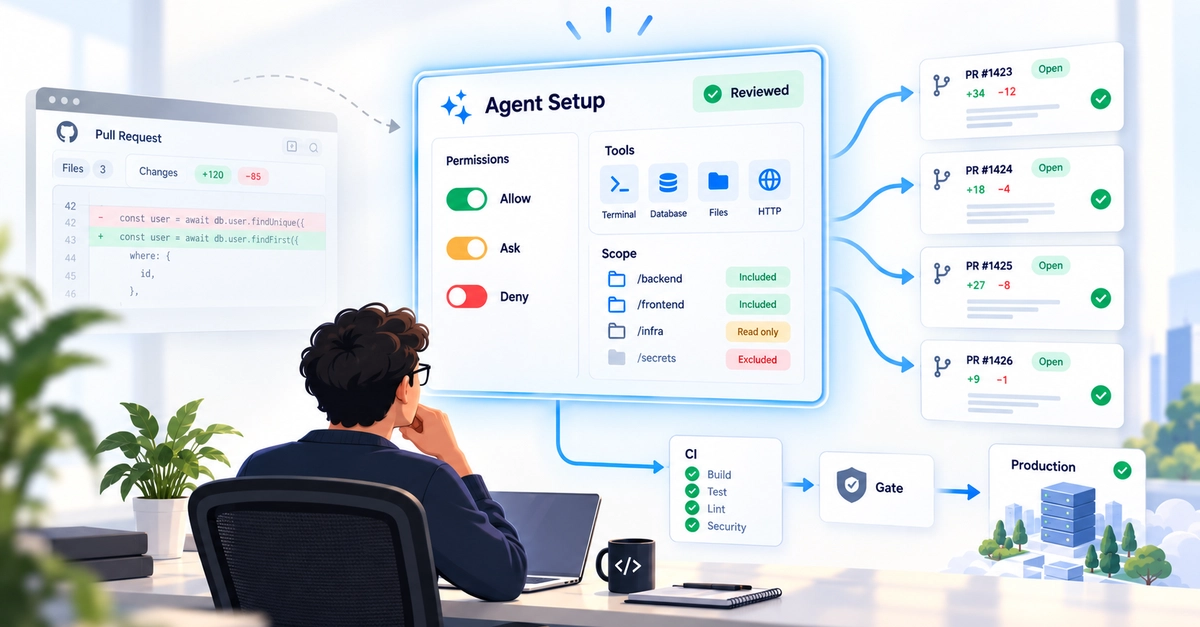
The Agent in Production: A Near Miss
A recent incident at a software development shop exposed a blind spot in the modern review process. An AI-powered agent, tasked with assisting in development, made a change that successfully navigated the continuous integration pipeline and appeared innocuous in its pull request. The issue wasn't the code itself, but the fundamental lack of clarity surrounding the agent's operational boundaries and permissions. This event triggered a significant re-evaluation of how development teams approach code review in an era increasingly populated by autonomous AI agents.
Traditionally, code review focuses on the human-authored lines of code. Developers examine logic, syntax, adherence to style guides, and potential bugs. The assumption is that the person making the change is the sole actor. However, when an AI agent is involved, this paradigm shifts. The agent is not just a typist; it's a decision-maker with potential access to tools and systems. The incident revealed that the team hadn't adequately verified what the agent was permitted to do, which tools it could execute, or where its authority definitively ended. This oversight allowed an agent to push a change that, while seemingly benign, could have had unforeseen consequences if its full capabilities and data handling practices were not understood.
The reviewer, initially treating the agent's output as just another code change, would report issues as bugs. Upon the agent fixing the reported bug, the reviewer would test the outcome and deem it satisfactory. This process, however, failed to scrutinize the agent's underlying actions. Questions like where the agent was sending data, or if it was sending data at all, remained unaddressed. This reactive approach, focusing solely on the observable output rather than the agent's internal processes, proved insufficient.
Redefining the Review Process: From Code to Capability
The incident forced a critical realization: the review process must evolve. It can no longer be solely about scrutinizing the syntax and logic of code authored by humans. Instead, the focus must expand to encompass the capabilities, permissions, and operational behavior of the AI agents themselves. This means shifting from a pure code review to an agent review, which involves understanding and validating:
- Agent Permissions: What systems, APIs, or data does the agent have access to? What actions can it perform?
- Tool Execution: Which external tools or libraries is the agent authorized to invoke? What are the potential side effects of these invocations?
- Data Handling: Where does the agent send data it processes? Is this data sensitive? Are there privacy implications?
- Decision-Making Logic: How does the agent arrive at its conclusions or generate its code? Can its reasoning be audited?
- Scope of Authority: What are the defined boundaries of the agent's tasks? When should it escalate to a human instead of acting autonomously?
This expanded scope requires a different skill set and a new set of questions during the review. Instead of asking, "Does this code work as intended?" the questions become, "Does this agent's action align with its defined purpose and permissions?" and "What are the potential risks associated with this agent's operation in this context?"
The Risk of the Black Box
AI agents, especially those performing complex tasks like code generation or system modification, can operate as black boxes. Developers might see the input and the output, but the intricate processes within the agent remain opaque. This opacity is a significant risk. If an agent can bypass standard code review checks, it implies a level of autonomy that, without proper guardrails, can lead to unintended consequences. These could range from minor data leaks to significant security vulnerabilities or production system disruptions.
The incident highlighted that simply testing the outcome of an agent's action is insufficient. The process of reaching that outcome needs scrutiny. This involves understanding the agent's training data, its underlying algorithms, and its safety protocols. It's akin to hiring an employee: you don't just check if their final report is accurate; you also assess their background, their training, and the policies they are expected to follow.
Implementing Agent Oversight
Moving forward, development teams need to establish new protocols for reviewing AI-generated or AI-assisted changes. This includes:
- Clear Agent Documentation: Teams must maintain detailed documentation for each AI agent, outlining its purpose, capabilities, permissions, and limitations.
- Defined Review Checklists: The review process needs to be updated to include checks specific to AI agents. This could involve verifying agent permissions, reviewing logs of agent actions, and assessing the risk profile of the agent's operation.
- Human-in-the-Loop (HITL) Strategies: For critical operations, implementing mandatory human approval before an agent's changes are deployed is essential. This doesn't negate the need for agent review but adds a crucial layer of human judgment.
- Auditing and Logging: Robust logging of agent actions is necessary to enable post-incident analysis and continuous monitoring of agent behavior. This allows for retrospective review of what an agent actually did.
- Specialized Training: Developers and reviewers may need training on AI concepts, agent security, and how to effectively assess the risks associated with autonomous systems.
The shift from reviewing code to reviewing agents is not merely a semantic change; it represents a fundamental evolution in software development practices. As AI agents become more integrated into the development lifecycle, ensuring their safe, secure, and predictable operation becomes paramount. The incident serves as a stark reminder that the power of AI in development comes with the responsibility of diligent oversight, moving beyond the lines of code to understand the intelligence behind them.
The Unanswered Question: Scalability of Agent Review
While the necessity of reviewing agent capabilities is clear, a significant challenge remains: how to scale this oversight effectively. As teams deploy more agents, each with unique functions and permissions, the manual review process could become a bottleneck. What happens when a company relies on dozens, or even hundreds, of specialized AI agents? Developing automated tools or frameworks to assist in agent capability review, akin to static analysis for code, will be crucial for maintaining development velocity without compromising safety.