Beyond Marketing: The Developer's Role in AI Brand Visibility
Generative Engine Optimization (GEO) is frequently discussed as a marketing challenge, but a significant portion of its leverage lies within the daily decisions made by development teams. The way code is structured, content is organized, and technical signals are implemented directly impacts how AI systems perceive and represent a brand. This technical foundation is as crucial as any marketing campaign in establishing brand visibility and accuracy within AI-driven platforms.
Entity Modeling: Building Recognizable Brand Blueprints
For AI models, particularly Large Language Models (LLMs), to understand and accurately represent a brand, the brand's core elements must be clearly defined and consistently represented within the codebase and content. This process, known as entity modeling, involves identifying key aspects of the brand – its products, services, plans, and unique identifiers – and ensuring they are expressed as stable, unambiguous entities. Inconsistent naming conventions across schema definitions, software components, documentation, and API references create a noisy signal for LLMs, making it difficult for them to anchor the brand correctly. Developers can influence this by establishing a unified vocabulary and structure that AI can reliably parse and associate with the brand identity.
Consider a scenario where a company has a product named "QuantumLeap Analytics." If this name appears inconsistently – sometimes as "QuantumLeap," other times as "QLytics," and in documentation as "Analytics Suite X" – an LLM will struggle to form a coherent understanding. Developers ensure consistency by defining canonical names in database schemas, class names, function signatures, and public-facing API documentation. This meticulous attention to detail transforms abstract brand concepts into concrete, machine-readable data points. It’s less about writing marketing copy and more about building a robust, machine-friendly representation of the brand’s identity within the digital infrastructure.
Structuring Content for AI Comprehension
Traditional website design often prioritizes user navigation and marketing campaigns. However, AI systems, especially those tasked with answering user queries or generating content, operate on a different principle: answering questions. The structure of the content directly impacts an AI's ability to locate, understand, and effectively reuse brand information. Patterns such as Frequently Asked Questions (FAQs), step-by-step how-to guides, and clearly marked Question & Answer (Q&A) blocks with clean markup are highly beneficial. These formats provide LLMs with direct answers and processes that can be easily extracted and presented. Developers can enhance this by ensuring that Q&A content is semantically marked up, perhaps using schema.org’s `Question` and `Answer` types, making it readily consumable by AI agents.
Think of it like building an instruction manual versus a brochure. A brochure is designed for browsing; an instruction manual is designed for finding specific solutions. LLMs are looking for solutions. When developers implement structured Q&A, they are essentially creating these highly effective instruction manuals within the website’s content. This ensures that when an AI needs to explain how to use a product or answer a common query, it can find the precise, pre-approved answer within the brand’s own content, rather than having to synthesize or potentially misinterpret information from less structured sources.
Maintaining Technical Signals for Long-Term Visibility
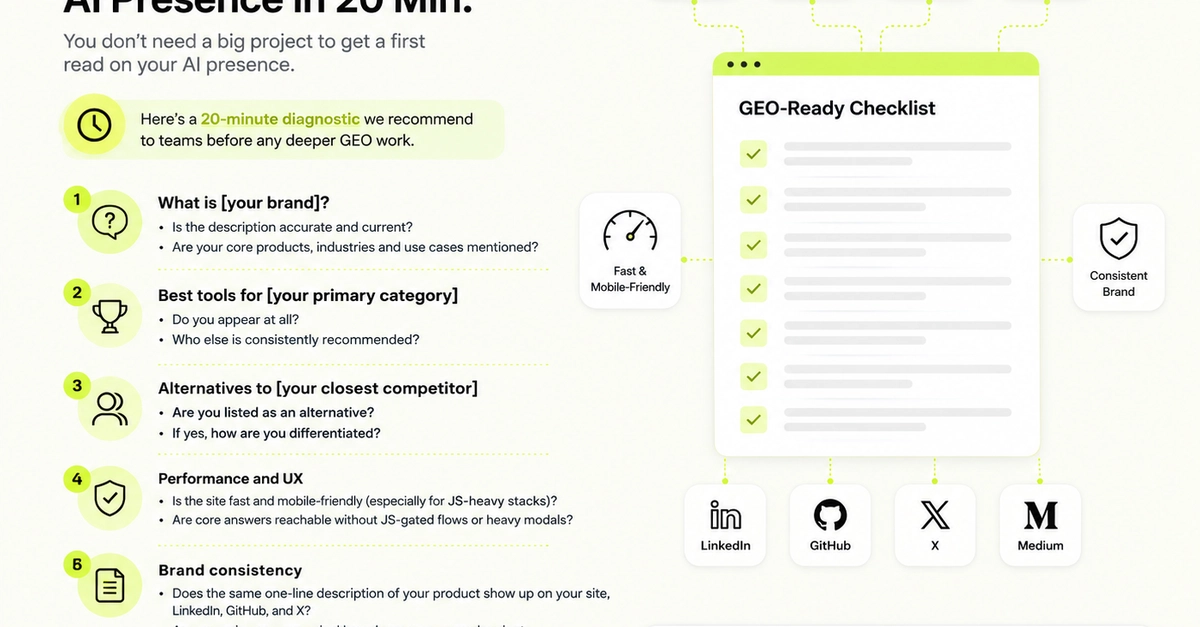
While less glamorous than feature development or content creation, essential technical signals play a critical role in maintaining AI-driven brand visibility over time. These include elements like sitemaps, `robots.txt` files, and specialized `llms.txt` files, as well as technical SEO best practices such as canonical URLs, website performance, and mobile layout optimization. These signals act as the underlying infrastructure that guides AI crawlers and models, much like a well-maintained road system guides traffic.
A clean and up-to-date sitemap helps AI discover all relevant pages. A properly configured `robots.txt` file ensures that AI can access the content it’s supposed to index while respecting crawl budgets and restrictions. The emerging practice of `llms.txt` (or similar mechanisms) allows developers to provide explicit instructions or curated datasets for LLMs, guiding their interaction with the site. Canonical URLs prevent duplicate content issues, ensuring that the primary version of a page is indexed and referenced. Furthermore, fast loading times and responsive mobile layouts contribute to a positive user experience, which is often a factor in how AI ranks or prioritizes content. Neglecting these technical foundations means that even well-structured content and clear entity modeling can be undermined, as AI systems may struggle to find, access, or properly interpret the brand’s digital footprint.
The Unseen Impact of Developer Choices
The surprising detail here is not that developers have influence, but the *depth* of that influence. It extends far beyond writing functional code. Every schema choice, every markup decision, every `robots.txt` directive is a point of leverage. For founders and product managers, understanding this technical layer is paramount. It means fostering closer collaboration between marketing, content, and engineering teams. It requires developers to think not just about user-facing functionality but also about machine-facing clarity. The decisions made in the codebase and content architecture today will directly shape how brands are understood and presented by AI systems tomorrow. If you’re building a product, ensuring your technical implementation aligns with the principles of GEO is not an afterthought; it's a core requirement for future-proofing your brand’s digital presence.