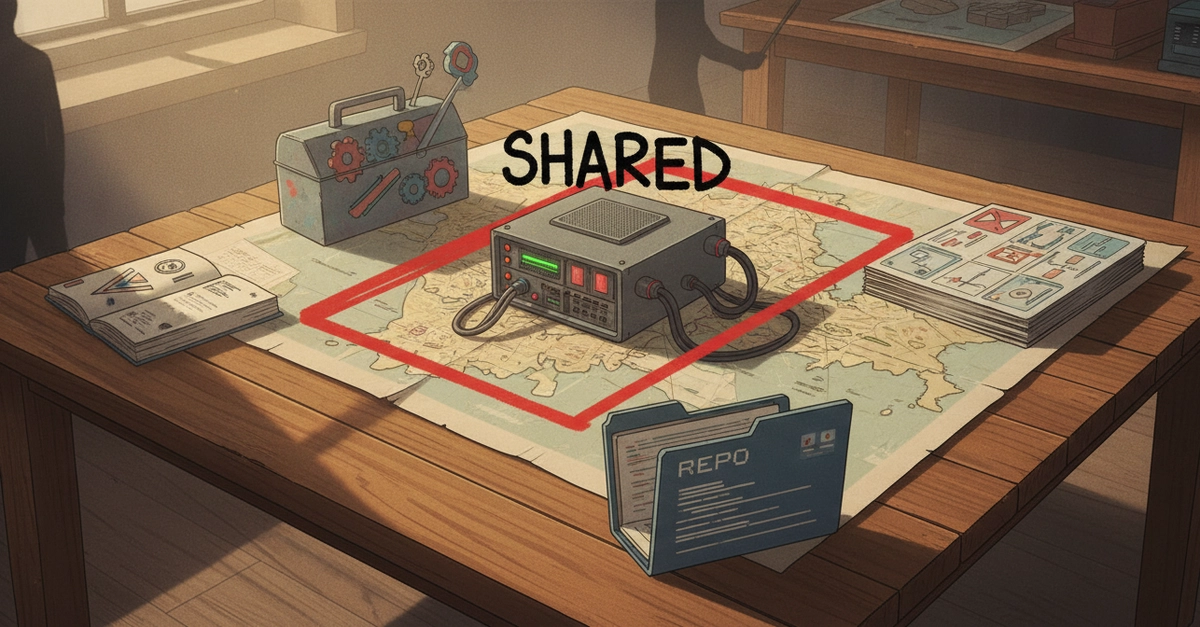
The Problem with Repo Cloning for Agent Setup
The initial approach to agent portability involved copying the last repository's agent setup into a new one. This method worked initially but carried over product-specific assumptions. As the number of active projects grew, this strategy became unmanageable. There was no longer a single, canonical repository to reliably copy from, and each improvement made to the agent setup had to be replicated across multiple locations, leading to inevitable drift.
This issue became apparent across several projects, including Codenames AI, a portfolio site, and a resume generator. These projects had accumulated shared workflows for essential tasks like planning, editorial work, dependency upgrades, review processes, and repository bootstrapping. Crucially, some of these workflows remained embedded within product-specific repositories because that was where they had naturally evolved. The goal was to enable new repositories to start with the established methodology already in place, without inheriting the specific implementation details of previous products.
The author's first instinct was to address this by creating an MCP (Master Control Program)-shaped architecture. This implies a centralized system or framework designed to manage and distribute these shared agent functionalities. However, the core of the problem wasn't the lack of a central architecture but the level at which the portability was being addressed.
Identifying the Wrong Boundary
The fundamental misunderstanding was trying to solve agent portability at the repository level. A repository typically contains the code for a specific product or service, along with its unique configurations and dependencies. When agent setup and workflows are copied directly from one repository to another, they bring along not just the functional logic but also implicit assumptions tied to the original product's environment, data structures, and operational context. This makes the copied setup brittle and difficult to adapt to a new, distinct project.
Consider the analogy of building a house. If you need to set up a plumbing system for a new house, copying the entire plumbing system from an existing house might seem like a shortcut. However, you'd also copy the specific pipe lengths, valve placements, and water pressure adaptations unique to the old house. This approach fails to account for the new house's different dimensions, layout, and local water supply characteristics. A better approach would be to have a standardized set of plumbing components and a blueprint that can be adapted to the new house's specific needs.
In the context of software agents, the 'plumbing system' represents the shared workflows and setup scripts. The 'house' is the specific product repository. Copying the entire repository is like copying the entire old house's plumbing. The 'wrong boundary' was treating the entire product repository as the unit of portability. This meant that every change, every fix, every optimization to the agent setup had to be manually propagated or carefully managed across multiple, diverging product repositories. This process is error-prone and leads to inconsistencies, where different projects end up with slightly different versions of the same agent setup, each with its own set of subtle bugs or outdated configurations.
The Correct Boundary: Abstracting Workflows
The realization was that agent portability should not be about copying entire product repositories or even specific setup scripts tied to a single product. Instead, the portability should be achieved by abstracting the core methodologies and workflows into a separate, reusable layer. This layer acts as a template or a library of best practices that can be applied to any new project, regardless of its specific implementation details.
This involves identifying the common tasks and patterns across projects: how to initialize a new project, how to manage dependencies, how to run tests, how to deploy, how to perform routine maintenance like dependency upgrades, and how to conduct code reviews. These common elements can be extracted and defined independently of any single product's code.
The correct boundary for portability lies in creating a separate entity, perhaps a meta-repository or a set of modular tools, that encapsulates these shared workflows. When starting a new project, instead of cloning an existing product repo, a developer would instantiate a new project based on this abstracted methodology layer. This layer would then allow the developer to select and configure the specific workflows needed for the new product, ensuring consistency and reducing the risk of errors.
This approach is akin to using a software development kit (SDK) or a framework. An SDK provides a set of tools, libraries, and conventions that developers can use to build applications. They don't copy the entire SDK's source code into their application; they reference it and build upon its defined interfaces and functionalities. Similarly, abstracted agent workflows provide a set of tools and processes that can be applied to new projects.
The key benefit of this shift is that improvements to the shared workflows can be made in one central place – the methodology layer – and then easily rolled out to all projects that utilize it. This eliminates the drift problem and ensures that all projects benefit from the latest best practices and bug fixes automatically, or with minimal effort.
Implications for Development and Maintenance
By moving the boundary of portability to an abstracted methodology layer, developers gain significant advantages. New projects can be bootstrapped much faster and with a higher degree of confidence, knowing they are starting with a robust, tested, and standardized set of workflows. The maintenance burden is also dramatically reduced. Instead of tracking and updating agent setups across dozens of individual product repositories, updates can be managed centrally.
This also promotes a more disciplined approach to software development. It encourages developers to think about common patterns and abstract them, leading to cleaner code and more maintainable systems overall. The separation of concerns becomes clearer: product repositories focus on product-specific logic, while the methodology layer handles the operational and workflow aspects.
The author's journey highlights a common pitfall in software engineering: solving a problem at the wrong level of abstraction. While cloning repositories might seem like a quick fix for code reuse, it often leads to more complexity and maintenance overhead in the long run. By identifying the correct boundary – the abstract methodology layer – developers can achieve true agent portability and build more scalable, maintainable, and consistent development environments.