The Illusion of Research: When Ideas Live Only in Your Head
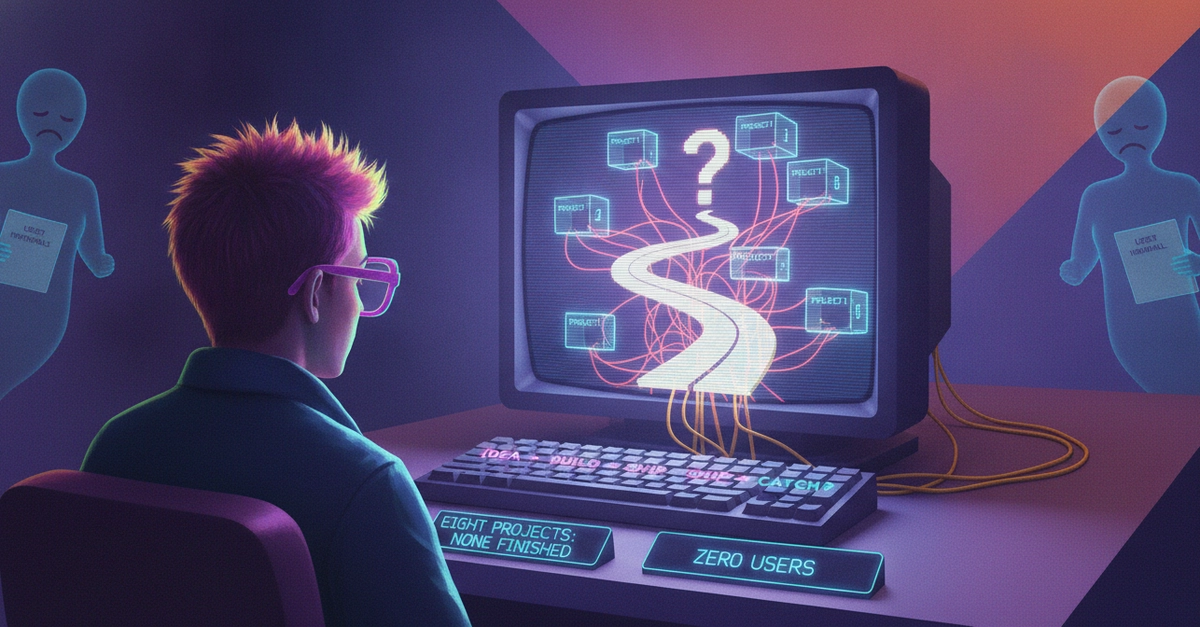
For three years, the author believed building software followed a simple, linear path: conceive an idea, build it, release it, and hope for traction. This approach led to eight unfinished projects and zero users. The core issue wasn't a lack of effort, but a fundamental misunderstanding of what constitutes effective product development and research. Instead of engaging with the real world, the developer spent countless hours at a desk, leaning on LLMs, scanning forums, and seeking validation within digital documents and internal thought processes. This created a self-referential loop where the ideal customer profile was a construct of their own making, detached from actual market needs.
The danger lies in mistaking internal ideation and theoretical exploration for genuine market research. When the 'ideal customer' exists only within documents and the developer's own descriptions, they are not a real person with real problems, but a phantom shaped by pre-conceived notions. This disconnect is a common pitfall, especially for solo founders or small teams who might lack external feedback mechanisms. The pursuit of validation within existing knowledge bases, rather than through direct interaction, stunts growth and leads to products that, while perhaps technically sound, fail to resonate with an actual audience.
Stepping Out: The Painful First Encounters with Real Users
The turning point arrived four months ago when the author decided to abandon the echo chamber and seek out these phantom customers in the real world. This transition was far from easy. The first forays into direct customer interaction were fraught with anxiety, described as a nauseating experience before even leaving the car. The initial three to four conversations were disastrous, characterized by an inability to articulate ideas coherently and a profound discomfort with the spontaneous nature of user dialogue. This initial breakdown highlights the psychological barrier many technical founders face when shifting from the controlled environment of code and documentation to the unpredictable landscape of human interaction and market feedback.
This initial failure is not a sign of inadequacy but a common, albeit painful, step in the learning process. It underscores the difference between explaining a concept you've meticulously crafted in isolation and truly understanding a user's unarticulated needs. The developer's realization that the ideal customer was not in a text file but "out in the field, he's on the street" marks a critical shift in perspective. It's the acknowledgment that product-market fit isn't discovered through introspection or AI-assisted brainstorming alone, but through direct, often uncomfortable, engagement with the people who might actually use and pay for the product.
The Shift: From 'Building It' to 'Understanding Them'
The author's journey from creating eight unfinished projects to actively seeking user feedback represents a fundamental pivot in their development philosophy. The previous methodology, characterized by an idea-build-ship cycle without sufficient validation, is akin to casting a fishing net into an empty pond. You might have the best net, but without understanding where the fish are, you'll never catch anything. The crucial lesson learned is that the 'research' phase must involve direct, qualitative interaction with potential users, not just theoretical exploration or AI-driven hypothesis generation. This means conducting interviews, observing user behavior, and actively listening to pain points, even when those pain points don't align with your initial vision.
The experience of "89 nos" is a powerful, albeit harsh, indicator of this disconnect. Each 'no' is not a rejection of the developer, but a signal that the product, or the way it was presented, did not meet a specific, real-world need. This iterative process of seeking feedback, receiving negative responses, and refining the understanding of the problem is the engine of product-market fit. It forces developers to confront their assumptions and adjust their course based on tangible evidence. The shift is from a creator-centric model, where the developer's vision is paramount, to a customer-centric model, where the user's problems and needs dictate the product's direction. This requires a willingness to be wrong, to adapt, and to embrace the uncertainty inherent in building something truly valuable for others.
Beyond the Code: Embracing the 'No' as a Learning Tool
The narrative presented is a stark reminder that software development is not solely about writing elegant code or designing sophisticated architectures. It is intrinsically linked to understanding human behavior, solving real-world problems, and navigating market dynamics. The author's candid admission of spending three years without shipping a single finished product, despite numerous attempts, is a relatable scenario for many in the tech industry. The critical insight is that the 'research' conducted was insufficient because it lacked external validation. The internal definition of an 'ideal customer' was a convenient fiction, a placeholder for the actual users who exist beyond the screen.
The shift to actively seeking out these users, despite the initial discomfort and the subsequent "89 nos," is where true progress begins. Each rejection, each "no," serves as a data point, informing what doesn't work and guiding the developer closer to what might. This iterative feedback loop is essential. It transforms the development process from a solitary act of creation into a collaborative effort, even if the collaborators are initially unaware they are collaborating. The lesson for founders and developers is clear: step away from the keyboard, get out into the field, and listen. The most valuable insights often come not from lines of code, but from conversations, observations, and the willingness to embrace the uncertainty of genuine user interaction. The journey from "89 nos" to a product that resonates is paved with these real-world encounters, not just digital ones.