Claude Max Usage: A Deep Dive for Open Source Maintainers
In July, Anthropic extended an invitation to the Claude for Open Source Program. The offer: six months of Claude Max 20x, free, for maintainers of open-source projects. For me, a developer who has been building the Iris web framework for Go since 2016, it was an easy decision. The invitation, prominently displayed on my GitHub profile, marked the beginning of an experiment to understand what "all day" usage of a top-tier AI assistant truly entails.
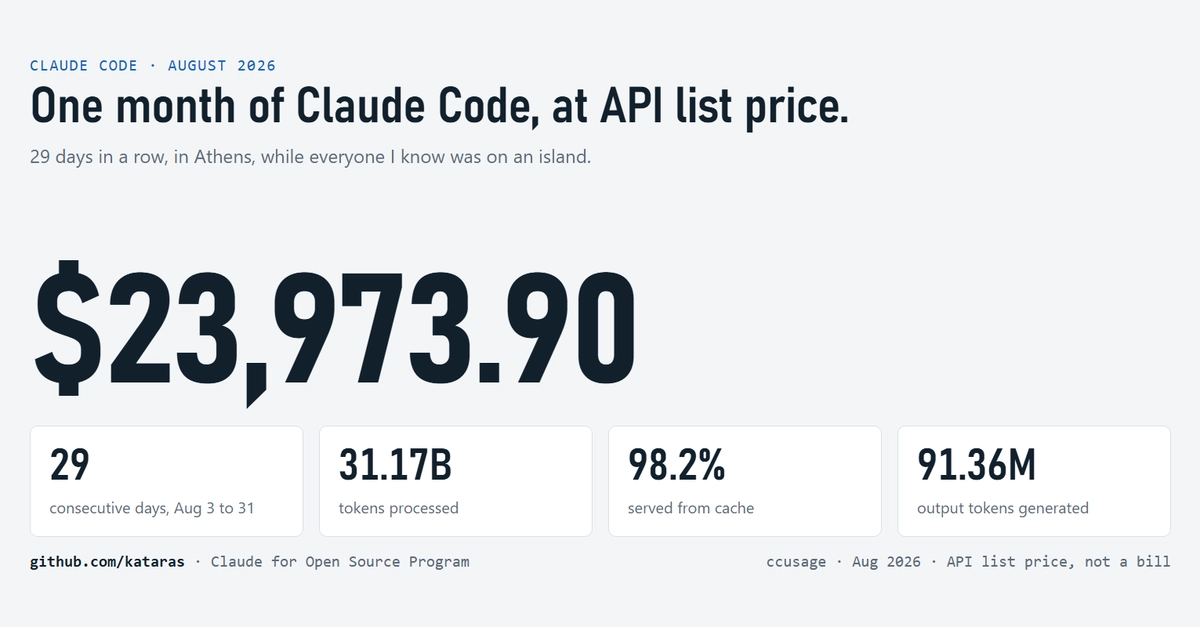
Claude Max 20x represents Anthropic's highest individual subscription tier. It offers the most generous rate limits for a flat monthly fee, catering to users who spend their entire workday interacting with Claude. To quantify this, I ran `ccusage` over my local Claude Code logs for August, exporting the detailed report. The results offer a fascinating glimpse into the consumption patterns of a dedicated AI user, even amidst a Greek August, a month known for its quietude in Athens.
August in Greece is not typical for focused work. Athens empties out, shops close, and the usual rhythm of business pauses. This period of reduced activity, however, did not significantly curb my interaction with Claude. The data reflects usage during a time when many would be on vacation, highlighting the pervasive integration of AI tools into the development workflow, regardless of external circumstances.

Quantifying "All Day" AI Use
The raw data from `ccusage` provided a clear picture of my August interaction with Claude. While the exact token counts and costs are proprietary to Anthropic's billing model, the program provided a fixed allocation. My goal was not to hit a specific cost target, but to understand the volume of requests and the nature of the tasks I delegated to Claude over the month. This involved everything from generating boilerplate code and debugging complex issues to refactoring existing logic and exploring new algorithmic approaches for Iris.
The framework itself, Iris, is a high-performance, minimalist web framework for Go. Its development demands meticulous attention to detail and a constant exploration of efficient solutions. Leveraging Claude Max 20x allowed me to accelerate this process. Instead of spending hours researching obscure Go concurrency patterns or meticulously crafting unit tests for edge cases, I could offload these tasks to Claude. The AI acted as an tireless pair programmer, available 24/7, capable of handling repetitive or time-consuming coding tasks.
One surprising aspect was the sheer variety of prompts and the depth of context Claude could maintain across multiple interactions. I found myself using it not just for code generation, but also for architectural discussions, performance tuning advice, and even generating documentation. The ability to paste large code segments and receive detailed, actionable feedback was invaluable. This went beyond simple autocompletion; it was akin to having a senior engineer on call, offering expert opinions and solutions.
The Cost of Intensive AI Use
While the Claude for Open Source Program covered the expense, understanding the financial implication of such intensive usage is crucial for broader adoption. The $24,000 figure is a hypothetical valuation based on the Max 20x tier's potential monthly cost had I been a regular subscriber. This represents a significant investment, underscoring the value proposition for individuals and teams who rely heavily on AI for productivity gains. For maintainers of critical open-source projects, this kind of resource can be a lifeline, enabling them to keep pace with commercial development without personal financial strain.
The question for many developers and companies will be whether this level of AI assistance justifies the cost. My experience suggests that for complex, long-term projects like Iris, the return on investment can be substantial. The time saved on mundane tasks translates directly into more time for high-level design, innovation, and addressing the core challenges of software development. It allows developers to operate at a higher cognitive level, focusing on the creative and strategic aspects of their work.
What remains to be seen is how Anthropic and other AI providers will structure pricing and access for individual developers and smaller teams in the long run. Will programs like this become standard, or will the cost of top-tier access remain a barrier for many? The current model, while generous for select open-source maintainers, highlights a potential tension between the democratization of AI tools and their commercial valuation.
Beyond Code Generation: AI as a Development Partner
My August usage was not solely about generating lines of code. It was about a fundamental shift in the development process. Claude became an indispensable partner in the entire lifecycle of building and refining the Iris framework. I used it to:
- Generate comprehensive unit and integration tests for complex routing and middleware scenarios.
- Refactor large code modules to improve performance and readability, often suggesting more idiomatic Go patterns.
- Debug intricate concurrency issues that are notoriously difficult to trace in Go.
- Explore alternative API designs for future versions of Iris, evaluating trade-offs in terms of performance and developer experience.
- Draft technical documentation and explanations for new features, ensuring clarity for users.
This multifaceted use case demonstrates that advanced AI models are evolving beyond simple code snippets. They are becoming sophisticated tools for problem-solving, architectural planning, and knowledge acquisition. For a project as mature and complex as Iris, which has been in development for nearly a decade, the ability to quickly iterate on ideas and receive expert feedback is invaluable. It's like having an entire R&D department at your fingertips, albeit one that operates purely in text.
The surprising detail here is not the sheer volume of interaction, but the depth of integration. I did not simply ask Claude to write code; I engaged it in a dialogue about the future of the framework, its performance characteristics, and its place within the broader Go ecosystem. This collaborative approach is where the true power of these advanced models lies, transforming them from tools into genuine development partners.
Looking Ahead: The Future of AI in Open Source
The Claude for Open Source Program is a commendable initiative, but it also raises questions about the long-term sustainability of such intensive AI usage for open-source projects. If this program were to end, would the cost of continued high-volume access be prohibitive for many maintainers? How can the benefits of these powerful AI tools be made more accessible to the open-source community at large?
My August experiment with Claude Max 20x demonstrated its immense potential as a productivity enhancer for software development. It's more than just a code generator; it's a partner that can accelerate development, improve code quality, and help tackle complex engineering challenges. As AI continues to evolve, its integration into the daily workflows of developers, particularly those maintaining vital open-source infrastructure, will only deepen. The challenge now lies in ensuring this powerful technology remains accessible and beneficial to the entire developer ecosystem.