
Filesystem Bug Analysis: A Developer's Journey
This post details the analysis and experience of discovering a bug within the simplefs project, a simplified filesystem implementation. The journey involved identifying a kernel soft lockup during filesystem mounting and file access operations, ultimately contributing to pinpointing the root cause. This exploration is intended for developers, students, and enthusiasts interested in low-level computing, Linux kernel internals, and filesystem design.
The Problem: System Hangs During Mount and Lookup
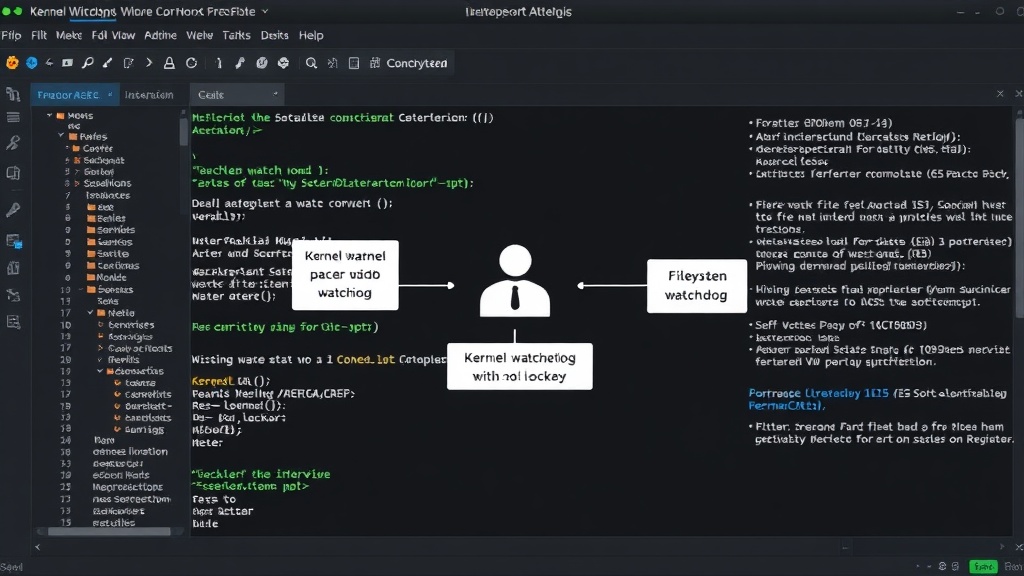
The primary issue manifested as a system hang or lockup when attempting to mount a simplefs filesystem image. This occurred whether the image was newly created or contained existing files. Further investigation revealed that the kernel watchdog would trigger a soft lockup warning, specifically pointing to the __file_lookup() function. This function, which wraps the simplefs-specific simplefs_lookup() operation, is crucial for traversing and accessing file system structures (inode operations). Consequently, standard commands like ls, or any program that relies on inode lookup, would cause the system to freeze during execution.
The core of the problem lies in how the filesystem handles directory entries and inode lookups. When a system call requests to find a file or directory within a mounted simplefs, the kernel invokes the filesystem's lookup operation. In this case, simplefs_lookup(), called via __file_lookup(), was entering an infinite loop or a state that the kernel watchdog interpreted as unresponsive. This soft lockup prevents normal system operation, requiring a hard reboot.
Initial Investigation: Tracing the Lockup
The first step in diagnosing such issues is to leverage kernel debugging tools. The kernel watchdog's warning is invaluable, as it provides a function name where the hang is occurring. In this scenario, __file_lookup() was the red flag. This function is a generic kernel helper that prepares for and calls the filesystem-specific lookup operation. Therefore, the problem was either within __file_lookup() itself (less likely for a common kernel function) or, more probable, within the simplefs_lookup() implementation that __file_lookup() was calling.
simplefs_lookup() is responsible for finding an inode given a parent directory inode and a filename. It typically involves iterating through the directory's contents (stored as entries within the filesystem image) and comparing names. A common cause for lockups in such operations is an infinite loop, often triggered by incorrect handling of directory entry pointers, corrupted filesystem metadata, or race conditions in concurrent access scenarios.
The Role of Inode Operations
Inode operations are fundamental to any filesystem. They define how the kernel interacts with the filesystem's metadata. Key operations include:
lookup: Find an inode by name within a directory.create: Create a new file.mkdir: Create a new directory.unlink: Remove a file.rmdir: Remove a directory.getattr: Get file attributes (permissions, size, etc.).setattr: Set file attributes.
The bug specifically affected the lookup operation. This implies that the mechanism for navigating the filesystem's directory structure was flawed. For a simplified filesystem like simplefs, this often means parsing a contiguous block of data that represents directory entries, each containing a name and an inode number. An error in processing these entries—such as a malformed entry, an incorrect pointer to the next entry, or a failure to terminate the iteration—could easily lead to an infinite loop.
Deep Dive into SimpleFS Lookup Logic (Hypothetical Analysis)
While the exact code for simplefs_lookup() is not provided in detail, we can infer its likely structure and potential pitfalls. A typical implementation might look something like this:
struct inode *simplefs_lookup(struct inode *dir, struct dentry *dentry, unsigned int flags)
{
    // 1. Get pointer to the directory data block on disk.
    // 2. Iterate through directory entries in the block.
    // 3. For each entry, compare its name with dentry->d_name.name.
    // 4. If a match is found, retrieve the inode number and call iget_locked() to get the inode.
    // 5. If end of directory entries is reached without a match, return NULL.
    // 6. Handle special entries like '.' and '..'
    // 7. Crucially: Ensure the loop terminates correctly.
}
Potential failure points include:
- Corrupted Directory Entries: If a directory entry is malformed, the name comparison or pointer advancement might fail, leading to an endless loop.
- Incorrect End-of-Directory Marker: Filesystems often use a specific marker or structure to denote the end of a directory's entries. If this marker is missing or misinterpreted, the loop might never terminate.
- Pointer Issues: Direct manipulation of disk data structures can lead to pointer errors. If a pointer to the next entry is corrupted or points back to a previous entry, an infinite loop is guaranteed.
- Race Conditions: Although less likely to cause a soft lockup directly without further kernel involvement, concurrent modifications to a directory being looked up could theoretically lead to unpredictable states.
The fact that the system locks up upon mounting suggests that the issue might be more fundamental, potentially related to how the filesystem structure is read into memory or initialized. However, the specific mention of __file_lookup() points strongly towards an issue within the lookup path once the filesystem is active.
Contributing to the Fix
While the ultimate root cause might require deeper kernel or filesystem-level debugging, the developer's role in identifying the problematic function and the context of the hang (inode lookup) is critical. This information allows maintainers to focus their debugging efforts. Often, such bugs are subtle, perhaps involving a specific edge case in how directory entries are stored or read. For instance, a filesystem might not properly handle directory entries that are exactly at the boundary of a disk block, or it might misinterpret the length of a filename that causes an overflow.
The surprising detail here is not the lockup itself, but the specific function trace pointing to __file_lookup(). This kernel helper is generally robust. Its involvement suggests that the problem is deeply intertwined with the filesystem's interaction with the VFS (Virtual File System) layer, specifically how it provides directory entry information. It implies that simplefs might be returning invalid data or getting stuck in a state where it cannot correctly signal the end of a directory scan to the VFS layer.
If you run a system that relies on custom filesystems, understanding these low-level interactions is paramount. A seemingly minor bug in a filesystem driver can bring down the entire operating system. This experience underscores the importance of rigorous testing for any filesystem code, especially in critical environments.
Broader Implications
Bugs in filesystems are among the most severe. They can lead to data corruption, system instability, and security vulnerabilities. A soft lockup, while not directly causing data loss, renders the system unusable and requires a restart, which itself can sometimes lead to data corruption if applications are not cleanly shut down. For developers working on low-level systems software, this case serves as a reminder that even in simplified projects, the complexity of managing persistent storage and kernel interactions is immense.
The path from observing a symptom (system hang) to identifying a specific kernel function and then contributing to a fix requires a methodical approach. It involves understanding the kernel's VFS layer, the specific filesystem's on-disk format, and employing debugging tools effectively. The contribution here, while not finding the absolute root cause, was crucial in narrowing down the search space, saving valuable debugging time.