The Developer's Dilemma: Recurring Syntax Woes
Every developer hits a wall. It's not about complex algorithms or novel architectures; it's the mundane but time-consuming task of recalling specific syntax for common, recurring patterns. For one developer, this manifested as repeatedly rewriting boilerplate code for things like rate limiter middleware, webhook signature checks, and retry-with-backoff logic. The hours spent searching Stack Overflow or official documentation for these fundamental building blocks were, in his estimation, significant and unnecessary.
This frustration led to the creation of AutoSnippets, a free, no-signup web tool designed to provide immediate access to production-ready code snippets. The goal is simple: eliminate the need to Google basic syntax, freeing up developers to focus on the more challenging aspects of their projects.
AutoSnippets: A Curated Library of Essential Code
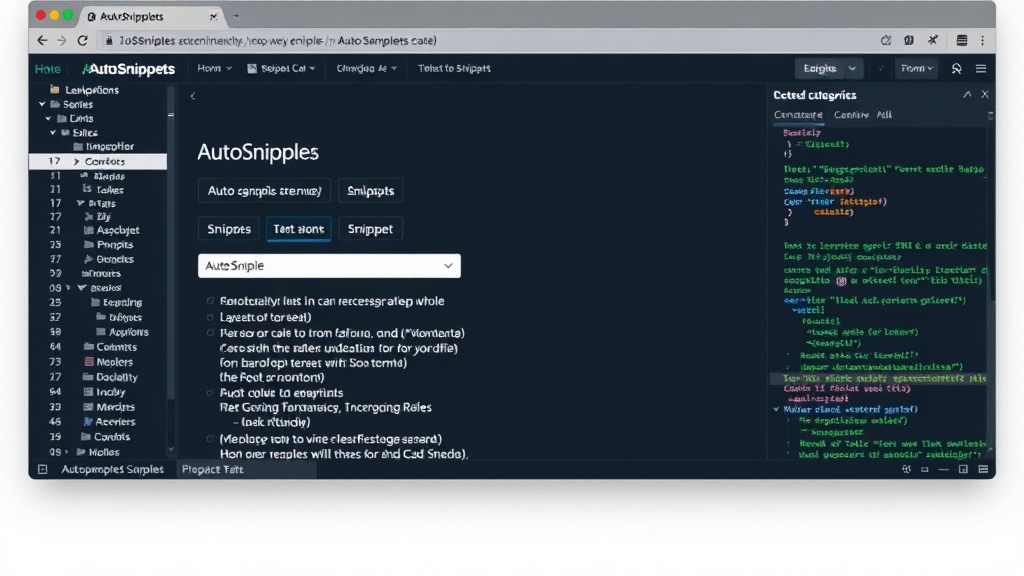
AutoSnippets currently boasts 50 snippets spanning 10 popular programming languages: Python, JavaScript, TypeScript, Java, C#, C++, Go, PHP, Rust, and SQL. The emphasis is on practical, immediately usable code that developers frequently need. These aren't just snippets; they are designed to be production-ready, meaning they adhere to good practices and can be dropped into existing projects with minimal modification.
The library covers a range of common tasks. For instance, developers working with Go can find a channel-based worker pool implementation (snippet #32), a pattern that efficiently manages concurrent tasks. Rust developers struggling with shared mutable state will appreciate snippet #41, which provides a safe counter using `Arc` and `Mutex`. For those dealing with hierarchical data, SQL snippet #50 offers a recursive Common Table Expression (CTE) for generating organizational charts. Even complex tasks like implementing Role-Based Access Control (RBAC) in PHP are distilled into a concise 8-line solution (snippet #38).
The developer behind AutoSnippets stresses the tool's accessibility. It's entirely free to use, requires no account creation or login, and can be bookmarked for quick access. This approach lowers the barrier to entry, making it a convenient resource for individual developers and small teams alike.
Beyond Basic Syntax: What Makes AutoSnippets Valuable
The value proposition of AutoSnippets extends beyond mere syntax recall. By providing tested, production-ready code, it implicitly offers a baseline for best practices. For example, the Go worker pool snippet likely incorporates error handling and graceful shutdown patterns, aspects that a developer might overlook or implement inefficiently when rushing through a search.
Consider the Rust `Arc` and `Mutex` counter. Implementing thread-safe counters correctly involves understanding memory safety and concurrency primitives. A poorly implemented version could lead to race conditions, a notoriously difficult class of bugs to debug. By offering a pre-built, presumably correct, implementation, AutoSnippets saves developers from potential pitfalls and the subsequent debugging nightmare.
Similarly, the SQL recursive CTE for org charts addresses a problem that often requires a deep dive into SQL's more advanced features. Developers not regularly working with recursive queries might spend hours deciphering the syntax and logic. AutoSnippets provides a ready-made solution, allowing them to integrate organizational hierarchy visualization quickly.
The choice of languages and snippets is strategic. These are languages and patterns that are widely used across the industry, from backend services (Python, Go, Java, C#, Rust) to front-end development (JavaScript, TypeScript), and database interactions (SQL). The inclusion of C++ and PHP further broadens its appeal.
The Future of Developer Productivity Tools
AutoSnippets emerges at a time when developer productivity is paramount. With the increasing complexity of software systems and the constant pressure to deliver faster, tools that streamline common tasks are invaluable. While AI-powered code generation tools are gaining traction, they often require careful prompting and validation, and can sometimes hallucinate incorrect or inefficient code. A curated library of proven snippets offers a more predictable and reliable alternative for specific, well-defined problems.
The surprising detail here is not the existence of code snippet tools, but their current accessibility and the specific focus on eliminating the most common, yet frustrating, developer time sinks. Many existing solutions are integrated into IDEs as plugins, require subscriptions, or are tied to proprietary platforms. AutoSnippets, by remaining a simple, free, and standalone web tool, carves out a distinct niche.
What remains to be seen is the pace at which new snippets are added and how the library evolves to incorporate emerging patterns and language features. As the tool grows, its utility will increase, potentially becoming an indispensable bookmark for a significant portion of the developer community. The creator has indicated that more snippets are in development, suggesting a commitment to expanding the resource. This proactive approach is key to maintaining relevance in the fast-moving world of software development.
For developers, the message is clear: stop wasting time on repetitive syntax lookups. Bookmark AutoSnippets. For founders, this highlights an opportunity to build tools that solve very specific, high-frequency developer pain points. The market for developer productivity tools is vast, and solutions that offer immediate, tangible value, like AutoSnippets, are well-positioned to gain traction.