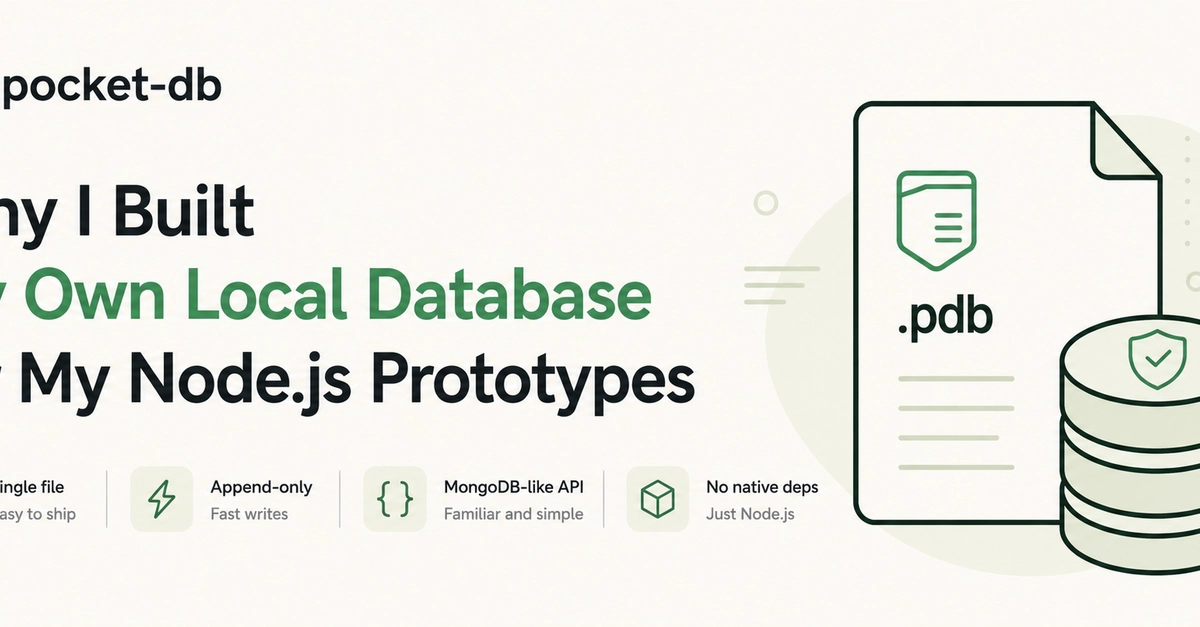
The Problem: Storage Bottlenecks in Rapid Development
Many developers, like the author of this piece, find themselves building numerous small, personal projects. These range from genealogy trackers and expense managers to file indexers and mini-games. The common thread is rapid iteration using JavaScript or TypeScript, chosen for their speed and flexibility during the nascent stages of an idea. However, a persistent roadblock emerges: data storage.
For weekend prototypes or local utilities, deploying a full-fledged database server is often overkill. It introduces unnecessary complexity, especially when the goal is to move a tool between machines or share it via simple copy-paste. This leaves developers with two common, yet ultimately flawed, approaches.
The first is using a single JSON file. This method involves loading the entire file into memory and then rewriting it wholesale on every save. While functional for small datasets, it quickly becomes a performance bottleneck as the data grows. Rewriting the entire file on each write operation becomes slow, and the risk of data corruption increases with larger files and frequent writes.
The second common approach involves using a lightweight embedded database like SQLite. While more robust than a simple JSON file, SQLite introduces its own set of challenges for JavaScript developers. Its query language (SQL) differs significantly from the JavaScript object manipulation developers are accustomed to. Furthermore, integrating SQLite often requires native bindings, which can complicate installation and cross-platform compatibility, especially in a Node.js environment where dependencies need to be managed carefully.
The Solution: A Custom Single-File Document Database
Frustrated by these limitations, the developer set out to build a custom solution tailored specifically for Node.js prototyping. The goal was to create a storage mechanism that felt natural to JavaScript developers, minimized operational overhead, and performed well for typical prototype workloads. The result is a single-file document database designed from the ground up for Node.js environments.
Key design principles guided its development: no server required, no native bindings, a MongoDB-style API, and append-only writes. These choices directly address the pain points identified with existing solutions.
The absence of a separate server process means the database runs directly within the Node.js application, making it as simple to deploy as copying a file. Eliminating native bindings sidesteps the common installation hurdles and compatibility issues associated with libraries that need to compile C++ or other native code, ensuring a smoother developer experience across different operating systems. The MongoDB-style API lowers the barrier to entry for developers already familiar with NoSQL document databases, allowing them to interact with data using familiar JavaScript object syntax and query patterns.
Append-Only Writes: Performance and Durability
The choice of an append-only write strategy is central to the database’s design. Instead of overwriting existing data blocks, new data is always added to the end of the file. This approach offers several advantages:
- Performance: Writing to the end of a file is typically a very fast operation, especially on modern file systems. It avoids the overhead of seeking to specific locations and performing in-place updates, which can be slow and fragmented.
- Durability: Because existing data is never modified, the database is inherently resilient to crashes during write operations. If the application terminates unexpectedly mid-write, the previously written data remains intact and uncorrupted. The file simply grows, and the next write will continue from where the last successful write left off. This is a significant improvement over JSON file rewrites, where a crash could leave the file in an inconsistent, unreadable state.
- Simplicity: Managing writes becomes a simpler, sequential process. The database engine only needs to keep track of the current end-of-file position.
For read operations and updates, the database would need to parse the file. While this might seem less efficient than random access in traditional databases, for the scale of typical prototypes (often measured in megabytes rather than gigabytes), this parsing is usually fast enough. Indexing strategies can further optimize read performance. The trade-off is acceptable for the target use case: rapid development where ease of use and setup speed are paramount.
The MongoDB-Style API: Familiarity Breeds Speed
The decision to adopt a MongoDB-style API was deliberate. Many Node.js developers have experience with MongoDB or similar NoSQL document databases. This familiarity means they don’t need to learn a new query language or data manipulation paradigm. Operations like finding documents, inserting new ones, updating existing records, and deleting data can be expressed using intuitive JavaScript objects and methods.
For example, a query to find all expense entries over $50 could look something like:
db.expenses.find({ amount: { $gt: 50 } })
And updating a specific record might involve:
db.expenses.updateOne({ _id: 'some_id' }, { $set: { category: 'travel' } })
This API abstraction means developers can focus on building their application's logic rather than wrestling with database integration details. The internal representation of the data (likely JSON or a similar structured format within the single file) is managed by the database layer, exposing a clean, high-level interface to the application.
Beyond Prototypes: Potential and Limitations
While built for prototypes, the underlying principles of this custom database could have broader implications. The append-only, single-file nature makes it exceptionally well-suited for scenarios requiring simple, self-contained data storage. This could include local development environments, desktop applications, browser extensions, or even simple IoT devices where a full database server is impractical.
However, it's crucial to acknowledge the limitations. For applications with very large datasets, high write concurrency requirements, or the need for complex relational queries and ACID compliance, a dedicated, robust database system would still be the appropriate choice. This custom solution prioritizes development speed and simplicity over the advanced features and scalability of enterprise-grade databases. The trade-off is explicit: gain ease of use and rapid iteration at the cost of raw performance and feature set for massive-scale applications.
The success of such a custom solution hinges on its ability to abstract away the complexities of storage without sacrificing the developer's ability to move fast. By offering a familiar API and a self-contained architecture, this approach significantly lowers the friction for getting ideas off the ground and into a testable state, proving that sometimes, building your own tool is the fastest way forward.