The Hidden Costs of Dollar-Billed Dev Tools in India
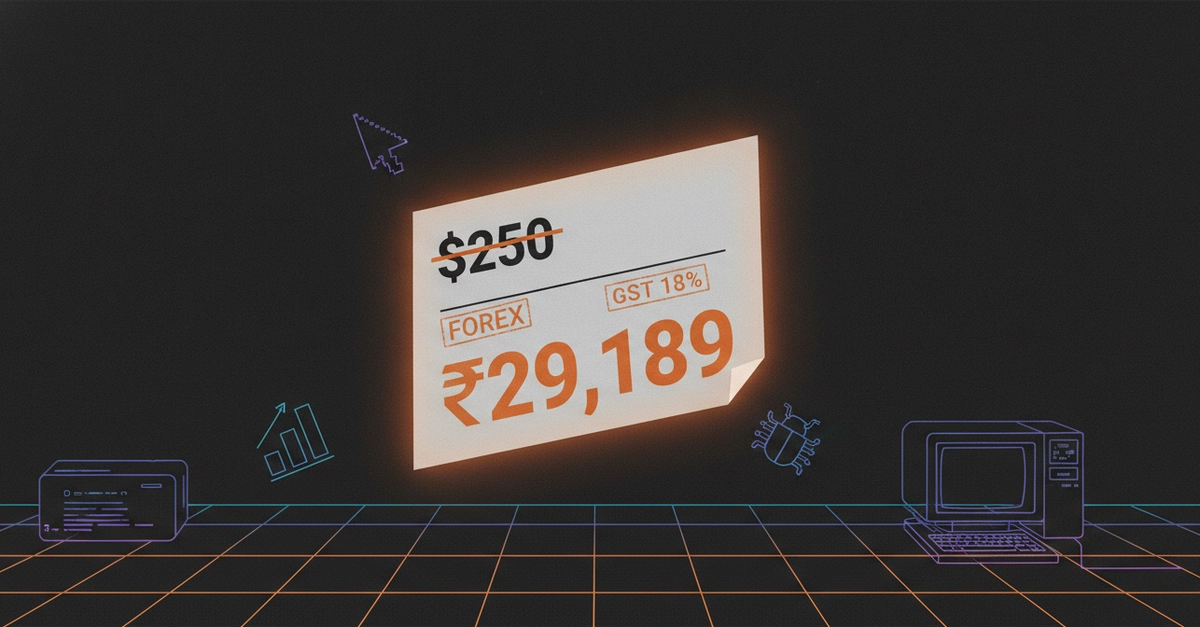
Indian developers paying for software-as-a-service (SaaS) tools billed in US dollars face a hidden cost that significantly inflates the advertised price. My own card statement showed a charge of ₹29,189 for a service priced at $250, a discrepancy of ₹5,289. This gap isn't a rounding error; it's a consistent pattern for any dollar-billed tool used by developers in India. The actual cost is a combination of two distinct charges, and critically, one of these can be reclaimed.
Understanding these costs is crucial for accurate budgeting and financial planning. The two primary culprits are the card's foreign exchange (forex) markup and the Goods and Services Tax (GST) applied to that markup, along with the GST on the base service itself. While the forex markup is an unavoidable charge levied by most banks on foreign currency transactions, the GST component, particularly on the service itself, is often recoverable.

Cost 1: The Card Forex Markup (Unrecoverable)
Every transaction made in a foreign currency using an Indian credit or debit card incurs a currency-conversion markup. This fee, typically ranging from 1.5% to 3.5% of the transaction value, is added by the card issuer. On top of this markup, an 18% GST is levied specifically on the markup amount itself. While this might seem small on a per-transaction basis, it accumulates rapidly. For instance, a standard credit card might charge 3.5% on every dollar spent, plus 18% GST on that 3.5%.
This markup is applied by the bank and is essentially the cost of converting your INR to USD at the time of the transaction. It's often invisible until you meticulously reconcile your bank statement against the original invoices. Unlike the GST on the service itself, this forex markup is a direct charge from the bank for facilitating the international transaction and cannot be recovered. Developers looking to minimize this cost should consider using cards that offer a zero-forex-markup policy, though these are less common and may come with their own set of conditions or annual fees.
Cost 2: GST on Services (Recoverable)
The second major component of the inflated cost is the Goods and Services Tax (GST) applied to the software service itself. When you purchase a service from a foreign vendor that does not have a physical presence in India, it is typically treated as an import of service. Under India's GST regime, the recipient of such services (the developer or their company) is liable to pay Integrated Goods and Services Tax (IGST) or Central GST (CGST) and State GST (SGST), usually at a rate of 18%.
This GST payment is where the recovery opportunity lies. If the developer is running a business or is registered as a freelancer with a GST identification number, this GST paid on imported services can be claimed as an Input Tax Credit (ITC). This means the amount paid as GST can be offset against future GST liabilities on services provided by the business. For businesses, this is a standard accounting procedure. However, many individual developers or small startups overlook this possibility, effectively paying the GST out of pocket.
How to Recover Your GST Payments
The process for recovering the GST paid on dollar-billed services involves a few key steps. First, ensure you have a valid GST registration if you are operating as a business or a registered freelancer. Second, obtain a proper invoice from the SaaS provider that clearly states the service provided, the amount billed in foreign currency, and ideally, the equivalent amount in Indian Rupees at the time of billing, along with your GSTIN if you've provided it.
When the transaction appears on your bank statement, you will see the final INR amount charged, which includes the base price, the forex markup, and the GST. To claim ITC, you need to pay the GST component on the base price of the service. For example, if a $100 service with a 3.5% forex markup results in a total charge of ₹8,765 (assuming an exchange rate of ₹80/$), the breakdown is roughly: $100 base = ₹8,000; 3.5% markup = ₹280; 18% GST on markup = ₹50.40; 18% GST on base price = ₹1,440. Total = ₹9,770.40. The recoverable amount is the ₹1,440 GST on the base price. You will need to self-assess and pay this GST, usually through a GSTR-3B filing, and then claim it as ITC. This requires careful record-keeping and understanding of GST regulations. Many SaaS providers are now offering options to bill directly in INR or provide GST-compliant invoices for Indian customers, which simplifies this process significantly.
The Impact on Developer Budgets
The combined effect of forex markups and GST can add a substantial percentage to the advertised cost of developer tools. For a $250/month tool, the actual cost could be over 20% higher than advertised, depending on the card's markup and the exchange rate. This is not a trivial amount, especially for developers managing multiple subscriptions or for startups operating on tight budgets.
For developers in India, it's essential to factor these hidden costs into their monthly expenses. Regularly reviewing bank statements against invoices, understanding the terms of your credit cards regarding foreign transactions, and investigating the possibility of using zero-forex-markup cards can help mitigate the unrecoverable costs. More importantly, proactively managing GST compliance by registering and claiming ITC can significantly reduce the net expense of essential developer tools. The initial effort to understand and implement GST recovery mechanisms can lead to substantial savings over time, ensuring that your technology stack's true cost is manageable and accounted for.