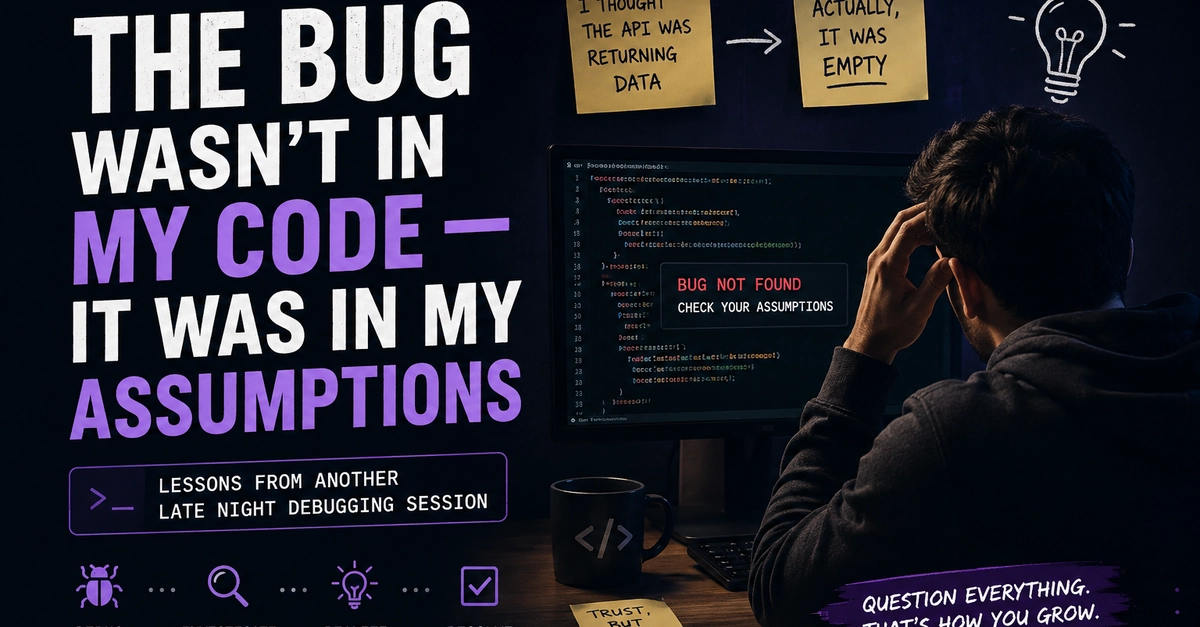
The Elusive Bug: When Code Looks Perfect
Developers frequently encounter a frustrating debugging scenario: the code appears flawless. Syntax is correct, logic seems sound, and after repeated review, no obvious errors surface. Yet, the application fails to perform as expected. This persistent problem, often leading to wasted hours, stems not from a flaw in the code itself, but from incorrect assumptions made by the developer about how the code, or its dependencies, will behave.
The core of the issue lies in the gap between a developer's mental model of a system and its actual operation. When an API call returns data, for instance, a developer might assume a certain structure or data type. If the API changes, or if an edge case produces an unexpected output, the application can break in ways that are hard to pinpoint because the code logic, in isolation, is perfectly valid.
Consider a common scenario: interacting with a third-party API. A developer might write code expecting a JSON response structured like this:
{
  "user": {
    "name": "Ash"
  }
}
This is a clear, expected structure. The code that processes this JSON is written with this specific format in mind. However, what happens if the API silently changes its response format? Perhaps the "user" object is now nested deeper, or a key is renamed, or an entire field is omitted under certain conditions. The original code, which perfectly handled the *assumed* structure, will now fail, throwing errors that seem to come from nowhere because the developer's assumption about the API's output was no longer valid.
This isn't a problem with the developer's coding skill, but with the implicit contract they've established with external systems. Debugging these issues requires not just looking at the code being written, but also rigorously validating the inputs and outputs of all dependencies, especially APIs.
Beyond QR Codes: The Account Sharing Dilemma
Another facet of assumption-driven bugs emerges in authentication and security. A common example involves QR code authentication, often used to simplify attendance tracking or login processes. Initially, dynamic QR codes seem to solve the problem of simple proxy attendance—preventing someone from just taking a screenshot of a static QR code and sharing it.
However, this solution introduces a new set of assumptions. The developer might assume that by securing the QR code, they have secured the authentication process. But this overlooks a more sophisticated form of account misuse: account sharing. The problem becomes acute when a student shares their legitimate account credentials with another person, who then attempts to log in or record attendance from a different location.
Imagine this scenario: Student A has a valid account and a trusted device. Student B, in a different location, obtains Student A's credentials. Student B then uses these credentials on their own phone to log in or record attendance. From the system's perspective, the credentials are valid, the user is authenticated, and the attendance request appears legitimate. The QR code, while dynamic, doesn't inherently prevent this if the account itself is compromised through sharing.

The assumption here is that validating credentials and a QR code is sufficient. The reality is that the account itself, or the device associated with it, can be the weak link. To combat this, developers must build systems that account for these deeper assumptions about user identity and device trust. This might involve implementing device-bound authentication, where the account is tied not just to credentials but also to the specific hardware it's accessed from. Any attempt to log in from an unrecognized device could trigger additional verification steps or outright deny access.
This layered approach acknowledges that a single point of validation, like a QR code or even a password, is often insufficient. It requires developers to anticipate how users might subvert the system, even when the code functions exactly as written. The debugging process, in these cases, is less about finding a syntax error and more about uncovering a flawed premise about user behavior or system integrity.
The Path Forward: Rigorous Validation and Layered Security
Addressing bugs rooted in faulty assumptions requires a shift in developer mindset. Instead of trusting that external systems or user behaviors will conform to expectations, developers must actively validate them.
For API interactions, this means:
- Implementing robust error handling for unexpected response formats, missing fields, or invalid data types.
- Utilizing schema validation tools to ensure that incoming data conforms to expected structures.
- Monitoring API changelogs and being prepared for backward-incompatible updates.
For authentication and security, it means:
- Moving beyond simple credential checks to incorporate device fingerprinting, multi-factor authentication (MFA), and session monitoring.
- Considering the threat of credential stuffing and account takeovers, not just simple proxying.
- Designing systems that assume malicious intent or, at minimum, unpredictable user behavior.
The lesson is clear: the most insidious bugs are often those that exploit the trust developers place in their own assumptions. By rigorously validating external inputs and anticipating potential misuse, developers can build more resilient and secure applications, moving beyond the frustration of chasing phantom errors.