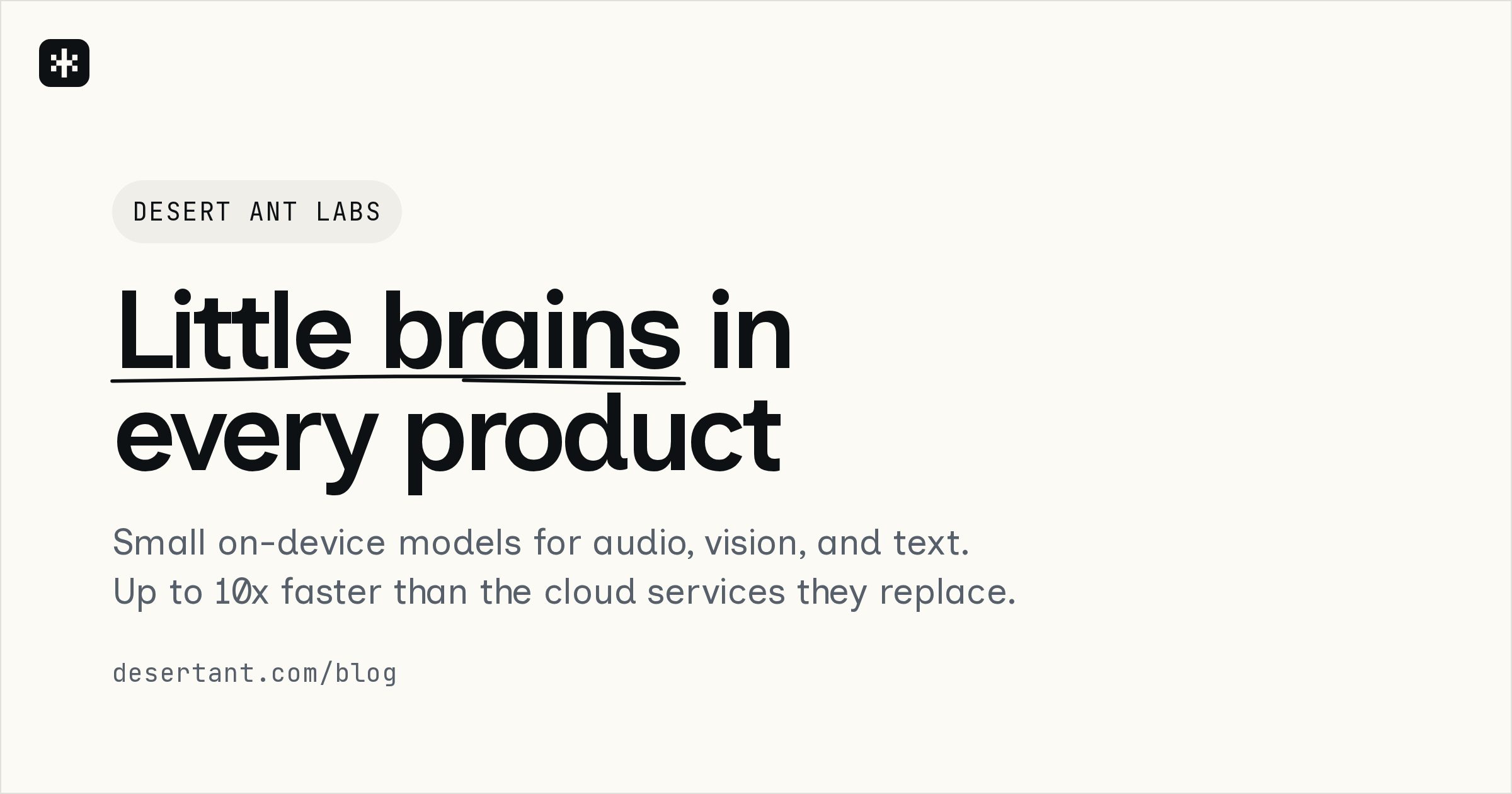
Introducing Desert Ant Labs: On-Device AI for Speed and Privacy
The race for more powerful and accessible AI is heating up, but often at the expense of user privacy and speed. Cloud-based AI services, while potent, introduce latency and send sensitive data across networks. This is precisely the gap Desert Ant Labs aims to fill. The company is launching a suite of AI models engineered for local execution, promising significant performance gains and enhanced data security by keeping computations on the user's device.
This approach sidesteps the traditional reliance on massive server farms and the associated costs and delays. For developers and users alike, the implications are substantial: AI applications that are not only faster but also more reliable in environments with intermittent connectivity, and critically, more private as raw data never leaves the user's control.
The core innovation lies in optimizing complex AI models to run efficiently on consumer-grade hardware. This involves sophisticated techniques in model compression, quantization, and specialized inference engines tailored for edge devices. The goal is to democratize advanced AI capabilities, making them available without the need for high-end cloud infrastructure or constant network access. This is particularly relevant for applications in areas like real-time data processing, on-device translation, personalized user experiences, and privacy-sensitive analytics.
Performance Benchmarks and Technical Approach
Desert Ant Labs emphasizes the speed advantage of their on-device models. By eliminating network round-trips and leveraging the processing power of local CPUs and GPUs, their models achieve inference times measured in milliseconds, a stark contrast to the seconds often experienced with cloud-based solutions. This level of responsiveness is crucial for interactive AI experiences, such as real-time object detection in augmented reality applications or instant voice command processing.
The technical underpinnings of Desert Ant Labs' offering involve several key areas. First, they employ aggressive model quantization, reducing the precision of model weights and activations from floating-point numbers to lower-bit integers. This significantly shrinks model size and speeds up computation with minimal loss in accuracy. Second, they have developed custom inference engines optimized for various hardware architectures, ensuring efficient execution across a range of devices, from smartphones to laptops.
Furthermore, the company focuses on efficient model architectures that are inherently less computationally intensive. This means designing neural networks that can achieve high performance with fewer parameters and operations, a specialized field that requires deep expertise in both AI research and systems engineering. The result is a library of models that are not only fast but also remarkably compact, allowing for easy integration into existing applications without substantial increases in app size or resource consumption.

Privacy and Security: The On-Device Advantage
Beyond performance, the privacy benefits of on-device AI are a major selling point. In an era of increasing data breaches and growing user concern over data privacy, keeping sensitive information on the user's device is paramount. Applications that process personal data, such as health metrics, financial information, or private communications, can do so without ever transmitting that data to external servers.
This inherent privacy by design reduces the attack surface for data exfiltration. It also simplifies compliance with data protection regulations like GDPR and CCPA, as developers do not need to manage the secure transfer and storage of user data in the cloud. For users, it means greater peace of mind, knowing their personal information remains under their direct control.
Desert Ant Labs is positioning its technology as a foundational layer for a new generation of AI-powered applications that are both intelligent and trustworthy. The ability to run sophisticated AI locally means that even in scenarios where network connectivity is unreliable or unavailable, these AI features remain functional. This is a critical consideration for applications in remote areas, during travel, or in situations where network infrastructure might be compromised.
Target Markets and Future Outlook
The immediate target markets for Desert Ant Labs include mobile application developers, embedded systems manufacturers, and developers of desktop applications requiring real-time AI capabilities. Areas such as enhanced mobile photography, personalized on-device assistants, advanced accessibility features, and offline productivity tools are prime candidates for this technology.
The company's focus on local, fast AI models aligns with broader industry trends towards edge computing and decentralized intelligence. As hardware capabilities on edge devices continue to improve, the feasibility and performance of running complex AI models locally will only increase. This suggests a strong growth trajectory for companies like Desert Ant Labs that are at the forefront of this shift.
The long-term vision likely involves expanding their model library to cover a wider range of AI tasks and developing tools that make it even easier for developers to integrate and customize these on-device models. The challenge will be to maintain a balance between model performance, size, and accuracy as AI capabilities continue to advance rapidly. However, by focusing on the fundamental advantages of local processing – speed, privacy, and offline capability – Desert Ant Labs is carving out a significant niche in the evolving AI landscape.