
DeepSeek-V4 Introduces Latent Reasoning for AI Models
DeepSeek AI has unveiled DeepSeek-V4, a significant architectural departure that embeds reasoning capabilities directly within the model's latent space. Unlike traditional approaches that rely on external modules or multi-step prompting to achieve complex reasoning, DeepSeek-V4 integrates this functionality into the core neural network structure. This fundamental shift aims to streamline inference, reduce computational overhead, and potentially unlock new levels of AI performance for demanding tasks.
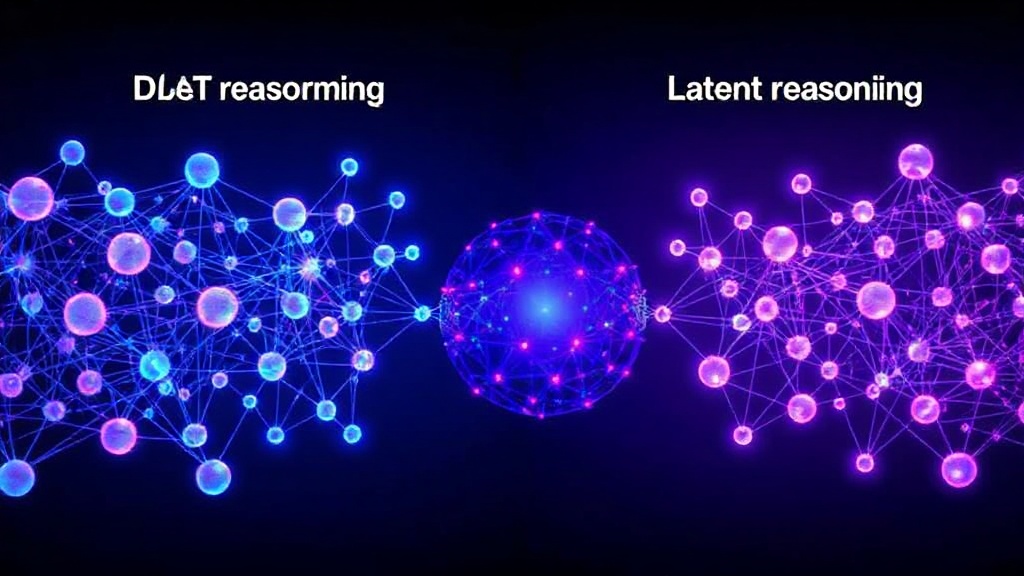
The core innovation lies in how DeepSeek-V4 processes and represents information. Instead of generating explicit, step-by-step logical chains that consume significant time and resources, the model learns to encode reasoning processes as transformations within its latent representations. Think of it less like a chain of command where each instruction is explicitly passed along, and more like a highly skilled strategist who internalizes the entire problem and its potential solutions, arriving at an optimal outcome through a more direct mental process.
This latent reasoning paradigm is designed to tackle complex problem-solving scenarios that have historically challenged large language models. These include intricate mathematical problems, multi-hop question answering, and code generation tasks that require deep understanding of context and logical dependencies. By moving 'thinking' into the latent space, DeepSeek-V4 seeks to make these complex operations more akin to the model's core forward pass, rather than an iterative, external computation.
Architectural Implications and Performance Gains
The implications for model architecture are substantial. Traditional LLMs often employ techniques like Chain-of-Thought (CoT) prompting, which requires the model to generate intermediate reasoning steps. While effective, CoT can be computationally expensive, especially at inference time, as it increases the number of tokens processed. DeepSeek-V4's latent reasoning approach bypasses this by learning to perform these reasoning steps implicitly within the model's internal states.
This internalisation of reasoning is expected to yield significant performance improvements. Inference times should decrease as the model does not need to generate and process lengthy intermediate thought processes. Furthermore, the model's ability to capture nuanced logical relationships and dependencies within its latent space could lead to more accurate and robust outputs for tasks requiring deep understanding. The developers claim that this approach allows the model to handle a wider range of complex queries with greater efficiency and less latency.
The training methodology for such a model is also critical. While details are sparse, it's understood that DeepSeek-V4 likely involves novel training objectives and data augmentation strategies that specifically reward the model for encoding reasoning abilities within its latent representations. This might involve self-supervised tasks that require the model to predict outcomes based on complex logical inputs, or reinforcement learning signals that guide the model to develop efficient internal reasoning pathways.
Potential Impact on AI Development and Application
The successful implementation of latent reasoning could have a broad impact across the AI landscape. For developers building AI-powered applications, this could mean deploying more sophisticated reasoning capabilities without the performance penalties associated with current methods. Applications requiring real-time decision-making, such as autonomous systems, advanced chatbots, or complex simulation environments, could see substantial benefits.
For researchers, DeepSeek-V4 opens up new avenues for exploring the internal workings of neural networks. Understanding how reasoning is encoded in latent spaces could provide deeper insights into the nature of intelligence itself and lead to more interpretable AI systems. The ability to directly manipulate and analyze these reasoning representations might offer a new frontier for AI interpretability research.
However, the shift also presents new challenges. The opacity of latent spaces means that debugging or understanding *why* a latent reasoning process failed could be more difficult than dissecting explicit CoT steps. The precise mechanisms by which these reasoning capabilities are encoded remain a complex area of study. What nobody has fully addressed yet is the scalability of this latent reasoning approach to even larger and more diverse problem sets, and whether it can generalize effectively to entirely novel reasoning paradigms.
Future Directions and Considerations
DeepSeek-V4's move to latent reasoning is a bold step, pushing the boundaries of what's possible with current neural network architectures. If successful and scalable, it could redefine how AI models approach complex cognitive tasks. The race is now on to see how other research labs and companies will respond to this architectural innovation. Will this become the new standard for efficient reasoning in AI, or is it a niche advancement for specific problem types?
The practical implications for developers are clear: keep an eye on benchmarks and real-world performance. If DeepSeek-V4 demonstrates a consistent advantage in speed and accuracy for reasoning-intensive tasks, it will necessitate a re-evaluation of current model deployment strategies. The potential for more powerful, yet leaner, AI systems is a compelling prospect for the entire tech industry.