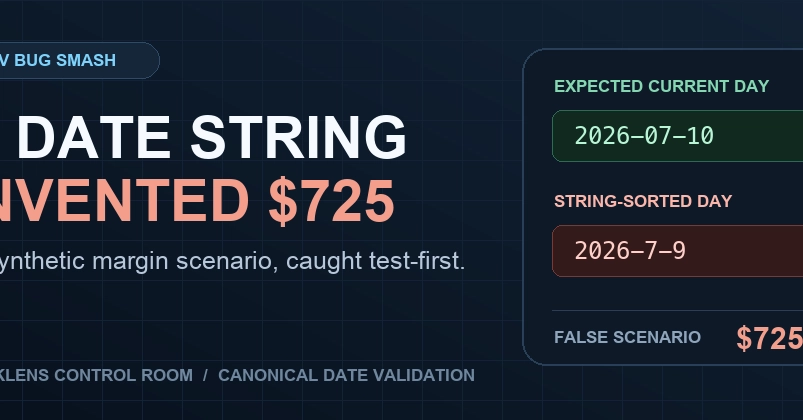
The Unseen Cost of a Simple Date String
In the world of financial applications, precision is paramount. Every dollar, every cent, and every calculation must be exact. Yet, a recent incident with LeakLens Control Room, a Python-based restaurant margin-review application, demonstrates how a seemingly innocuous date string can derail even deterministic systems, leading to a tangible financial misrepresentation. The application, designed to keep AI away from critical financial math by relying on Python for calculations, encountered a bug that cost it $725 in a synthetic margin report. This wasn't an AI hallucination; it was a fundamental misunderstanding of data context by the code itself.
LeakLens Control Room aims to provide a clear, human-decided review of financial data. It calculates every dollar using Python, with an optional AI narrative provider to explain evidence. The core principle is that all rates, thresholds, rankings, and dollar scenarios originate from deterministic code, ensuring predictability. However, the bug surfaced when the application let a raw CSV field dictate which operating day counted as "current." This decision, driven by a simple date string, led to a critical miscalculation in the synthetic margin report.
The incident highlights a broader challenge in data-driven applications: the gap between raw data input and its intended contextual meaning. While the code itself might execute flawlessly based on the input it receives, the interpretation of that input can introduce errors. In this case, the raw CSV field, likely intended for data logging or an internal identifier, was repurposed to define the "current operating day." This meant that the system was reporting margins based on a day that wasn't truly the current operational day, skewing the financial analysis.
LeakLens Control Room: Architecture and Intent
LeakLens Control Room is a live, functional application built with a standard stack: Python for the backend logic, SQLite for data storage, and HTML, CSS, and JavaScript for the user interface. The public demo utilizes synthetic data, a common practice to showcase functionality without exposing sensitive real-world information. The optional narrative provider, which defaults to a model like GPT-5.6, is intended to explain the evidence derived from the calculations, not to perform the calculations themselves. This separation of concerns is crucial: deterministic code handles the financial math, and AI assists in interpretation.
The project's overview, submitted for DEV's Summer Bug Smash challenge, emphasizes this design philosophy. The goal is to maintain human oversight in financial decisions, with AI serving as an assistant rather than an autonomous decision-maker. The deterministic nature of the Python calculations was intended to be the bedrock of trust. Every rate, threshold, ranking, and dollar scenario is supposed to be a direct output of the code, free from the probabilistic uncertainties of AI models. This incident, therefore, strikes at the heart of the application's core promise: reliable, deterministic financial reporting.
The specific bug involved a date string that was not properly validated or interpreted for its contextual meaning within the application's workflow. Instead of a date being parsed and used for temporal comparisons or reporting periods, it was treated as a definitive marker for the "current" operating day. This is akin to using a timestamp from a log file to determine the current date of a financial report, rather than using a system clock or a specifically designated configuration parameter. The consequence was a synthetic margin report that presented a $725 discrepancy, misrepresenting the business's financial health for that specific period.
The Root Cause: Data Context and Deterministic Flaws
The core of the problem lies in how the application handled the date string from the raw CSV field. While the Python code executed its logic correctly based on the input, the input itself was contextually flawed. Consider it like this: if you ask a meticulous accountant to sum up a list of numbers, they will do it perfectly. But if you accidentally include a phone number in that list and tell them it's a quantity, they will sum that phone number too, leading to a nonsensical total. The accountant (the Python code) performed their task correctly; the error was in the data provided and its interpretation.
The "So What?" Perspective
Developers must implement robust data validation and context-aware parsing for all inputs, especially date strings and identifiers from external sources like CSVs. Ensure that fields intended for specific purposes (e.g., operational dates) are not conflated with other data types (e.g., raw log timestamps). Implement strict type checking and range validation for critical financial data points.
While not a direct security vulnerability in the traditional sense, this bug highlights the risk of data integrity issues. Input validation failures can lead to misrepresentations of financial status, potentially impacting business decisions. Secure coding practices should include comprehensive data sanitization and context-aware parsing to prevent such logical errors.
This incident underscores the need for rigorous testing of all data pipelines, not just AI components. Even deterministic systems can fail due to subtle data interpretation errors. Founders should ensure their financial reporting tools have multi-layered validation checks and clear audit trails for how data is interpreted and used in calculations.
For creators building data-driven applications, this serves as a reminder that user input and data from external sources require careful handling. Even simple fields can have profound impacts if their context is misunderstood by the application logic. Prioritize clear data schemas and validation rules to maintain the integrity of your application's outputs.
This incident highlights the importance of data lineage and context in machine learning and data analysis. Raw data, even from deterministic sources, must be understood in its operational context. Teams should establish clear metadata for datasets and implement validation layers that check for contextual appropriateness, not just format correctness.
Sources synthesised
- 18% Match