%22%20%2F%3E%0A%20%20%3C%2Fsvg%3E)
The Limits of Traditional Object-Oriented Programming
For decades, object-oriented programming (OOP) has dominated software development. Its tenets of encapsulation, inheritance, and polymorphism offer powerful abstractions for managing complexity. However, this focus on objects, with their scattered data and methods, often clashes with the fundamental way modern hardware operates. CPUs are designed for sequential data access and caching. When an object's data is spread across memory, fetching it requires numerous cache misses and memory fetches, creating a performance bottleneck. This is particularly acute in performance-critical applications like game engines, high-frequency trading systems, and scientific simulations, where every nanosecond counts.
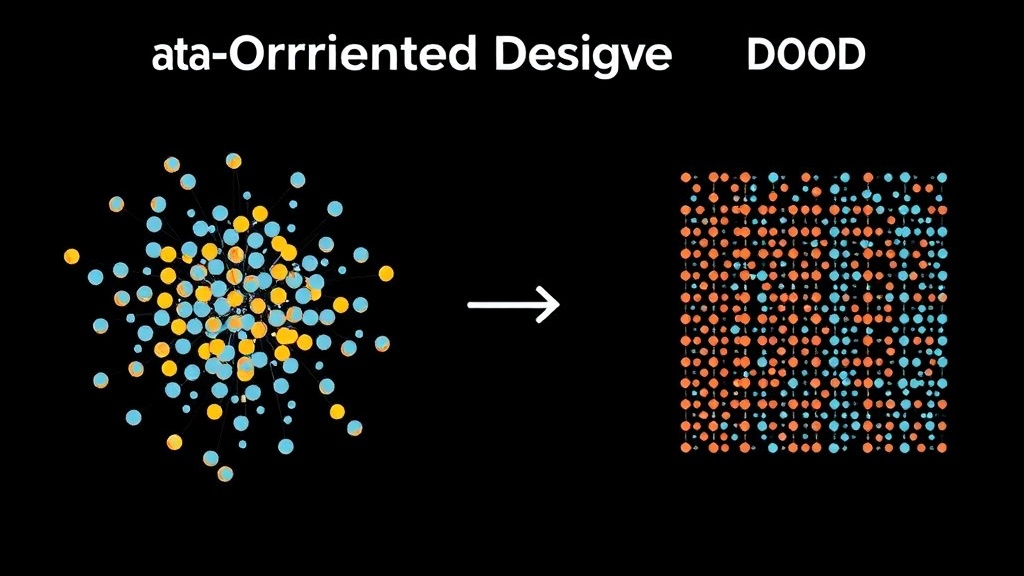
Data-Oriented Design (DOD) offers a potent alternative by flipping the abstraction. Instead of thinking about objects and their behaviors, DOD prioritizes the data itself and how it is laid out in memory. The core idea is that the arrangement of data has a more significant impact on performance than the structure of the code. By optimizing data structures for cache efficiency and contiguous memory access, DOD can yield dramatic performance improvements, often orders of magnitude, compared to traditional OOP approaches.
Core Principles of Data-Oriented Design
DOD is not a strict paradigm with rigid rules like OOP, but rather a set of principles and practices. At its heart are three fundamental concepts:
1. Data Layout Matters Most
This is the cornerstone of DOD. Instead of grouping data by object identity, data is grouped by type and access patterns. This means that data that is frequently accessed together should be stored contiguously in memory. Consider a game where you have entities with various components like position, velocity, and health. In an OOP approach, each entity might be an object with member variables for each of these. In DOD, you would likely have separate arrays or contiguous blocks of memory for all positions, all velocities, and all health values. This arrangement ensures that when you iterate through, say, all entities' positions, the CPU can load a large chunk of position data into its cache, leading to very fast access.
2. Encapsulate Behavior, Not Data
While OOP encapsulates data within objects, DOD encapsulates behavior. Functions or systems operate on specific chunks of data. For example, a physics system would operate on arrays of position and velocity data. This separation of data and behavior makes it easier to reason about and optimize code. When a system needs to perform an operation, it can fetch all the necessary data efficiently because it's laid out contiguously. This also promotes parallelism, as independent systems operating on different data sets can run concurrently without interfering with each other.
3. Optimize for the Machine
DOD is intrinsically linked to understanding hardware architecture, particularly CPU caches. Modern CPUs have multiple levels of cache (L1, L2, L3) that store frequently accessed data closer to the processing cores. Cache misses, where the required data is not in the cache and must be fetched from slower main memory, are a primary performance killer. DOD aims to maximize cache hits by ensuring that data accessed sequentially is also stored sequentially. This principle is often referred to as spatial locality (accessing nearby memory locations) and temporal locality (reusing recently accessed data).
When to Apply Data-Oriented Design
DOD is not a universal replacement for OOP. It shines in scenarios where raw performance and efficient memory access are paramount. Common domains include:
- Game Development: Engines often manage thousands or millions of entities with similar properties (e.g., all characters' positions, all bullets' velocities). DOD allows for extremely fast iteration and updates.
- High-Performance Computing (HPC): Scientific simulations, financial modeling, and complex data analysis benefit immensely from optimized data access.
- Real-time Systems: Applications requiring predictable, low-latency responses, such as embedded systems or real-time operating systems.
- Data Processing Pipelines: Systems that perform batch processing or stream analysis on large datasets.
For applications where development speed and maintainability through high-level abstractions are the primary concerns, OOP might still be the better choice. However, even in such systems, identifying performance-critical hot spots and applying DOD principles to those specific modules can yield significant gains.
Challenges and Considerations
Adopting DOD requires a shift in mindset. Developers must think about data structures and memory layout proactively. Debugging can also be more challenging, as the state of the program is spread across multiple arrays rather than contained within individual objects. Furthermore, DOD can sometimes lead to more verbose code, as the logic for handling data might be spread across different systems rather than centralized within an object. The abstraction level is lower, requiring a deeper understanding of how the underlying hardware functions.
Despite these challenges, the performance benefits of DOD are undeniable. For developers pushing the boundaries of what's computationally possible, understanding and applying Data-Oriented Design is becoming increasingly essential.