The Illusion of Data Loading as a Finish Line
Many data practitioners, especially those early in their careers, often view the process of loading data into a data warehouse as the culmination of their efforts. The ETL (Extract, Transform, Load) or ELT pipeline is built, data flows in, and the job feels done. This perspective, however, is a common misconception that can lead to significant downstream inefficiencies and missed opportunities. The reality is that raw, loaded data is rarely, if ever, immediately suitable for meaningful analysis. It’s akin to delivering a pile of bricks to a construction site and declaring the house built. The real work – the shaping, fitting, and assembling – has barely begun.
This realization often hits hardest when teams start building their first sophisticated data models or when business stakeholders begin asking for specific, nuanced insights that raw data simply cannot provide without further preparation. The concept of “analysis-ready data” is not just a buzzword; it represents a critical shift in thinking from data ingestion to data utility. It means data has been cleaned, standardized, validated, and structured in a way that makes it directly consumable by analysts, data scientists, and business intelligence tools without requiring them to perform repetitive, low-level data wrangling.
The journey from raw data dump to analysis-ready state involves a series of crucial transformations that go far beyond simple loading. This includes data cleaning (handling missing values, correcting errors), standardization (ensuring consistent formats for dates, units, categories), validation (checking for data integrity and adherence to business rules), and enrichment (combining data from different sources, adding calculated fields). Without these steps, the data warehouse can quickly become a “data swamp” – a repository of data that is difficult to access, understand, and trust, ultimately hindering data-driven decision-making.

Introducing dbt: Orchestrating the Transformation
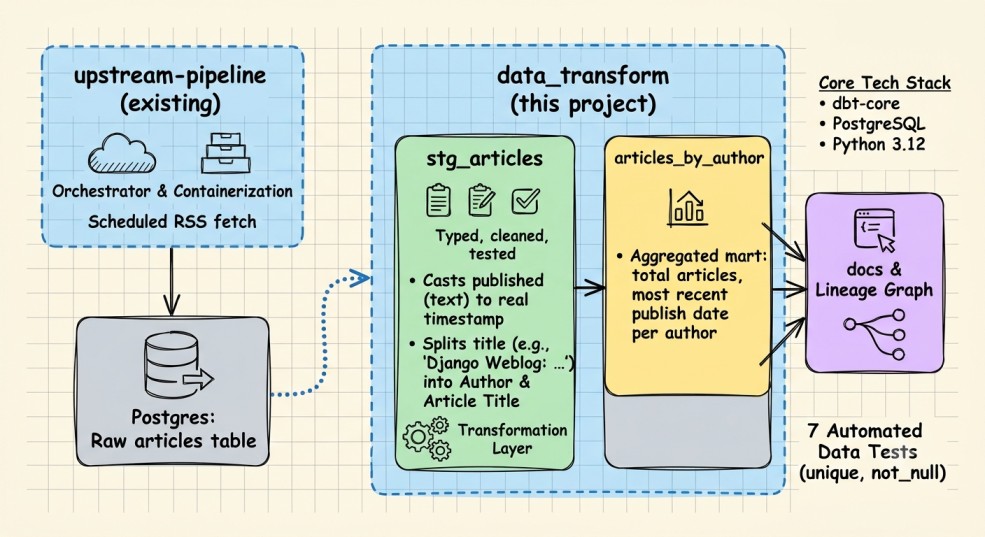
Tools like dbt (data build tool) have emerged to address this challenge head-on. dbt operates on the principle that data transformation should be a first-class citizen in the data workflow, not an afterthought. Unlike traditional ETL tools that often bundle extraction, transformation, and loading into a single, sometimes monolithic, process, dbt focuses exclusively on the “T” in ELT, assuming data has already been loaded into a cloud data warehouse. This separation of concerns allows teams to leverage the power of their data warehouse for transformations, making the process more scalable and performant.
dbt introduces software engineering best practices to the data modeling process. This means treating your SQL `SELECT` statements as code. This code can be version-controlled, tested, and documented. When you write a dbt model, you’re essentially defining a SQL query that transforms your raw data into a more refined, analysis-ready dataset. dbt then compiles and runs these queries against your data warehouse, creating tables or views that represent these transformed datasets. These can be thought of as layers of data, starting from raw staging tables, moving to intermediate transformations, and finally culminating in presentation-ready dimensional models or fact tables.
The core of dbt’s philosophy is the concept of materialization. When you define a dbt model, you specify how it should be materialized in your data warehouse: as a table, a view, or an incremental table. Tables are physical, stored data structures. Views are logical, essentially saved queries. Incremental tables are particularly powerful, allowing you to update only the new or changed data since the last run, rather than rebuilding the entire table. This drastically speeds up data refresh cycles for large datasets.
What “Analysis-Ready” Data Truly Means
Analysis-ready data is more than just clean; it’s structured for discoverability, understandability, and usability. It implies a high degree of data quality and governance. For analysts, this means they can connect to a model, trust the data it presents, and immediately start querying for insights without needing to understand the intricate details of the raw source systems or the specific cleaning steps applied.
Consider a common scenario: sales data. Raw data might contain customer IDs that are inconsistently formatted, product SKUs that are misspelled, and dates that are stored as strings. An analysis-ready model would standardize customer IDs to a consistent format, map SKUs to canonical product names, and ensure all dates are proper date types. It might also include pre-calculated fields like customer lifetime value or product category hierarchies. This preparation allows an analyst to write a query like `SELECT customer_name, SUM(order_total) FROM sales_models.customer_orders WHERE order_date BETWEEN '2023-01-01' AND '2023-12-31' GROUP BY customer_name` with confidence, rather than spending hours cleaning and joining disparate tables.
The process of achieving analysis-ready data also inherently involves documentation and testing. dbt encourages writing documentation for each model, explaining its purpose, its columns, and any relevant business logic. Furthermore, data quality tests can be integrated directly into the dbt workflow. These tests can check for uniqueness, referential integrity, accepted values, and custom business logic. For example, a test could ensure that no new customer orders are recorded with a total value less than zero. When these tests fail, the dbt run will halt, preventing bad data from propagating further into the analytics layer and alerting the team to an issue that needs immediate attention.
The Shift in Mindset and Workflow
Adopting a philosophy where data loading is the starting point requires a fundamental shift in how data teams operate. It moves the focus from simply getting data *into* the warehouse to ensuring data is *usable and trustworthy* once it’s there. This means investing time and resources into the transformation layer, treating it with the same importance as data ingestion or visualization.
For developers, this means learning tools like dbt, understanding SQL modeling best practices, and embracing concepts like data lineage and testing. It’s about building robust, maintainable, and transparent data pipelines. For analysts and data scientists, it means understanding the structure of the analysis-ready models, leveraging the provided documentation and tests, and providing feedback to the data engineering team on how to further improve the data products. This collaborative loop is essential for ensuring the data infrastructure truly meets business needs.
The benefits of this approach are substantial. Reduced time-to-insight for business users, increased trust in data, improved data quality, and greater efficiency for the data team. When data is analysis-ready, the focus shifts from data wrangling to actual analysis and insight generation. It transforms the data warehouse from a passive repository into an active engine for business intelligence and data-driven strategy. The initial effort to build and maintain a robust transformation layer pays dividends by unlocking the true potential of an organization’s data assets, moving beyond mere data storage to genuine data value creation.