
The Gap Between Policy and Practice
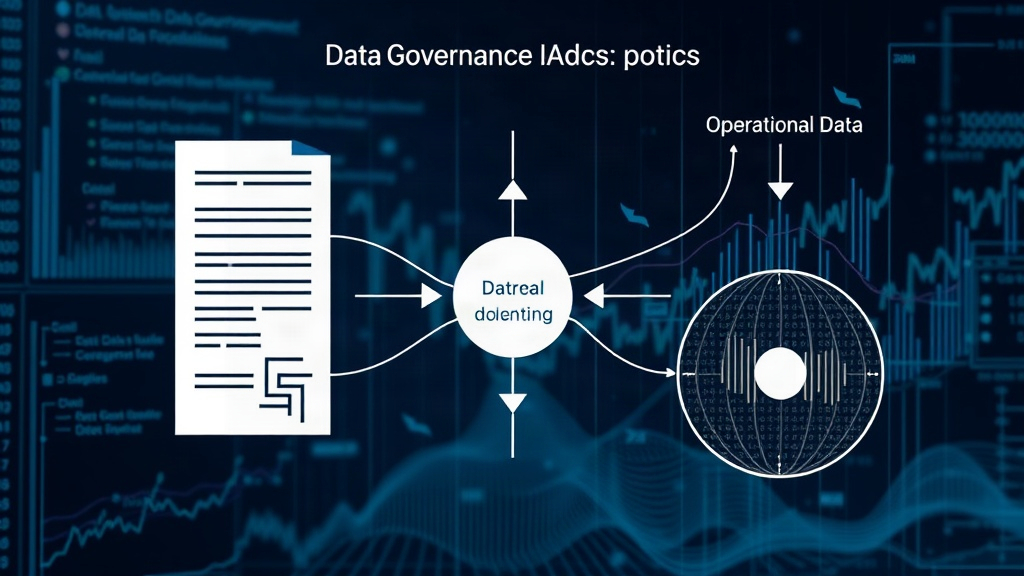
Organizations often invest significant effort in crafting data governance policies and frameworks. These documents lay out the ideal state: clear ownership of data assets, defined access controls, and standards for data quality. However, moving from the polished PDF to practical, everyday execution reveals a significant chasm. The ease with which a data governance policy can be written belies the immense difficulty in ensuring its consistent application across disparate teams and complex systems. This disconnect is where the true challenges of data governance emerge, impacting everything from routine reporting to advanced AI initiatives.
The core of the problem lies in translating abstract policy into concrete, actionable processes that resonate with operational teams. While a policy might state that "all customer data must be owned by the CRM team," the reality is often that sales, marketing, and support teams all interact with and contribute to customer data, creating fragmented ownership and understanding. This ambiguity breeds uncertainty. When teams require data for critical functions like analytics, AI model training, or business intelligence, they often face a gamble. They must implicitly trust that the data they extract is accurate, consistent, and properly curated, or they embark on time-consuming data validation efforts. This lack of inherent trust erodes efficiency and can lead to flawed decision-making based on unreliable data.
Ownership and Access: The Fuzzy Front Lines
One of the most frequently cited hurdles in data governance is establishing and enforcing clear data ownership. While formal roles might be assigned on paper, the practical reality often sees data being managed by multiple teams with overlapping responsibilities. This diffusion of ownership means that no single entity feels fully accountable for the data's quality, security, or lifecycle. Consequently, when issues arise – be it a data breach, a quality anomaly, or a request for access – it becomes a protracted process to identify the correct point of contact and responsibility.
Access control, intrinsically linked to ownership, presents a similar challenge. Policies may dictate who should and should not have access to sensitive datasets, but implementing these controls uniformly across all systems and applications is a monumental task. Legacy systems, shadow IT, and the sheer volume of data can create blind spots where unauthorized access can occur or legitimate access is hindered by overly complex or outdated processes. The result is often a compromise: either data becomes too freely accessible, increasing risk, or it becomes too difficult to access, stifling innovation and operational efficiency.
Data Quality and Consistency: The Unseen Costs
Beyond ownership and access, the perceived and actual quality of data is a critical battleground for governance. For reporting and analytics, inconsistent data formats, missing values, or conflicting definitions can render reports unreliable. Imagine trying to aggregate sales figures across different regions where "sales" are defined and recorded differently. This forces analysts to spend an inordinate amount of time on data cleansing and reconciliation, time that could otherwise be spent on generating insights. The confidence in the data diminishes, leading to a reliance on manual checks and a general skepticism towards any data-driven output.
For AI and machine learning initiatives, the stakes are even higher. Models trained on inaccurate, biased, or inconsistent data will inevitably perform poorly and may even produce harmful outcomes. The promise of AI is often hampered by the foundational reality of data quality. Teams developing AI models are frequently forced to build their own data pipelines and validation layers, essentially duplicating efforts that should ideally be standardized and managed by a robust data governance program. This not only increases development time and cost but also introduces a significant risk of introducing subtle biases that are difficult to detect and correct later.
The Human Element: Culture and Enforcement
Ultimately, the success or failure of data governance hinges on the human element and organizational culture. Policies are only effective if they are understood, adopted, and enforced by the people within the organization. A common observation is that while creating the policy is relatively straightforward, instilling a data-aware culture where adherence becomes second nature is the true challenge. This requires continuous training, clear communication, and a commitment from leadership to prioritize data governance not as a compliance burden, but as a strategic imperative.
Enforcement is particularly thorny. Without clear mechanisms for monitoring compliance and consequences for non-adherence, even the best-laid policies can become mere suggestions. This often leads to a situation where teams revert to old habits, especially under pressure to deliver results quickly. The question then becomes: how do organizations bridge this gap? It requires a multi-faceted approach that combines technological solutions for automation and monitoring with cultural initiatives that foster accountability and data literacy. Without this, data governance remains a well-intentioned but ultimately underperforming initiative, a set of rules that exist more in theory than in practice.