D-Wave's Quantum Ambitions Expand Beyond Annealing
D-Wave Systems, a company long synonymous with quantum annealing, is making a significant strategic pivot. While its specialized quantum annealers have found niches in optimization problems, the company has now publicly demonstrated its first gate-based quantum computing system, codenamed Advantage2. This move signals D-Wave's intent to compete across a broader spectrum of quantum computing paradigms, challenging the notion that a single approach will dominate the field.
For years, D-Wave has been a leader in building superconducting quantum processors designed for annealing. These systems are particularly adept at finding the lowest energy state of a complex system, a task that directly maps to solving optimization problems. Think of it less like a general-purpose calculator and more like a highly specialized tool designed to find the absolute best solution among an astronomically large number of possibilities, much like finding the single best route for a delivery truck visiting 50 cities.
However, the broader quantum computing landscape has largely focused on gate-based universal quantum computers. These systems operate using quantum logic gates, similar to classical bits, and are theoretically capable of running any quantum algorithm. This has led to a perception that annealing-centric machines might be a dead end for many advanced quantum applications. D-Wave's introduction of Advantage2, featuring its novel "dual-rail" qubits, directly addresses this perception and aims to bridge the gap.
Introducing Dual-Rail Qubits and the Advantage2 System
The core innovation in D-Wave's new gate-based system lies in its "dual-rail" qubit architecture. Unlike traditional superconducting qubits that often rely on a single oscillating element, D-Wave's dual-rail qubits use two coupled oscillators. This design, according to D-Wave researchers, offers several key advantages:
- Improved Coherence Times: By effectively "sharing" the quantum state between two oscillators, the system can achieve longer coherence times. This means the delicate quantum states are less likely to collapse due to environmental noise, a critical factor for performing complex computations.
- Reduced Crosstalk: The dual-rail design inherently mitigates unwanted interactions (crosstalk) between adjacent qubits. This is a persistent challenge in scaling up quantum processors, as more qubits lead to more potential interference.
- Enhanced Control and Readout: The architecture allows for more precise control over individual qubits and more reliable readout of their states, both essential for accurate computation.
The Advantage2 system, as tested, reportedly features 1,200 logical qubits. While the exact number of physical qubits is not fully detailed, the focus is on the logical qubit count, which represents the stable, error-corrected units available for computation. This is a substantial leap, positioning D-Wave to tackle problems that were previously out of reach for their annealing-only systems.
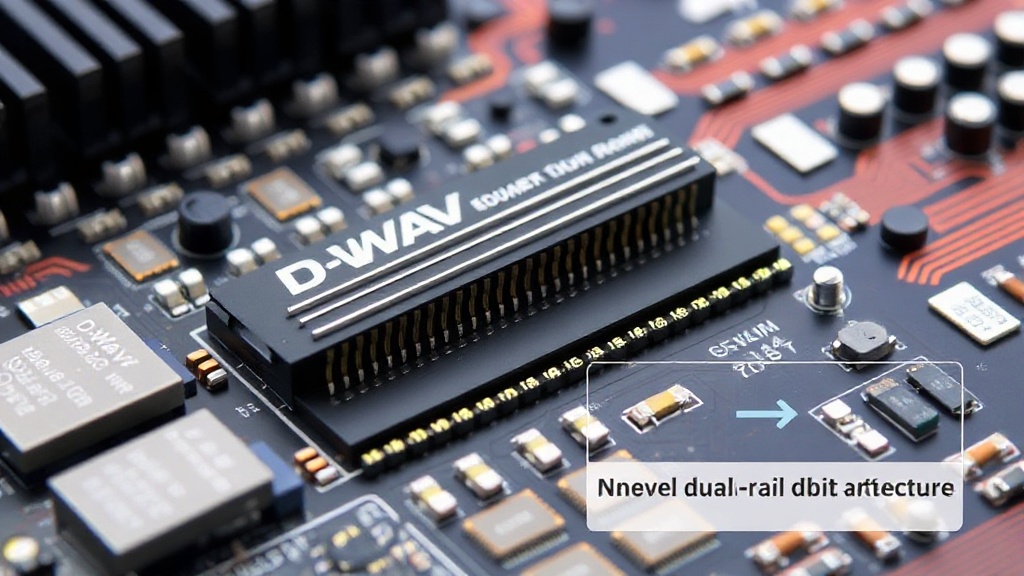
The company has been testing entanglement on these dual-rail qubits, a fundamental quantum phenomenon where particles become linked and share the same fate, regardless of distance. Successful and robust entanglement is a prerequisite for running many advanced quantum algorithms, including those used in areas like quantum simulation, drug discovery, and materials science. D-Wave's ability to demonstrate this on their new architecture is a strong indicator of its potential.
The Broader Quantum Computing Landscape and D-Wave's Position
D-Wave's move is significant because it challenges the narrative that the quantum computing race is a zero-sum game between different qubit modalities or architectural approaches. While IBM, Google, and others continue to push the boundaries of superconducting transmon qubits for universal gate-based computing, and companies like IonQ and Quantinuum focus on trapped ions, D-Wave is carving out a unique path. They are not abandoning their annealing heritage but integrating it with gate-based capabilities, potentially offering a hybrid approach that leverages the strengths of both.
The quantum computing industry is still in its nascent stages. We are far from having fault-tolerant, large-scale quantum computers that can break current encryption or revolutionize medicine overnight. Instead, we are seeing a period of rapid experimentation and specialization. Companies are discovering that different quantum architectures are better suited for different types of problems. D-Wave's dual-rail system could prove to be a powerful platform for certain classes of scientific research and complex simulations that require both high qubit counts and robust quantum phenomena like entanglement.
The surprising detail here is not just that D-Wave is building gate-based hardware, but that they are doing so with a fundamentally different qubit design. This suggests that the innovation in quantum hardware is far from over, and that novel approaches to qubit design could unlock significant performance gains and new application areas. It also implies that the path to useful quantum computing might involve a diversity of hardware, rather than a single dominant technology.
What Lies Ahead for D-Wave and the Quantum Race?
The successful demonstration of Advantage2 and its dual-rail qubits is a critical step for D-Wave. It validates their research and development efforts and positions them as a more versatile player in the quantum computing ecosystem. The company's next challenge will be to scale this system further, demonstrate its practical utility for real-world problems beyond annealing, and onboard developers and researchers to its new platform. The availability of such systems, even in limited access, is crucial for the entire field to mature.
If you are a researcher or a developer looking to explore quantum computing beyond optimization, D-Wave's new offering warrants your attention. The dual-rail architecture offers a potentially more stable and controllable platform for exploring complex quantum algorithms. As the field progresses, the ability to run both annealing and gate-based computations on a single vendor's hardware could become a significant advantage, offering flexibility and a more direct path to leveraging quantum advantages for specific, challenging problems.
What nobody has fully addressed yet is the long-term roadmap for hybrid annealing-gate-based systems. Will D-Wave's approach become a standard, or will it remain a specialized niche? The success of Advantage2 will be a key indicator in answering this question, potentially reshaping how we think about the future of quantum hardware development.