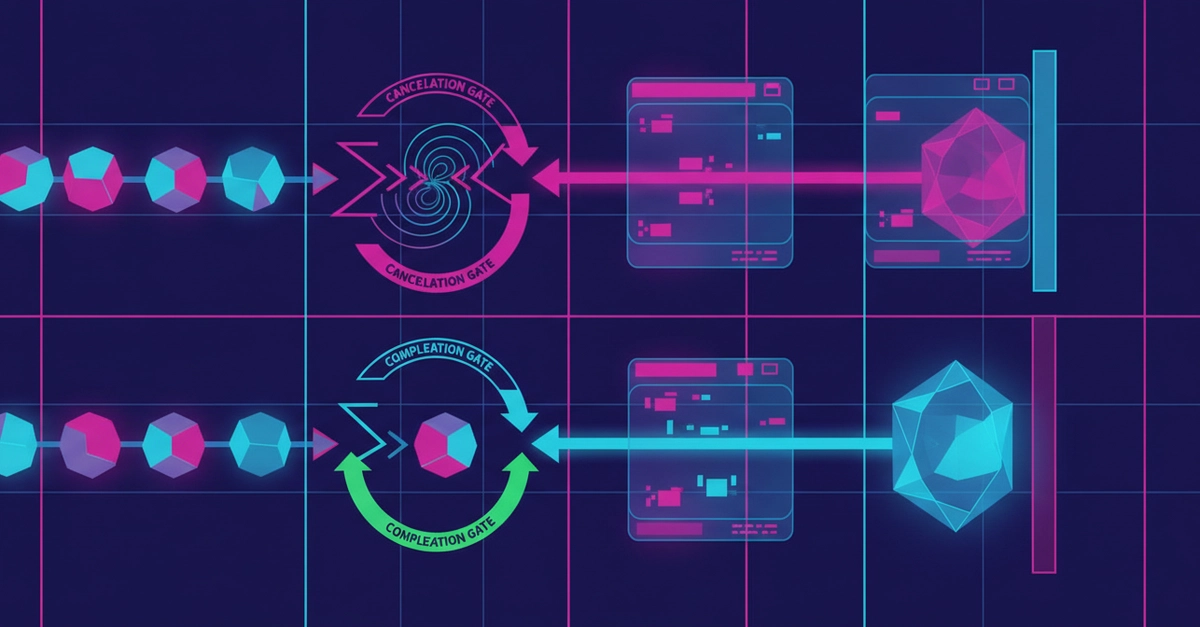
The Problem with Token-by-Token AI Testing
Testing streaming AI interfaces presents a unique challenge. Traditional testing methods often break when faced with the dynamic, token-by-token nature of AI responses. A test that asserts an exact sequence of tokens, like building a sentence one word at a time, becomes immediately brittle. The moment the AI's output changes even slightly – perhaps due to buffering, network latency, provider behavior, or a library update – the test fails. This isn't a failure of the AI's core functionality, but a symptom of how the data is transported.
These chunk boundaries are transport details, not functional guarantees. They can fluctuate without altering the user's perceived outcome. For instance, the AI might still produce the same coherent sentence, but the intermediate tokens arrive in a different order or grouping. Relying on this precise token sequence for tests is akin to testing a web page by asserting the exact order of HTTP packets. It’s testing the plumbing, not the plumbing’s purpose.
Focus on the AI's Contractual Responsibilities
Instead of chasing individual tokens, tests should focus on the deterministic contracts the AI's user interface must uphold. These contracts represent the predictable behaviors and states that users rely on, irrespective of the underlying streaming mechanics. Key responsibilities include:
- Showing Progress: The UI should clearly indicate that the AI is processing and generating a response. This could be a typing indicator, a loading spinner, or a gradual reveal of content.
- Distinguishing Content Types: The interface must differentiate between standard text output, tool calls (e.g., function executions), or other structured data.
- Ignoring Stale Events: If the user cancels a request or a new request is initiated, the UI must correctly discard or ignore any subsequent tokens from the older, now-irrelevant stream.
- Supporting Cancellation: Users must be able to halt the AI generation process mid-stream, and the UI should reflect this cancellation gracefully.
- Ending in a Coherent State: Regardless of how the stream ends (completion, cancellation, error), the UI must present a stable, understandable final state.
By testing these predictable behaviors, tests become robust against changes in streaming implementation while still ensuring the user experience is correct and reliable.
Modeling the Stream as Events
To implement this contract-based testing, the first step is to treat the incoming byte stream not as a raw, undocumented callback collection, but as a normalized stream of discrete events. This normalization layer sits between the raw transport and the UI component, abstracting away the messy details of chunking and timing.
A practical approach involves defining a clear event type that encapsulates meaningful units of information. For example, an AgentEvent could represent different stages or types of output. This event could include properties like type (e.g., 'text', 'tool_code', 'tool_result', 'error'), content (the actual data), and potentially a finished flag to signal the end of a logical response segment.
Consider this TypeScript type definition:
type AgentEvent {
  type: 'text' | 'tool_code' | 'tool_result' | 'error';
  content: string;
  finished?: boolean;
}
This event-driven model allows the UI component to subscribe to these normalized events rather than directly handling the raw stream. The testing framework can then mock or intercept these AgentEvent objects, providing predictable sequences that validate the UI's response to different types of AI output and state changes.
Implementing with Cypress
Cypress, a popular end-to-end testing framework, can be leveraged to test these event-driven AI interfaces. The core idea is to intercept the network requests or WebSocket messages that deliver the AI stream and substitute them with a controlled sequence of mocked AgentEvent objects.
Instead of asserting that the DOM contains specific tokens in order, Cypress commands would interact with the UI based on the arrival of these mocked events. For example:
- Testing text generation: Assert that when an
AgentEventof type 'text' arrives, the UI updates with the provided content. After a sequence of 'text' events, assert that the final state is coherent. - Testing tool calls: Verify that when an
AgentEventof type 'tool_code' is received, the UI correctly displays or executes the code, perhaps by asserting the presence of a specific UI element or by observing a subsequent state change. - Testing cancellation: Simulate a user clicking a cancel button. Then, send a 'cancel' signal or simply stop sending further mocked events. Assert that the UI stops updating and enters a clean, cancelled state.
- Testing error handling: Mock an
AgentEventof type 'error' and assert that the UI displays an appropriate error message without crashing or entering an inconsistent state.
This approach allows tests to be robust. A change in how the AI service chunks its output won't break the test, as long as the normalized AgentEvents are still produced correctly. The test remains focused on whether the UI correctly interprets and displays these events according to its contract.
The Unanswered Question: Scalability of Mocking
While this event-driven approach significantly improves test stability, a potential challenge emerges with highly complex or long-running AI interactions. The manual creation and orchestration of mock event sequences for every conceivable scenario can become tedious. What remains to be fully explored is how to scale this mocking strategy. Could we develop tools or patterns that allow for more dynamic generation of mock event streams, perhaps by capturing real-world interactions and replaying them as normalized events, or by using a simpler AI model to generate mock responses that adhere to specific structural rules?
Conclusion: A More Resilient Testing Paradigm
Testing streaming AI interfaces requires a shift in perspective. By moving away from fragile token-by-token assertions and towards testing the UI's adherence to its defined contract through a normalized event model, developers can build more stable, reliable, and maintainable test suites. This paradigm ensures that tests validate the user experience and the system's predictable behavior, rather than the ephemeral details of data transport.