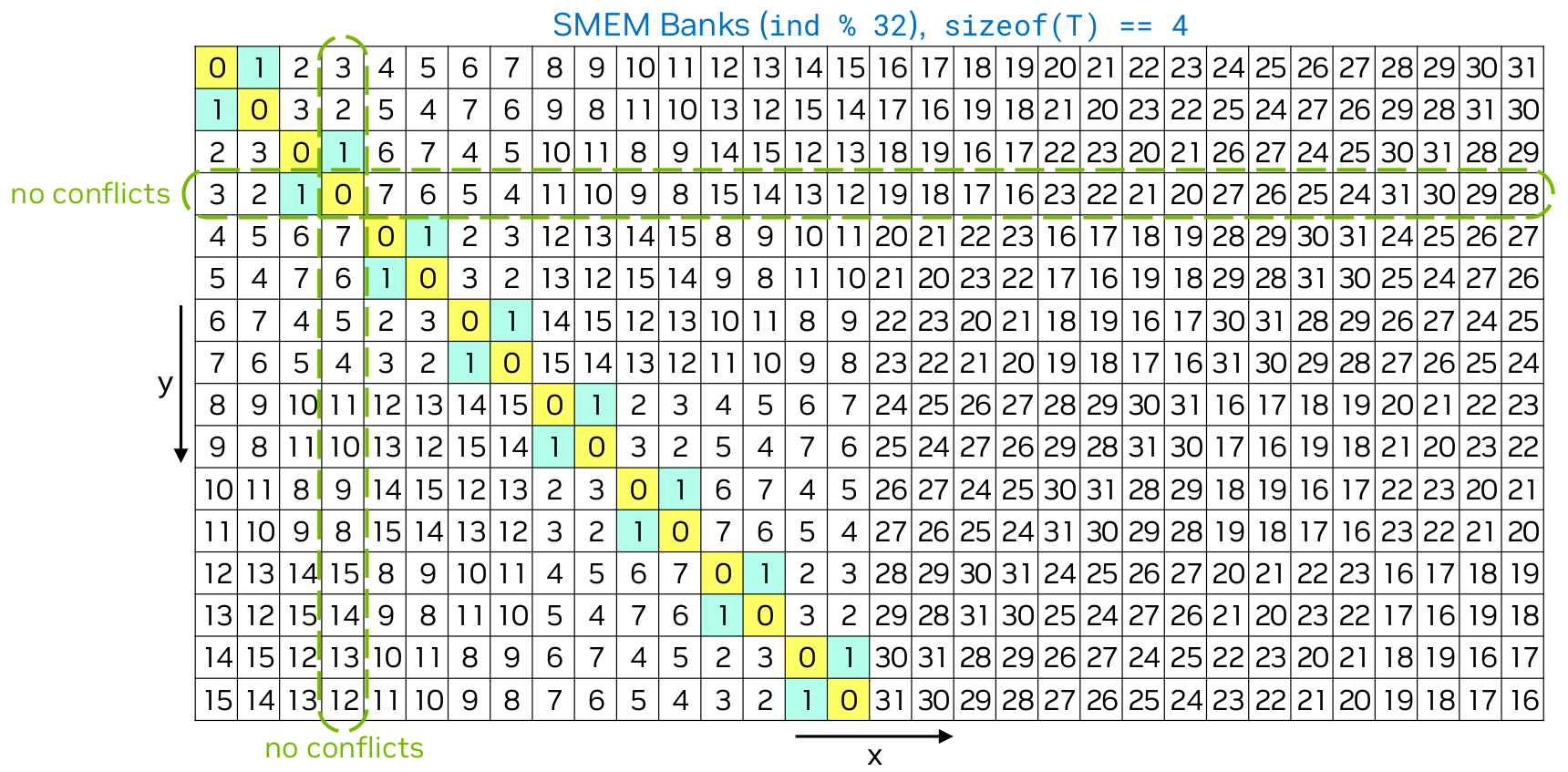
The Bottleneck: Shared Memory Access Patterns
Graphics Processing Units (GPUs) excel at parallel computation, but their performance is often gated by memory access patterns. In CUDA programming, shared memory serves as a crucial, low-latency on-chip memory accessible by all threads within a thread block. It's a developer-managed cache that can dramatically speed up computations when data is reused frequently. However, how threads within a block access this shared memory is critical. Naive access patterns can lead to shared memory bank conflicts, where multiple threads in the same warp (a group of 32 threads) attempt to access different memory locations that reside in the same physical memory bank simultaneously. This serialization of access serializes execution, negating the parallel benefits of the GPU.
Consider a common scenario: a 2D stencil computation or matrix transpose where threads within a block need to read data from shared memory. If threads in a warp attempt to read elements that map to the same bank, the GPU hardware must serialize these accesses. For example, if a warp of 32 threads accesses contiguous 32-bit words, and each word resides in a different bank, there is no conflict. But if the stride between accessed elements is a multiple of the number of banks (typically 32 on modern NVIDIA GPUs), conflicts arise. This is analogous to a highway with multiple lanes (memory banks) but only one exit ramp (access point per bank). If too many cars try to use the same ramp at the same time, traffic grinds to a halt.
Understanding Bank Conflicts
Shared memory is divided into multiple banks. On NVIDIA GPUs, the number of banks is typically 32. Each bank can be accessed simultaneously by one thread per warp. A bank conflict occurs when two or more threads within the same warp access memory locations that map to the same bank. This can happen based on the address of the data being accessed and the number of banks. The formula for bank mapping is often described as:
Bank Index = (Address / ElementSize) % NumBanks
Where:
Addressis the byte address of the data in shared memory.ElementSizeis the size of the data type being accessed (e.g., 4 bytes forfloat, 8 bytes fordouble).NumBanksis the total number of shared memory banks.
If multiple threads in a warp calculate the same Bank Index for their respective data accesses, a bank conflict occurs. The hardware serializes these accesses on a bank-by-bank basis. A single-bank conflict means accesses are serialized for that specific bank. A multi-bank conflict can occur if multiple banks are involved, but the worst-case scenario is when all threads in a warp try to access the same bank.
Introducing Swizzling: The Solution
Shared memory swizzling is a technique to rearrange data layout in shared memory or alter access patterns to avoid bank conflicts. The core idea is to ensure that threads within the same warp access different memory banks. Instead of storing data contiguously in a way that aligns with a linear thread index, swizzling rearranges it. This is often achieved by modifying how data is written into shared memory, effectively "swizzling" the dimensions of the data.
For instance, when dealing with 2D data, instead of storing row-major or column-major directly, one might store it in a way that interleaves elements across banks. A common swizzling technique for 2D arrays is to transpose the data as it's loaded into shared memory. If the original data is accessed with a stride that causes conflicts, transposing it means threads will access different rows (which are now columns in shared memory) and thus different banks.
Let's illustrate with a 2D tile loading scenario. Suppose a thread block loads a 2D tile of size TILE_DIM x TILE_DIM into shared memory. Threads are typically mapped to this tile. If a thread (tx, ty) in a warp accesses shared memory element (tx, ty), and tx varies rapidly within a warp while ty is constant for a warp (or changes slowly), this can lead to bank conflicts if tx causes multiple threads to hit the same bank. By transposing the tile in shared memory, thread (tx, ty) might store its data at a location corresponding to (ty, tx) in shared memory. When threads in the warp then access data, their indices are effectively swapped, often breaking the pattern that caused the conflict.
Referenced Sources
- verified