
Introducing Crucible: A Rigorous AI Judgment Engine
A new project, codenamed Crucible, is emerging from stealth with a bold ambition: to create a systematic and objective engine for evaluating artificial intelligence outputs. The core concept revolves around a structured process of registering a thesis, steelmanning its constituent claims, measuring these claims against a defined substrate, and then iteratively refining the weakest aspects. This approach aims to move beyond superficial evaluations of AI-generated content, providing a deeper, more analytical framework for understanding AI capabilities and limitations.
The developer behind Crucible, whose identity is not yet public, describes it as an "agentic harness, engine, and more." The intention is to release more impactful pieces of this work to the public, suggesting a phased rollout of its capabilities. The underlying philosophy appears to be that complex AI outputs, particularly those generated by advanced models, require a more robust and adversarial testing methodology than currently exists. Traditional evaluation methods often fall short when dealing with nuanced arguments, emergent behaviors, or highly complex reasoning chains that AI can produce.
Crucible's methodology is built on several key pillars:
1. Thesis Registration
The process begins with the formal registration of a thesis. This is not merely a statement of opinion, but a well-defined proposition that the AI system is tasked with supporting or refuting. The thesis must be specific enough to be testable and falsifiable. This initial step ensures that the evaluation has a clear target and scope. Without a precisely articulated thesis, the subsequent steps risk becoming unfocused and unproductive.
2. Steelmanning Claims
Once a thesis is registered, Crucible's engine then undertakes the critical task of "steelmanning" each claim that supports or refutes the thesis. Steelmanning, a concept borrowed from argumentation theory, involves constructing the strongest possible version of an argument, even if it contradicts one's own beliefs. In the context of Crucible, this means the engine will actively work to find the most compelling, well-supported, and logically sound interpretations of the AI's output related to the thesis. This is a departure from simply accepting the AI's output at face value; instead, it actively seeks to challenge and strengthen the AI's own reasoning by presenting it in its most robust form.
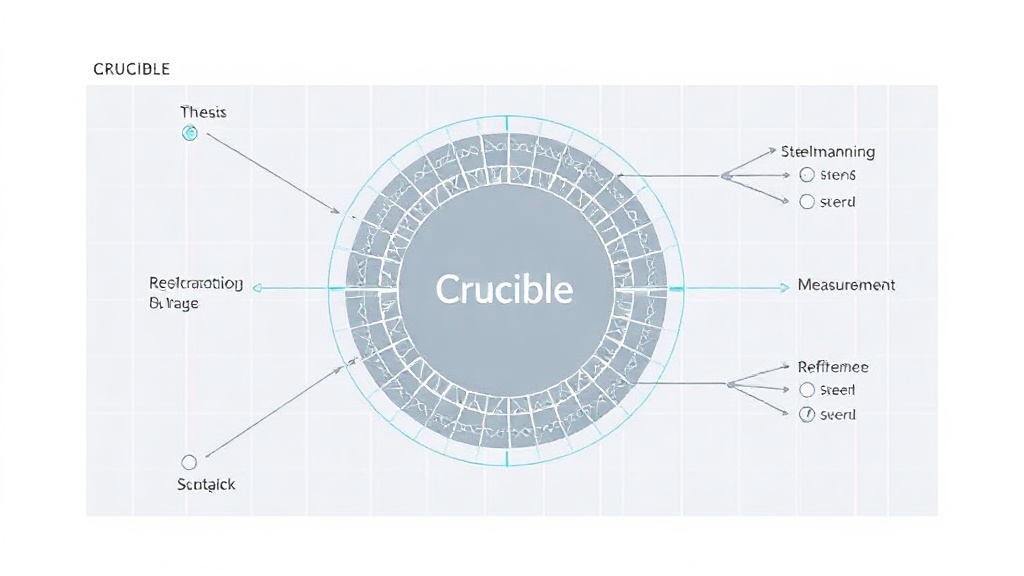
3. Measurement Against a Substrate
The steelmanned claims are then measured against a "substrate." This substrate is the objective reality, the ground truth, or a pre-defined, authoritative dataset against which the AI's claims are evaluated. This could be a curated knowledge base, a set of empirical data, or even the consensus of human experts on a particular topic. The key is that the substrate provides an external, verifiable benchmark. The engine quantizes the AI's performance on each claim, identifying discrepancies, inaccuracies, or areas of weakness.
4. Refining the Weakest Axis
The final, and perhaps most iterative, stage involves refining the "weakest axis." This refers to the specific aspect of the AI's reasoning or output that proved most vulnerable during the measurement phase. Crucible aims to identify these weak points and then use this information to guide further development or fine-tuning of the AI model. This could involve providing targeted feedback, generating counter-examples, or prompting the AI to re-evaluate its conclusions based on the identified flaws. The goal is continuous improvement, making the AI more robust and reliable over time.
Broader Implications for AI Development
The emergence of tools like Crucible signals a maturing phase in AI development. As AI systems become more sophisticated and their outputs more complex, the need for rigorous, systematic evaluation becomes paramount. Current methods, often relying on simple accuracy metrics or human qualitative assessment, struggle to keep pace. Crucible’s approach, by formalizing the process of challenging and measuring AI claims, offers a path towards more trustworthy and verifiable AI systems. This is particularly relevant in fields where AI decision-making has significant real-world consequences, such as medicine, finance, and autonomous systems.
The developer’s stated intention to release components of Crucible publicly suggests a potential for standardization in AI evaluation. If widely adopted, Crucible could become a common framework for benchmarking AI models, fostering greater transparency and allowing for more direct comparisons between different systems. This could accelerate progress by enabling researchers and developers to build upon a shared understanding of what constitutes robust AI reasoning.
One of the most surprising aspects of Crucible's design is its self-critical nature. Instead of merely testing for correctness, it actively seeks to find the AI's flaws by presenting its arguments in their strongest possible form. This adversarial approach to evaluation, mirroring techniques used in formal logic and scientific hypothesis testing, is crucial for uncovering subtle biases or logical fallacies that might otherwise go unnoticed. It's less about proving the AI right and more about ensuring it can withstand the most rigorous scrutiny.
The question that remains unanswered is how Crucible will scale. As AI models become capable of generating increasingly complex and multi-faceted outputs, the computational resources and human oversight required to "steelman" every claim and measure against a comprehensive substrate could become prohibitive. The architecture and implementation details will be crucial in determining its practical applicability across a wide range of AI tasks and domains.
Ultimately, Crucible represents a significant step towards a more scientific and disciplined approach to AI evaluation. By abstracting the process of critical judgment into a formal engine, it promises to equip developers with a powerful tool for building more reliable, trustworthy, and capable artificial intelligence.