Crossplane's Silent Communication Failures
Crossplane, a powerful open-source Kubernetes add-on for managing cloud infrastructure, can present a deceptive facade of success. While designed to abstract away infrastructure complexity, its default configurations can mask critical failures, leading to situations where resources appear managed but are, in fact, unreachable or uncorrected.
A recent experiment, detailed on Dev.to, highlights several key areas where Crossplane’s “sleeping” state can impact operations. The core of the issue lies in how Crossplane reports success and handles resource drift. The experiment involved a two-cluster Crossplane lab setup. The goal was to test and demonstrate Crossplane's communication with resources it manages, both within a native cluster and in a remote one.
The first major finding is stark: Native composition cannot reach another cluster. This isn't an error in the traditional sense, but a silent absence of functionality. Crossplane, by default, lacks the necessary mechanisms to bridge the gap between its control plane and a remote managed cluster when using native composition. To achieve cross-cluster communication for managed resources, users must explicitly leverage provider-kubernetes objects. Without this explicit configuration, Crossplane will not inherently possess the capability to communicate with or manage resources in a separate cluster through its native composition methods. This absence is not signaled by an error message, but by a lack of any indication that such communication is even possible or intended within the default setup.
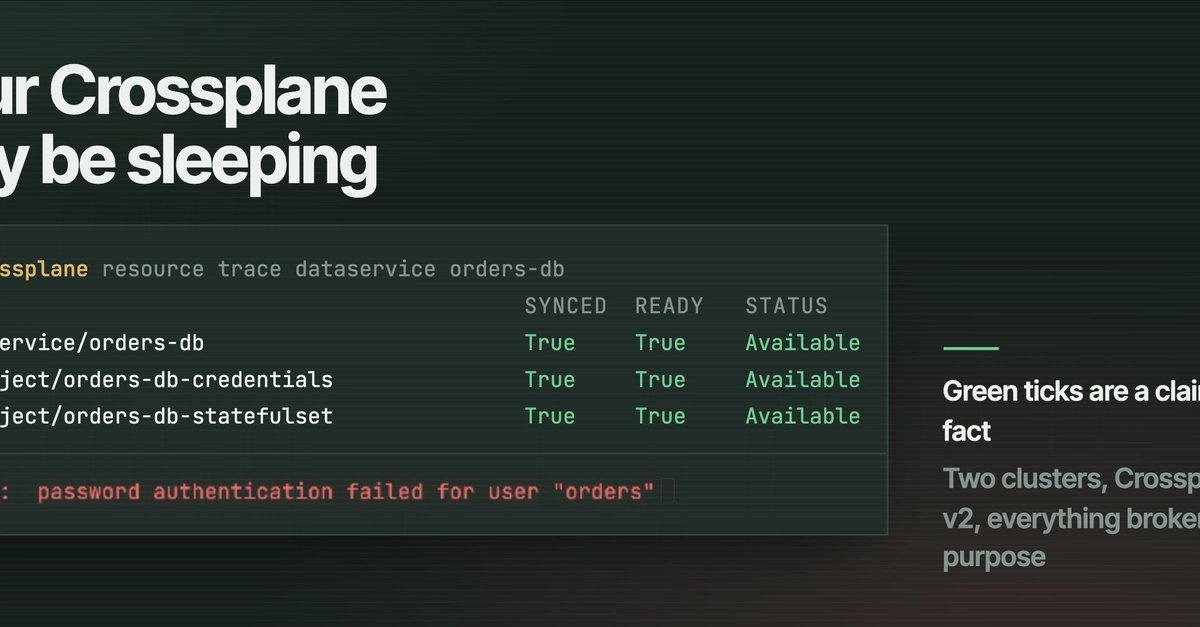
This lack of explicit signaling is compounded by another critical observation regarding readiness reports. The experiment found that readiness reports can show green for a workload that cannot start. The default policy in Crossplane often equates a green readiness status to “applied successfully,” not “functioning correctly.” This distinction is crucial. A resource can be syntactically correct and successfully applied to the target cluster, yet fail to start or operate due to underlying configuration issues, network problems, or dependencies that Crossplane, in its default state, does not validate beyond the initial application. The system offers four policy options for readiness checks, but the active policy is not readily apparent, leaving operators unaware of the stringency of the checks being performed.
This misinterpretation of success can lead to significant operational blindness. Developers might assume their deployed application or infrastructure component is running as expected, only to discover later that it’s non-functional. The gap between “applied successfully” and “working as intended” is a critical area where Crossplane's default behavior falls short for many practical use cases.
Uncorrected Drift and Alpha Features
Beyond initial deployment success, Crossplane’s ability to maintain desired state over time is also hampered by its default settings. The experiment revealed that drift goes uncorrected for ten minutes. Infrastructure drift occurs when the actual state of managed resources deviates from the desired state defined in Crossplane’s configurations. Crossplane is designed to detect and reconcile this drift, but the default reconciliation loop has a significant delay.
The watch field, which intuitively sounds like a mechanism to address this promptly, is currently in alpha. This means it’s experimental, requires explicit gating (enabling it via feature flags), and, crucially, often does nothing unless a specific flag is also passed to the provider pod. This multi-layered requirement means that even when attempting to use this feature, operators might not realize it's inactive unless they have carefully followed the alpha documentation and enabled all necessary components. The default behavior, therefore, is a passive stance on drift, waiting for a scheduled reconciliation cycle rather than actively watching and correcting deviations in near real-time.
This ten-minute window for uncorrected drift can be problematic for environments requiring high availability or strict state management. Imagine a critical load balancer configuration that is accidentally modified outside of Crossplane; it could take up to ten minutes for Crossplane to detect and revert this change, during which time the application could experience downtime or misrouting.
The good news is that both the readiness reporting and drift detection issues are fixable. The article suggests that leveraging CEL (Common Expression Language) can provide more sophisticated checks. For readiness, CEL can be used to define more granular conditions that must be met for a resource to be considered truly ready, moving beyond a simple “applied” status. For drift detection, while the watch field is alpha, more robust reconciliation strategies can be configured by tuning the reconciliation periods or by implementing custom controllers that leverage Crossplane’s Composition functions to enforce specific state checks more frequently.
The underlying takeaway is that while Crossplane offers immense power, its default settings are geared towards a basic level of functionality and may not provide the operational robustness expected by production environments without careful, explicit configuration. Operators must be aware that a green status doesn't always mean a healthy system, and that drift detection requires deliberate setup beyond simply deploying Crossplane.
If you are running Crossplane in production, it is imperative to review your configuration, particularly around provider settings, readiness policies, and drift reconciliation. Treat the default settings as a starting point, not an endpoint. Investigate enabling alpha features like the watch field with the appropriate flags, and consider implementing custom validation logic using CEL or other mechanisms to ensure your infrastructure is not just applied, but truly operational and aligned with your desired state.
The Broader Implications for Kubernetes Infrastructure Management
These findings underscore a broader challenge in declarative infrastructure management: the gap between declarative intent and actual operational reality. Tools like Crossplane aim to simplify the management of complex, distributed systems, but they introduce their own layers of abstraction that can obscure underlying problems.
For developers and platform engineers, this means a need for deeper visibility into Crossplane's internal workings and the states of the resources it manages. Relying solely on the reported status from the control plane can be insufficient. Teams must implement robust monitoring and alerting that probes the actual state of managed resources, not just the status reported by Crossplane’s controllers. This might involve custom health checks, synthetic transactions, or direct observation of the managed clusters and cloud provider APIs.
The silent nature of these failures is particularly concerning. Unlike hard errors that halt processes, silent failures allow operations to continue in a degraded or non-functional state. This can lead to long periods of undetected issues, increasing the Mean Time To Detect (MTTD) and Mean Time To Recover (MTTR).
For founders and security professionals, understanding these nuances is vital for building reliable and secure infrastructure. A system that appears to be managed but isn't fully functional introduces subtle security risks and operational inefficiencies. It’s akin to having a security guard who reports “all clear” without actually checking the perimeter. The reliance on alpha features also signals a need for caution in production environments, as these features may change or be removed, requiring ongoing maintenance and adaptation.
The experiment serves as a critical reminder: the power of Crossplane comes with the responsibility of understanding its configuration and limitations. Its potential for silent failures and delayed drift correction means that a hands-off approach is not viable. Continuous vigilance and a proactive stance on configuration validation and monitoring are essential for leveraging Crossplane effectively and ensuring the true operational health of your infrastructure.