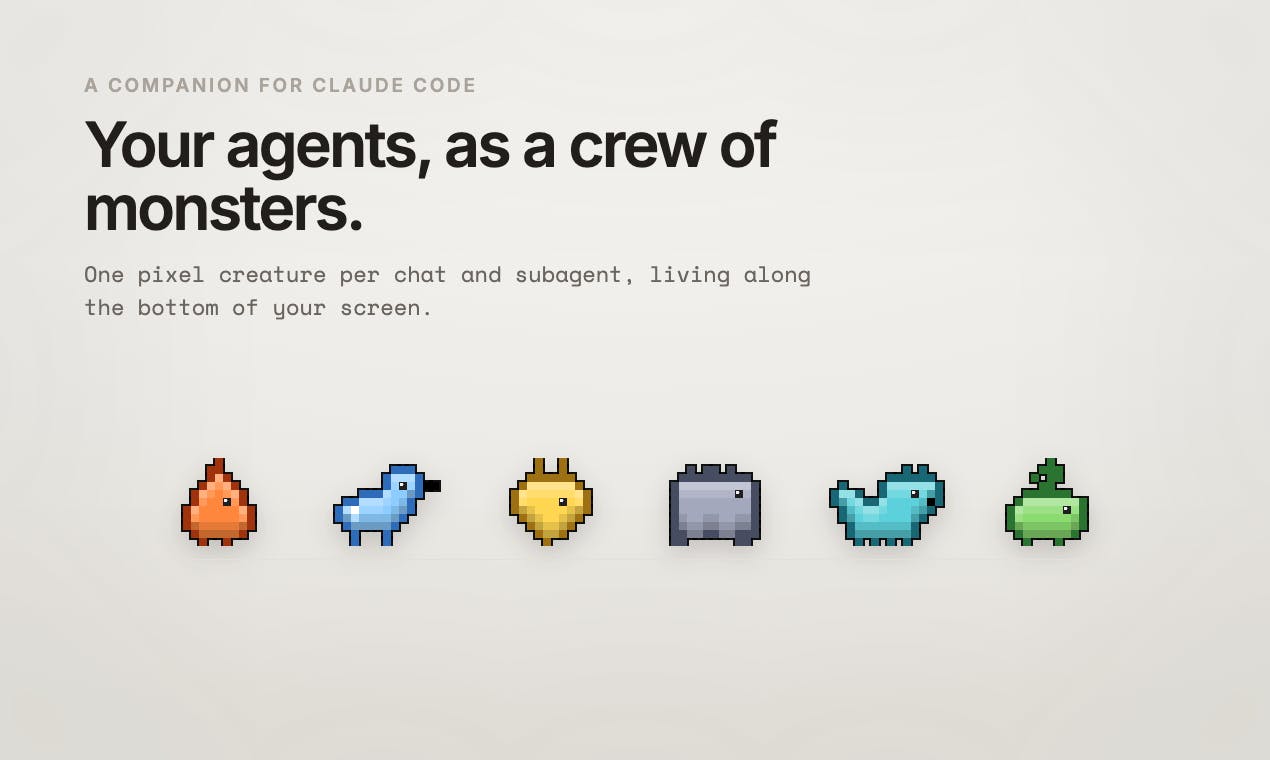
Introducing Crew: Orchestrating AI Agents for Code
Crew, a new product launched on Product Hunt, aims to simplify the management and deployment of AI agents, particularly for coding-related tasks. The platform positions itself as a way to assemble a "tiny crew of monsters" that work collaboratively within the Claude Code environment. This concept suggests a more structured and efficient approach to leveraging large language models (LLMs) for complex development workflows.
The core idea behind Crew is to create a team of specialized AI agents, each designed to handle specific aspects of a coding project. Instead of interacting with a single, monolithic AI, developers can orchestrate a group of agents that might include roles like a code generator, a debugger, a documentation writer, or a tester. This modular approach allows for greater flexibility and precision in AI-assisted development.
Think of it less like a single, all-knowing AI assistant and more like a small, highly specialized software development team. Each member of the Crew has a defined role and can communicate with others to achieve a common goal. This distributed intelligence model is designed to tackle tasks that might be too complex or nuanced for a single AI model to handle effectively on its own.
Agent Specialization and Collaboration
The power of Crew lies in its ability to foster collaboration among these specialized agents. By defining specific roles and communication protocols, developers can ensure that each agent contributes its unique expertise to the project. For instance, one agent might be tasked with writing the initial code based on specifications, while another agent reviews that code for potential bugs or inefficiencies. A third agent could then be responsible for generating relevant documentation or unit tests.
This collaborative framework is particularly beneficial for code-related tasks where precision, consistency, and thoroughness are paramount. Complex refactoring, feature implementation, or even debugging can be broken down into smaller, manageable sub-tasks, each assigned to an agent best suited for the job. The output from one agent serves as the input for another, creating a seamless workflow that mirrors human team dynamics.
The platform's emphasis on "monsters" suggests a playful yet powerful approach to AI agent development. These are not just simple chatbots; they are envisioned as capable entities that can perform intricate operations within the coding lifecycle. The integration with Claude Code implies a focus on leveraging the advanced capabilities of Anthropic's models for these agentic workflows.

Streamlining Development Workflows
Crew aims to reduce the cognitive load on human developers by automating and orchestrating repetitive or complex coding tasks. By setting up a Crew, developers can delegate specific parts of their project to AI agents, freeing them up to focus on higher-level design, architecture, and strategic decision-making. This can lead to faster development cycles and potentially higher quality code.
The platform's design likely includes features for defining agent roles, setting up communication channels, and monitoring the progress of the AI team. This level of control is crucial for ensuring that the AI agents are working effectively towards the desired outcomes and that their outputs align with project requirements. The ability to easily configure and reconfigure these agent teams is also a key aspect of its utility.
What remains to be seen is how easily Crew integrates with existing developer toolchains and CI/CD pipelines. For widespread adoption, seamless integration with tools like GitHub, VS Code, and various testing frameworks will be essential. The success of such platforms often hinges on their ability to become an unobtrusive yet powerful part of the developer's daily workflow.
Potential Use Cases and Future Implications
The potential use cases for Crew are broad, spanning from automated code generation and bug fixing to sophisticated code analysis and optimization. Developers could use Crew to rapidly prototype new features, generate boilerplate code, or even assist in complex algorithmic implementations. For teams, it offers a way to scale their development efforts without a linear increase in headcount.
As AI agent orchestration tools mature, platforms like Crew could fundamentally alter how software is developed. The concept of a "developer" might evolve to include more roles focused on designing, managing, and guiding AI teams, rather than solely writing code line by line. This shift could democratize software creation, allowing individuals with less traditional coding experience to build complex applications with AI assistance.
The competitive landscape for AI agent management is rapidly evolving. Tools that can effectively manage complex, multi-agent interactions and deliver tangible productivity gains will likely gain significant traction. Crew's focus on specialized roles and collaboration within a specific LLM ecosystem (Claude Code) positions it as a promising contender in this emerging space.