The Generalist: CPU
Open your laptop's spec sheet and you will find a CPU, a GPU, and if it is recent enough, an NPU. Open a cloud instance page and you get offered GPUs, TPUs, and a networking card that turns out to be a whole computer wearing a trench coat. Somewhere in a lab, a fridge colder than deep space is running a QPU. Six acronyms, all ending in PU, all doing "computation." The obvious question, and the one many have kept dodging for years: why not just build one really good processor and stop?
The short answer is that "computation" is not one thing. The longer answer is the fun part. Each of these processors is a specialized tool, optimized for a particular class of problems, much like how a chef uses a chef's knife for most tasks, but a paring knife for delicate work and a cleaver for bone.
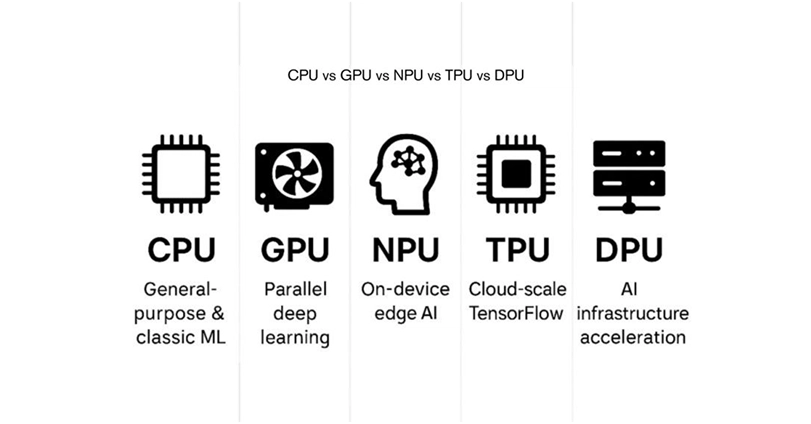
The Central Processing Unit (CPU) is the venerable workhorse of computing. It's designed for general-purpose tasks, handling everything from running your operating system and applications to managing user input and executing complex logic. CPUs are masters of sequential processing, adept at executing a wide variety of instructions one after another with low latency. Their architecture features sophisticated control units and large caches to quickly fetch and process instructions. However, their strength in versatility comes at the cost of parallel processing efficiency. When faced with a massive number of identical, simple tasks, a CPU can become a bottleneck.
Think of a CPU like a highly skilled project manager. They can handle diverse tasks, coordinate different teams, and make complex decisions. But if you need to paint 1,000 identical fence posts, the project manager would be incredibly inefficient compared to a team of 1,000 painters, each doing one simple job.
The Parallel Powerhouse: GPU
The Graphics Processing Unit (GPU) started its life as a specialized processor for rendering images and video. Its architecture is fundamentally different from a CPU's. Instead of a few powerful cores, a GPU boasts thousands of smaller, simpler cores. This design makes GPUs exceptionally good at performing the same operation on many different pieces of data simultaneously – a concept known as Single Instruction, Multiple Data (SIMD). This parallel processing capability is why GPUs have become indispensable for tasks like 3D rendering, scientific simulations, and, critically, the training of machine learning models.
The massive parallelism of GPUs allows them to crunch through the matrix multiplications and tensor operations that are the bedrock of deep learning at speeds CPUs can only dream of. While a CPU might take hours to train a complex neural network, a GPU can often do it in minutes or hours.
The AI Accelerators: TPU and NPU
As AI and machine learning workloads grew, the need for even more specialized hardware became apparent. This led to the development of the Tensor Processing Unit (TPU) and the Neural Processing Unit (NPU).
TPUs, developed by Google, are custom-built ASICs (Application-Specific Integrated Circuits) designed to accelerate machine learning workloads, particularly those involving large neural networks. They are optimized for high-volume, low-precision matrix calculations, which are fundamental to deep learning inference and training. TPUs can perform these operations with incredible efficiency and speed, often outperforming even GPUs on specific AI tasks. They are a prime example of how hardware can be tailored to a particular algorithmic domain.
NPUs, on the other hand, are a more general category of AI accelerators, often found in mobile devices and edge computing platforms. While TPUs are typically associated with large-scale cloud-based AI, NPUs are designed for on-device AI processing. They are optimized for neural network operations like convolution and recurrent neural networks, and they often incorporate features for power efficiency, crucial for battery-powered devices. The distinction between a high-end NPU and a low-end TPU can blur, but the core idea is dedicated hardware to speed up AI inference and, in some cases, training, directly where the data is generated.
The Network's Engine: DPU
The Data Processing Unit (DPU) addresses a different kind of bottleneck: network performance and data center efficiency. As data volumes explode and network speeds increase, offloading network, storage, and security tasks from the main CPU becomes essential. A DPU is essentially a system-on-a-chip (SoC) that integrates a CPU, a network interface, and programmable hardware accelerators for tasks like packet processing, encryption/decryption, and storage virtualization. By handling these I/O-intensive operations, DPUs free up the host CPU to focus on running applications.
This is particularly important in cloud environments and high-performance computing, where efficient data movement and network security are paramount. A DPU acts as a dedicated traffic controller and security guard for data flowing in and out of a server, ensuring smooth and secure passage without burdening the main processor.
The Quantum Frontier: QPU
The Quantum Processing Unit (QPU) represents a leap into a fundamentally different paradigm of computation. Unlike classical processors that use bits representing 0 or 1, QPUs use qubits, which can exist in a superposition of both states simultaneously. This allows quantum computers to explore a vast number of possibilities concurrently, making them potentially capable of solving certain problems that are intractable for even the most powerful classical supercomputers. These problems include complex optimization tasks, drug discovery through molecular simulation, and breaking modern encryption.
However, QPUs are still largely in the research and development phase. They require extreme operating conditions, such as near-absolute zero temperatures, to maintain the delicate quantum states. Their architecture is exotic, relying on phenomena like entanglement and interference. While QPUs promise revolutionary capabilities, they are not replacements for classical CPUs or GPUs; rather, they are specialized accelerators for a very specific class of problems.
The Consolidation Question
The existence of these distinct processor types highlights a fundamental principle in computing: specialization often leads to superior performance and efficiency for specific tasks. Trying to create a single processor that excels at everything – from precise, sequential logic (CPU), to massive parallel graphics rendering (GPU), to AI-specific matrix math (TPU/NPU), to high-speed data networking (DPU), and quantum phenomena (QPU) – would result in a design that is mediocre at all of them. It would be like trying to build a single tool that is equally adept at hammering nails, sewing intricate stitches, and performing brain surgery.
Instead, the industry has converged on a heterogeneous computing model. This approach involves using a combination of different specialized processors, each tackling the tasks it's best suited for. This allows for greater overall system performance, power efficiency, and capability. For developers and users, this means understanding the strengths of each processor type is becoming increasingly important for optimizing applications and leveraging the full potential of modern hardware.