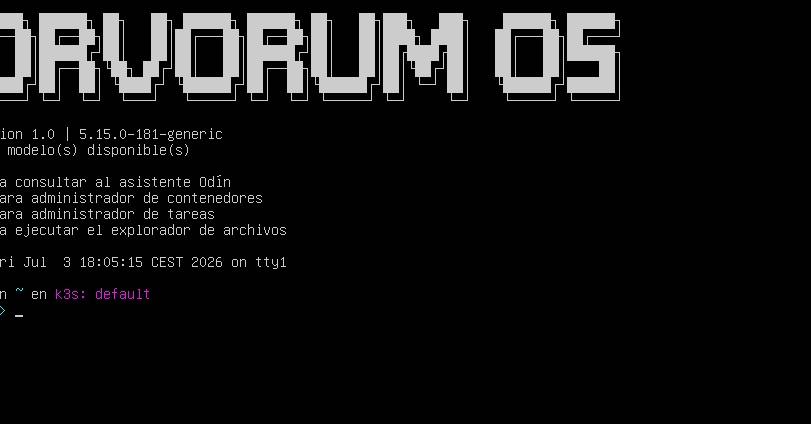
Corvorum OS Server Edition 1.0: A New Contender in Server Operating Systems
Corvorum OS, known for its developer-centric Desktop Edition, has launched its Server Edition 1.0. This new operating system aims to provide a robust, AI-integrated platform for server environments, targeting developers and DevOps professionals who require a ready-to-go infrastructure from the first boot. Building on the minimal Ubuntu base of its desktop counterpart, Corvorum OS Server Edition 1.0 prioritizes functionality, modern tooling, and an opinionated setup designed to accelerate development and deployment cycles.
Integrated AI and Core DevOps Tooling
The standout feature of Corvorum OS Server Edition 1.0 is its built-in local AI capabilities, powered by Ollama. This integration allows users to run various AI models directly on their server, eliminating the need for external API calls and the associated latency and cost. The OS comes pre-configured with Ollama, Python, Docker, Ansible, and Kubernetes K3s, providing a comprehensive suite for building and managing minimal DevOps infrastructures. This out-of-the-box readiness significantly reduces the setup time typically associated with configuring these tools individually.
For developers, this means immediate access to powerful AI models for tasks such as code generation, assistance, or data analysis, all running locally. The inclusion of Docker and Kubernetes K3s means users can start containerizing applications and orchestrating them with minimal friction. Ansible is also present, enabling infrastructure as code practices from the outset. This curated set of tools addresses the common needs of modern development workflows, from local testing to initial cluster deployment.

Command-Line Efficiency and AI Interaction
Corvorum OS Server Edition 1.0 emphasizes command-line efficiency. Tools like `mc` (Midnight Commander) are included for intuitive file management in the terminal, while `btop` provides real-time system process monitoring. These utilities are essential for server administrators who prefer or require command-line operations for their performance and scripting capabilities.
Interacting with the integrated AI is designed to be straightforward. Users can leverage Ollama's native command-line interface to manage and deploy models. Furthermore, Corvorum OS introduces a dedicated `IA` command that directly invokes the Odin-assist model, which is based on Qwen2.5:1.5B. This specific command simplifies the process of accessing a powerful, locally-hosted AI assistant for tasks like debugging, writing documentation, or generating code snippets. The ability to switch between different AI models via Ollama and utilize a specific, optimized assistant command offers a flexible and powerful AI experience directly within the server environment.
A Foundation for Modern Server Development
The release of Corvorum OS Server Edition 1.0 signifies a growing trend in operating systems designed with AI and cloud-native development as core tenets. By bundling essential DevOps tools and local AI capabilities, Corvorum OS aims to lower the barrier to entry for complex server setups. This approach is particularly beneficial for startups, small development teams, or individual developers who need a powerful, yet easy-to-manage, server environment without extensive configuration overhead.
The choice of a minimal Ubuntu base ensures stability and access to a vast ecosystem of software packages, while the curated additions provide immediate productivity. The OS is not just about installing tools; it's about providing an integrated experience where these tools work harmoniously. For instance, the local AI can potentially assist in writing Ansible playbooks or Dockerfiles, further streamlining the DevOps pipeline.
While Corvorum OS Server Edition 1.0 is positioned for developers and DevOps professionals, its integrated AI and user-friendly CLI tools might also appeal to power users seeking a more intelligent and efficient personal server setup. The focus on local AI is a significant differentiator, offering privacy and performance advantages over cloud-based AI services. This edition appears to be a calculated move to capture a segment of the market that values self-sufficiency and cutting-edge tooling.
The question remains how Corvorum OS Server Edition will scale for larger, more complex enterprise deployments. While K3s is suitable for many use cases, its limitations compared to full Kubernetes distributions might be a factor for organizations with extensive orchestration needs. However, for its target audience of developers and smaller teams, the OS offers a compelling, integrated solution that promises to boost productivity and simplify server management.