The Problem with Unstructured Text Output
Small Language Models (SLMs) are increasingly powerful tools for automation. However, their inherent nature to generate free-form text presents a significant challenge when aiming for reliable, narrow automation. Developers often resort to post-processing generated output – parsing strings, extracting information, and validating formats. This approach is brittle, error-prone, and computationally inefficient. It’s like trying to build a precise machine using only a hammer and chisel; you can get there, but it’s a messy, indirect process.
Consider a simple task: an SLM needs to classify customer feedback into one of three categories: 'Bug Report', 'Feature Request', or 'General Inquiry'. An unconstrained SLM might output: “I think there might be a bug with the login feature,” or “Could you add a dark mode option?” or “Just wanted to say thanks for the app.” Parsing these variations requires complex regular expressions or further NLP steps, adding overhead and potential failure points. If the SLM generates something entirely unexpected, like a poem about customer service, the parser will likely fail.
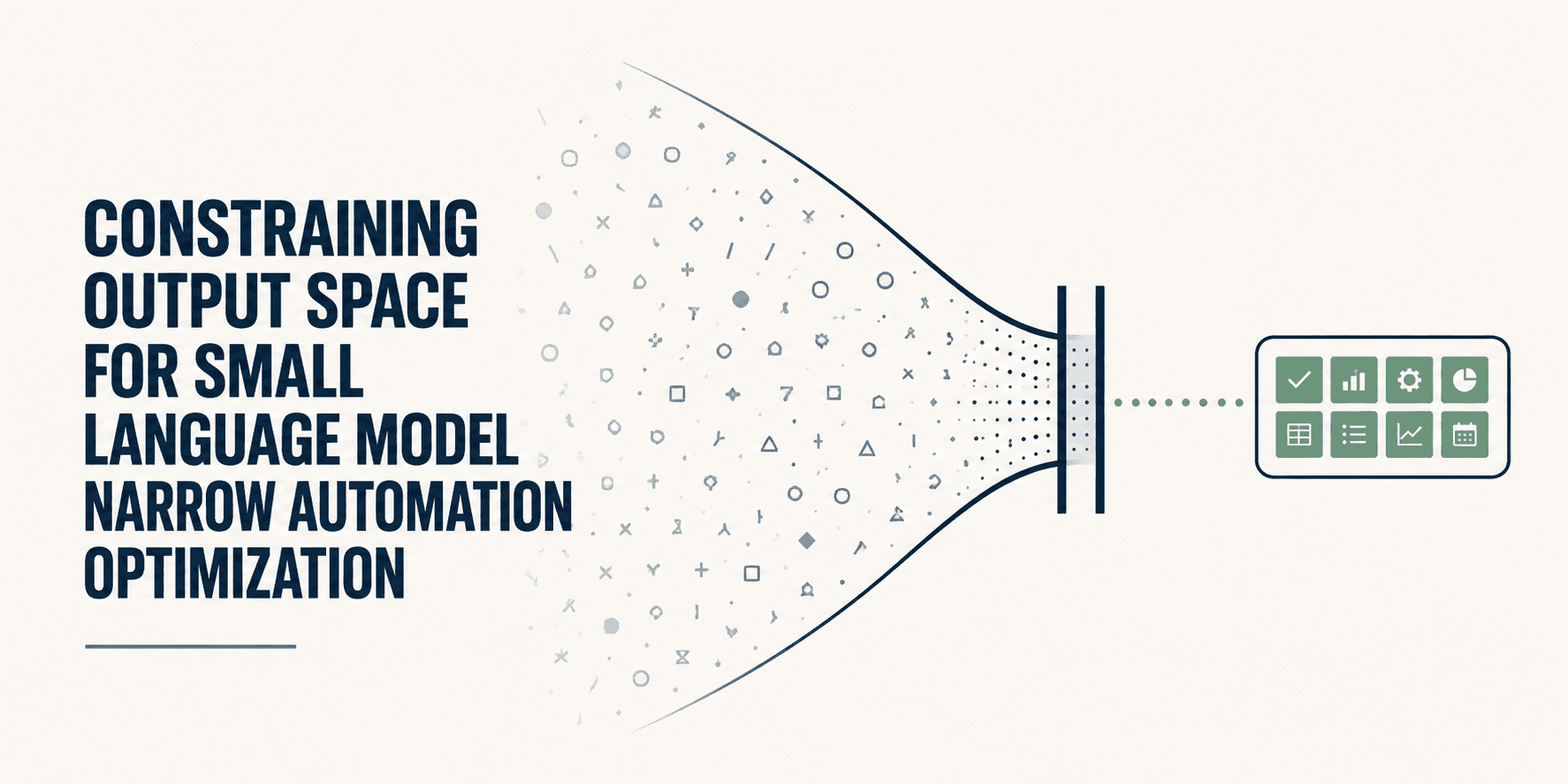
This is where the concept of constraining the output space becomes critical. Instead of allowing the SLM to generate anything, we guide it to produce output that conforms to a predefined structure or set of options. This dramatically simplifies downstream processing and increases the reliability of the automation.
Constraining the Output Space: A Practical Approach
The core idea is to leverage the SLM’s ability to follow instructions and generate structured data, rather than unstructured prose. Instead of asking the SLM to “tell me what this feedback is about,” we ask it to “choose one category from the following list: Bug Report, Feature Request, General Inquiry.” The prompt itself is engineered to elicit a specific, predictable response.
This can be implemented in several ways, depending on the SLM's capabilities and the specific task. For many modern SLMs, including those designed for constrained tasks, the prompt can explicitly list the allowed outputs. The SLM is trained to adhere to these instructions.
For instance, a prompt might look like this:
Classify the following customer feedback into one of these categories: 'Bug Report', 'Feature Request', 'General Inquiry'.

Feedback: "The app crashes every time I try to upload a photo."

Category:
An ideal SLM response would be simply: Bug Report. No extra words, no preamble, just the chosen category. This direct output is easily consumed by subsequent code or logic.
This technique is analogous to how a form on a website works. Instead of a free-text field where users can write anything, you provide dropdowns, radio buttons, or checkboxes. The user is guided to provide data in a structured, predictable format. Constraining the SLM’s output space applies this principle to the model’s generation process.
Benefits of Constrained Output
The advantages of this approach are manifold:
- Increased Reliability: By limiting the possible outputs, you eliminate a vast number of potential errors associated with parsing unstructured text. The system becomes far more robust.
- Reduced Latency and Cost: Eliminating the need for complex parsing logic or additional LLM calls for summarization/extraction significantly speeds up the automation pipeline and reduces inference costs.
- Simplified Development: Developers can write simpler, more direct code to handle the SLM’s output. Instead of intricate parsers, they can use simple string comparisons or lookups.
- Improved Scalability: A more reliable and efficient pipeline is inherently more scalable. You can process more requests with the same or fewer resources.
- Enhanced Control: You have greater control over the types of information the SLM can produce, aligning its output precisely with the needs of your automation.
Implementing Constrained Output
The implementation details will vary based on the specific SLM and framework you are using. However, the general principles remain consistent:
1. Prompt Engineering
This is the most crucial step. Your prompt must clearly define the task and the acceptable output format. Explicitly list the options, use clear instructions, and potentially provide few-shot examples demonstrating the desired input-output behavior. For example:
Task: Identify the sentiment of the following product review.

Allowed Sentiments: Positive, Negative, Neutral.

Review: "The battery life is amazing, but the screen is a bit dim."

Sentiment: Neutral

Review: "This is the best purchase I've made all year!"

Sentiment: Positive

Review: "The software is buggy and crashes frequently."

Sentiment:
2. Output Validation (Minimal)
While the goal is to avoid heavy parsing, a light validation layer is still advisable. This layer checks if the SLM’s output exactly matches one of the allowed options. If it doesn’t, you can log the incident, retry the prompt, or fall back to a default behavior. This acts as a safety net.
3. Model Selection
Some SLMs are better suited for structured output tasks than others. Models specifically fine-tuned for instruction following or task-oriented dialogue often perform better. Researching models that excel at generating structured data is beneficial.
Future Directions and Considerations
This technique forms the foundation for building robust, automated workflows powered by SLMs. As SLMs become more integrated into software development, mastering methods like output space constraint will be essential for practical deployment. The ongoing research into SLM control mechanisms and predictable generation will further refine these techniques.
What nobody has fully addressed yet is the optimal strategy for dynamically generating these constrained output sets for highly variable, multi-turn automation tasks. While static lists work for many scenarios, more complex workflows might require the SLM to define its own valid outputs based on conversational context, a problem that remains an active area of exploration.
For developers looking to move SLMs from experimental toys to reliable automation components, focusing on constraining the output space is a pragmatic and powerful first step.