The Hidden Flaw in Standard Evaluation Metrics
Every statistical confidence interval you've encountered for evaluation pass rates—whether derived from Wald, Wilson, or Clopper-Pearson methods—operates on a fundamental assumption: each data point is an independent observation. This assumption is routinely violated in practice. Consider common evaluation scenarios: 40 questions generated from just 8 source documents, 200 conversational turns from a mere 30 unique dialogues, or 150 examples that are actually 50 distinct cases with three paraphrased variations each. These are not independent draws from a population. When correlated or clustered data is fed into formulas designed for independence, the resulting confidence intervals become artificially narrow. This leads to a critical problem: declaring statistically significant differences where none truly exist, a common pitfall in model evaluation.
This issue is insidious because the code runs, the intervals are calculated, and they appear correct on the surface. However, the underlying assumption is broken, rendering the precision of these intervals misleading. The practical consequence is overconfidence in model performance, potentially leading to premature deployment or misallocation of resources based on faulty data analysis. The core problem lies in the fact that correlated examples share overlapping information, effectively reducing the real information content of the dataset compared to its nominal size.
Why Clustering Shrinks Your Real Sample Size
Independent examples contribute unique pieces of information to your evaluation. Correlated examples, by their nature, share overlapping information. If five questions are all derived from the same paragraph in a document, they are unlikely to test fundamentally different aspects of a model's understanding. They might probe nuances of phrasing or specific keywords, but they don't offer the breadth of insight that five questions drawn from five different documents would provide. This overlap means that while you might have a nominal sample size of 200, the effective sample size—the number of truly independent pieces of information—is significantly smaller.
Think of it like trying to understand a complex topic by reading the same introductory paragraph five times versus reading five different chapters. The former provides diminishing returns; you learn little new after the first read. The latter exposes you to a wider range of concepts and details. In statistical terms, this redundancy inflates the apparent precision of your metrics. The confidence interval, which should reflect the uncertainty inherent in sampling, becomes too tight because the formula doesn't account for the fact that many of your 'samples' are essentially variations on a theme, not distinct pieces of evidence.
Quantifying the Impact of Clustered Data
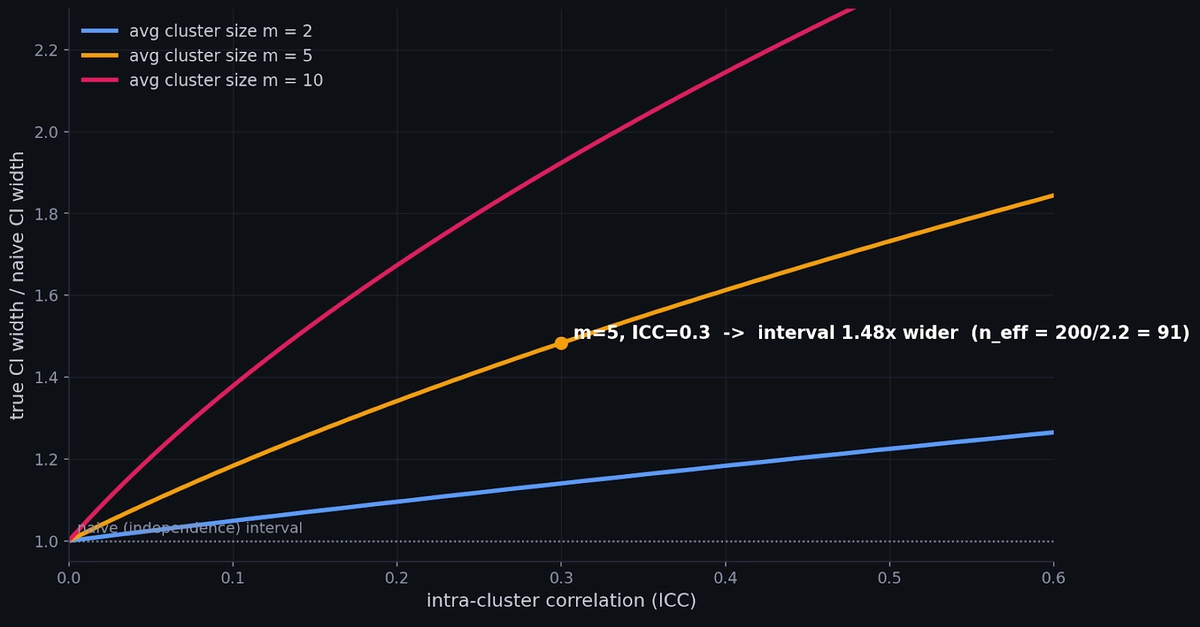
The extent to which clustering impacts confidence intervals depends on the degree of correlation within the data. High correlation means a significant reduction in effective sample size. For instance, if you have 100 examples that are essentially only 20 independent pieces of information, your confidence interval could be up to
This is a critical oversight for any evaluation pipeline that relies on statistical measures of performance. The assumption of independence is a cornerstone of many statistical tests. When violated, these tests can produce misleading results, leading to incorrect conclusions about a model's capabilities. For developers and researchers building and evaluating AI models, understanding this nuance is paramount. It means that simply increasing the number of data points in an evaluation set might not proportionally increase the reliability of the confidence intervals if those new points are clustered. The implications extend to decision-making processes. If an evaluation reports a narrow confidence interval, suggesting high certainty in a model's performance, but that certainty is illusory due to data clustering, then decisions based on that evaluation—such as model selection, feature engineering, or deployment—will be flawed. This could manifest as deploying a model that performs poorly in real-world scenarios because the evaluation did not accurately capture the true variability and uncertainty of its performance. The solution involves either ensuring true independence in the evaluation set or employing statistical methods designed to handle correlated data, such as block bootstrapping or generalized estimating equations (GEE), which can account for the intra-cluster correlation. The problem of clustered data in evaluation sets is not unique to any particular domain of AI development. Whether it's natural language processing, computer vision, or recommendation systems, evaluation datasets are often constructed in ways that introduce dependencies. For example, in image recognition, multiple images might be taken of the same object under slightly different lighting conditions, creating a cluster of related data points. In NLP, multiple sentences might be extracted from the same document or conversation, leading to contextual dependencies. Addressing this requires a conscious effort to design evaluation strategies that acknowledge and mitigate the impact of data clustering. This could involve: Ultimately, the goal is to ensure that evaluation metrics provide a true and reliable picture of a model's performance and uncertainty. Overly optimistic confidence intervals due to ignored data dependencies can lead to significant downstream problems, from poor user experiences to costly engineering rework. Developers and researchers must move beyond a superficial application of statistical formulas and engage with the underlying assumptions to build more robust and trustworthy AI systems. What remains unaddressed is the widespread adoption of these more robust statistical methods. Many teams, especially those under pressure to deliver quickly, may opt for the simpler, albeit less accurate, standard methods. The inertia of existing practices and the perceived complexity of alternative approaches present a significant barrier to more rigorous evaluation in AI development.The Need for Robust Evaluation Practices