The 10x Error: When Confidence Trumps Accuracy
A patient was discharged to a rehab facility on an insulin dosage of 80 units. The prescriber had said 8.
Somewhere between the clinician's voice and the chart, a speech-recognition system heard "eighty" instead of "eight," transcribed it with total confidence, and nobody caught it before it reached the patient. This isn't a hypothetical — it's a documented patient safety incident reported through ISMP's medication error tracking. A single digit, silently wrong, and a system that never once flagged it as uncertain.
This incident reframes the entire problem of AI in critical applications. It's not about a model making a mistake; models make mistakes constantly, and those are often recoverable if they can be detected. This is a story about a model that was confidently wrong, and the profound implications that have for how we deploy AI in high-stakes environments.
Beyond Simple Error Rates: The Peril of Confident Ignorance
Traditional AI development often focuses on minimizing error rates. We train models, test them, and iterate until the percentage of incorrect predictions drops below an acceptable threshold. But what if the model is wrong 99% of the time, yet still produces a confident output for that 1% error? This is the danger of confidence-gated AI: systems that present incorrect information with the same assurance as correct information.
In the case of the medical transcription system, the model likely had a high probability score associated with the word "eighty." Perhaps the audio quality was poor, or the clinician's pronunciation was ambiguous. A robust system, however, would not just provide the most probable output; it would also indicate its own uncertainty. If the confidence score for "eighty" was only marginally higher than for "eight," or if a significant probability mass was distributed across multiple plausible words, the system should have flagged the output as low-confidence. Instead, it acted as a black box, delivering a single, incorrect answer with unwavering certainty.
This is not unique to speech recognition. Consider an AI-powered code completion tool. If it suggests a syntactically correct but semantically flawed line of code with 100% confidence, it can lead developers down a rabbit hole of debugging. Or imagine an AI diagnostic tool for image analysis that confidently misidentifies a benign mole as malignant, or vice versa. The consequences ripple outwards, impacting trust, efficiency, and safety.
Designing for Uncertainty: The Confidence-Gated Approach
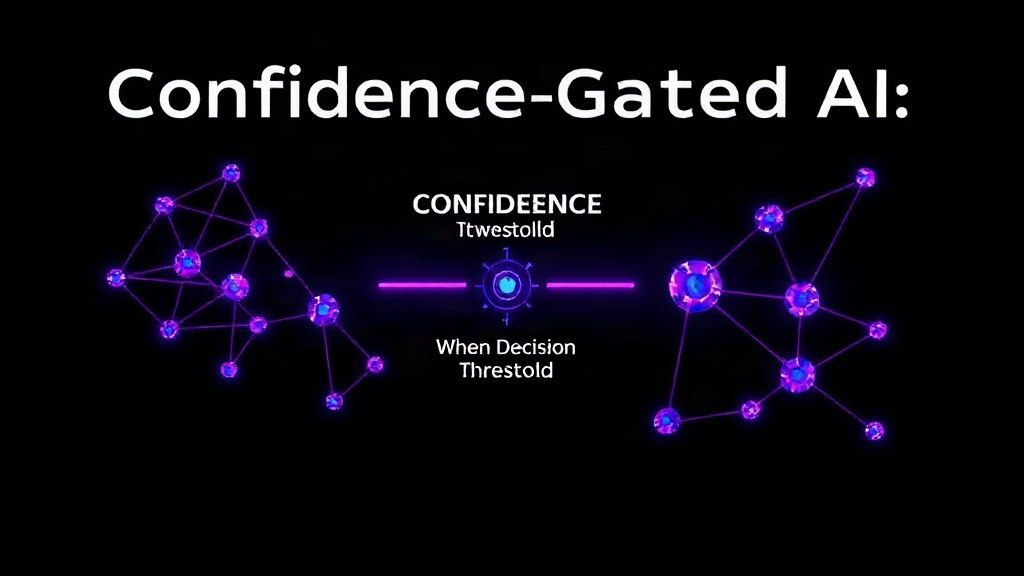
The solution lies in building AI systems that understand the limits of their own knowledge. This is the core idea behind confidence-gated AI. Instead of simply outputting a prediction, the model also outputs a measure of its confidence in that prediction. This confidence score acts as a crucial gatekeeper.
How can this be implemented? For many classification tasks, models naturally produce probability distributions over possible classes. For instance, a sentiment analysis model might predict "positive" with 95% confidence, "negative" with 3%, and "neutral" with 2%. If the threshold for confidence is set at 90%, this prediction would be accepted. If, however, the model predicted "positive" with 60% confidence and "negative" with 40%, it would fall below the threshold. In such cases, the system should not auto-correct or present a definitive answer. Instead, it should:
- Flag for Human Review: The most direct application is to route low-confidence outputs to a human expert for verification. This is precisely what should have happened with the insulin dosage.
- Request Clarification: In interactive systems, a low-confidence prediction could trigger a prompt to the user for more information or to confirm the interpretation.
- Provide Multiple Options: If ambiguity is high, the system could present the top N most likely interpretations, along with their confidence scores, allowing the human operator to choose.
- Refuse to Act: In the most critical scenarios, a low-confidence output might necessitate that the system simply does not perform the action it was intended to take, preventing potential harm.
The Trade-offs: Precision vs. Recall and the Cost of Caution
Implementing confidence gating is not without its challenges. The primary trade-off is often between precision and recall. By setting a high confidence threshold, you increase precision (fewer false positives) but might decrease recall (more false negatives or missed opportunities). Conversely, a lower threshold might catch more correct predictions but also allow more incorrect ones to pass through.
The "correct" threshold is highly context-dependent. For a medical transcription system handling medication dosages, the cost of a false positive (an incorrect transcription being accepted) is astronomically high, demanding a very strict confidence threshold. For a content recommendation engine, a few inaccurate suggestions are less critical, allowing for a lower threshold to maximize engagement (recall). Developers must carefully consider the downstream impact of errors in their specific domain.
Furthermore, accurately calibrating confidence scores is an active area of research. Some models can be overconfident or underconfident in their predictions, meaning their reported probability doesn't accurately reflect the true likelihood of correctness. Techniques like temperature scaling or using dedicated calibration layers can help align predicted probabilities with actual frequencies of error.
What Lies Ahead: Building Trustworthy AI
The medical transcription error serves as a stark reminder: AI systems must be designed not just for performance, but for trustworthiness. Confidence gating is a critical step in this direction. It shifts the paradigm from simply asking "What is the answer?" to "How sure are you about this answer, and what should we do if you're not sure?"
As AI becomes more integrated into decision-making processes across industries – from finance and law to autonomous driving and scientific discovery – the ability for systems to signal their own uncertainty will be paramount. It's about building AI that doesn't just automate tasks, but that collaborates intelligently with humans, understanding when to act and, crucially, when to defer.
The challenge for developers and product managers is to move beyond optimizing for raw accuracy and begin incorporating explicit mechanisms for uncertainty quantification and management. This requires a deeper understanding of model behavior, a willingness to accept that perfect certainty is often unattainable, and a commitment to building systems that gracefully handle the inherent ambiguity of the real world.