The Great Laptop Divide: Computex 2026's Bifurcated Market
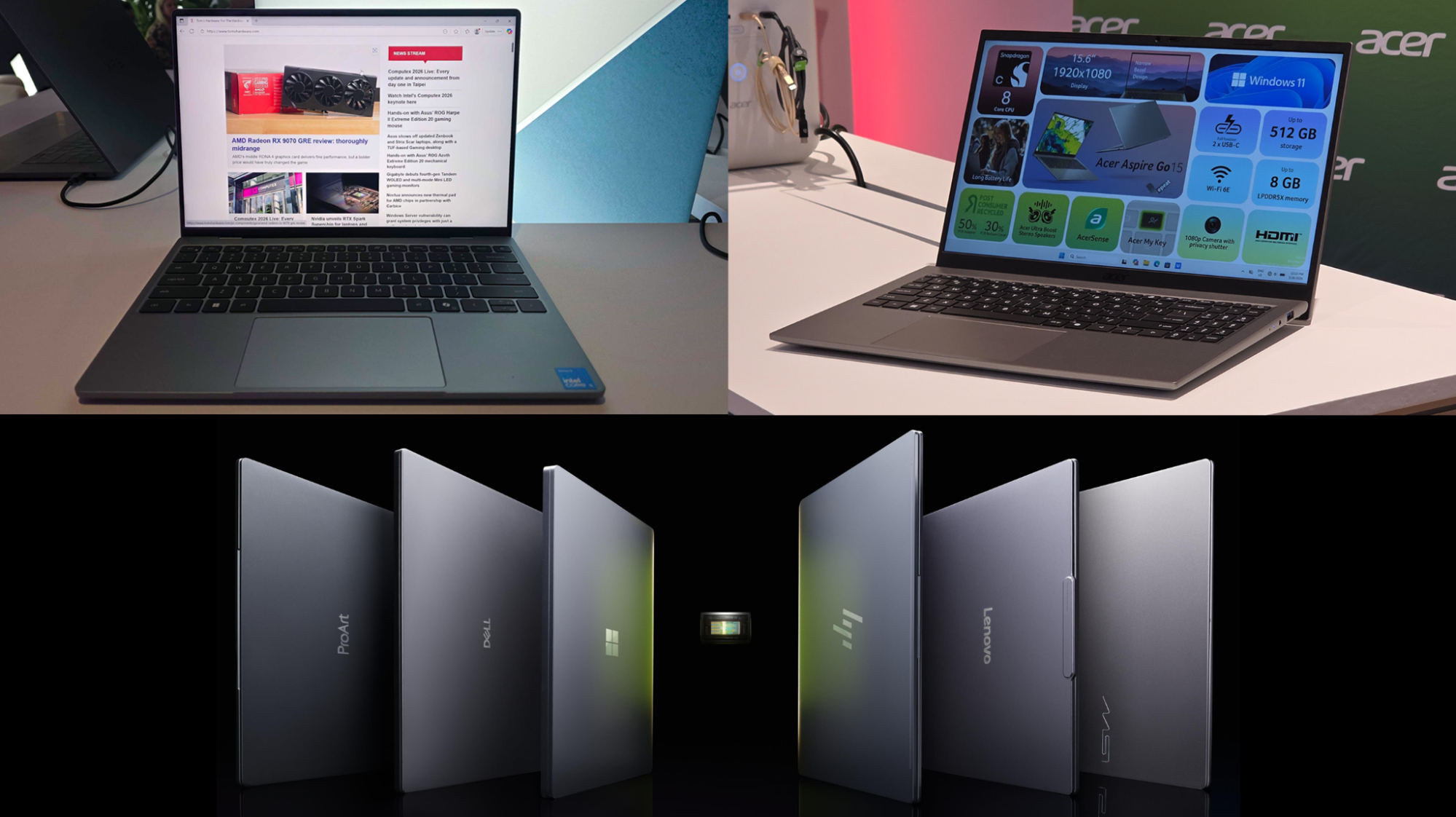
Computex 2026 has underscored a stark division in the laptop market, with manufacturers catering to two dramatically different segments of the consumer base. Without major new GPU or CPU platform announcements to anchor the show, the prevailing trends coalesced into two distinct categories: ultra-affordable laptops, often featuring a baseline of 8GB of RAM, and high-end, premium devices powered by Nvidia hardware, which promise a future built around AI agents and a more intelligent Windows on Arm experience. This bifurcation signals a strategic divergence for PC manufacturers, aiming to capture both the budget-conscious mass market and the nascent, but potentially lucrative, AI-first computing segment.
The lower end of the spectrum is characterized by a renewed focus on accessibility and essential functionality. Laptops equipped with 8GB of RAM, once considered standard, are now being positioned as the entry point for a significant portion of the market. This strategy echoes the success of Apple's MacBook Air M1 with 8GB RAM, which demonstrated that for many everyday tasks – web browsing, document editing, light media consumption – this configuration remains perfectly adequate. Manufacturers are leveraging this insight to produce cost-effective machines that appeal to students, casual users, and businesses looking to equip large workforces without breaking the bank. The emphasis here is on driving volume and maintaining relevance in a price-sensitive segment, often by relying on efficient, albeit less powerful, processors and integrated graphics.
These 8GB RAM laptops are not designed for demanding workloads. Their utility is confined to basic productivity and general computing. For users whose primary interaction with a laptop involves checking email, browsing the web, or working on documents, these machines offer a viable and affordable solution. The challenge for manufacturers in this space is to balance cost reduction with a user experience that doesn't feel frustratingly slow. This often means optimizing software pre-installed on the devices and carefully selecting components that offer the best performance-per-dollar ratio. The success of this segment hinges on delivering a functional, reliable computing experience at a price point that makes new hardware accessible to a broad audience.
Nvidia's Vision: AI Agents and the Future of Windows on Arm
On the opposite end of the spectrum, Computex 2026 showcased a bold vision for the future of personal computing, heavily influenced by Nvidia's strategic push into AI. The company, along with its hardware partners, is betting big on the concept of AI agents – intelligent software entities that can perform complex tasks autonomously or semi-autonomously on behalf of the user. This vision requires significant computational power, particularly for on-device AI processing, which is where Nvidia's latest mobile chipsets and dedicated AI acceleration hardware come into play. These are not your typical laptops; they are positioned as powerful workstations designed for a new era of AI-driven productivity.
The promise is a Windows on Arm experience that is fundamentally transformed by artificial intelligence. Instead of users explicitly commanding every action, AI agents will proactively manage workflows, assist with research, automate repetitive tasks, and even generate content. This requires substantial local processing capabilities to ensure speed, privacy, and reliability, as opposed to relying solely on cloud-based AI services. Nvidia's hardware, with its integrated NPUs (Neural Processing Units) and powerful GPUs, is engineered to handle these intensive AI workloads efficiently. This focus on on-device AI is a critical differentiator, aiming to make personal computers more intuitive and powerful assistants, rather than just tools.
The price point for these Nvidia-powered machines reflects their advanced capabilities. These laptops are expensive, targeting professionals, developers, and early adopters who are willing to invest in cutting-edge technology. The integration of Nvidia's AI-centric hardware aims to provide a tangible performance uplift for AI tasks, setting these devices apart from standard laptops. This segment represents a significant bet on the future of computing, where AI is not an add-on feature but the core operating principle. The success of this vision depends on both the hardware's ability to deliver on its AI promises and the software ecosystem's capacity to leverage these new capabilities effectively.
The Ecosystem Challenge and Competitive Landscape
The success of both ends of this bifurcated market hinges on different factors. For the 8GB RAM segment, the challenge is differentiation and user experience. With many manufacturers offering similar configurations, standing out requires more than just a low price. It demands a reliable build quality, a clean software experience, and perhaps unique design elements or ecosystem integrations. The competition here is fierce, with established players and emerging brands vying for the attention of budget-conscious consumers.
For the premium Nvidia-powered laptops, the hurdles are more complex. Beyond the high cost, there's the need to cultivate a robust software ecosystem that fully exploits the AI capabilities of the hardware. Developers need to build applications that take advantage of NPUs and AI acceleration. Furthermore, Microsoft's role in enabling a seamless and powerful Windows on Arm experience is paramount. The platform needs to be stable, performant, and offer a wide range of compatible applications, both traditional x86 applications emulated efficiently and native Arm applications optimized for AI. The surprising detail here is not the sheer ambition of Nvidia's AI agent vision, but the potential gulf between this high-minded future and the practical realities of software development and user adoption, especially given the current state of Windows on Arm compatibility and performance for legacy applications.
Ultimately, Computex 2026 has laid bare the diverging paths for the laptop industry. One path leads to mass-market accessibility through affordability and essential functionality, while the other points towards a future of intelligent, AI-powered computing at a premium price. The industry's ability to successfully navigate these distinct trajectories will define the laptop landscape for the coming years.