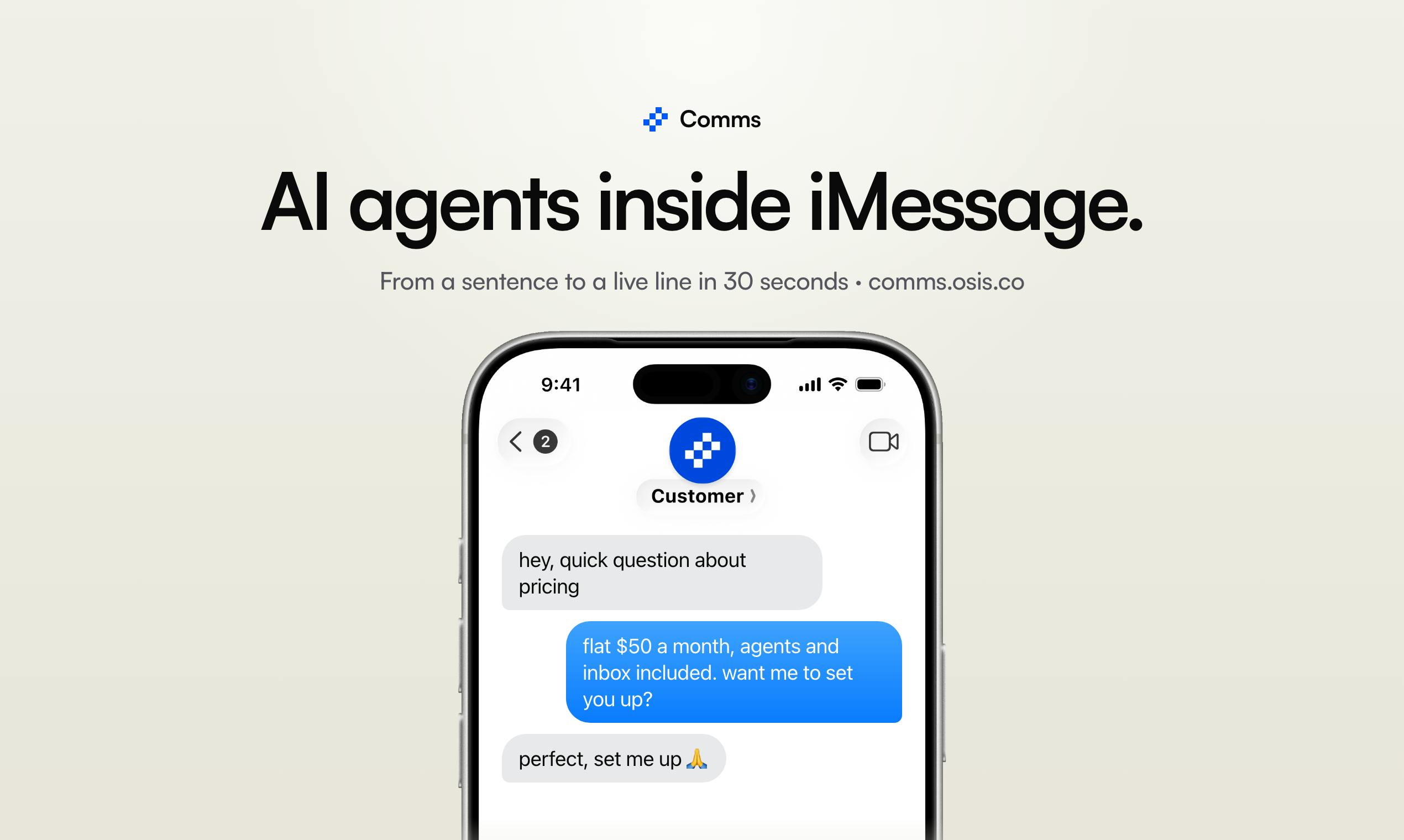
Introducing Comms: AI Agents in iMessage
Comms has launched a new platform that enables developers to create and deploy AI agents directly within Apple's iMessage application. This move aims to bring the power of conversational AI to a ubiquitous messaging platform, allowing for seamless interaction without requiring users to download separate applications or navigate complex interfaces.
The core promise of Comms is to democratize the creation of AI-powered messaging experiences. Historically, integrating AI into consumer-facing applications has involved significant development overhead, including building custom front-ends, managing backend infrastructure, and handling user authentication. Comms abstracts away much of this complexity, allowing developers to focus on the AI logic and user experience within the familiar confines of iMessage.
For developers, this means a drastically reduced barrier to entry for building and distributing AI assistants. Instead of a traditional app store model, Comms leverages iMessage, a platform already installed and actively used by millions of iPhone users. This approach could lead to rapid adoption and widespread experimentation with new AI-powered services.
The platform provides tools and APIs that allow developers to define the behavior and responses of their AI agents. These agents can be designed to perform a variety of tasks, from answering frequently asked questions and providing customer support to facilitating bookings, managing reminders, or even offering personalized recommendations. The integration within iMessage ensures that these agents can be accessed through simple text-based conversations, mimicking natural human interaction.
One of the key challenges Comms addresses is the discoverability and deployment of these agents. By operating within iMessage, agents can be shared among users through standard messaging features, such as forwarding conversations or inviting new participants. This peer-to-peer sharing model could foster organic growth and viral distribution, a stark contrast to the often-stagnant discovery mechanisms in traditional app marketplaces.
The technical underpinnings of Comms likely involve a robust backend infrastructure capable of processing natural language understanding (NLU) and natural language generation (NLG) at scale. Developers would typically define their agent's 'brain' using existing AI frameworks or Comms' proprietary tools, which then communicate with the iMessage interface through Comms' own APIs. This allows the AI agent to receive user input from iMessage, process it, and send back a response that appears as a native message.
Consider the process of booking a restaurant reservation. Instead of opening a dedicated booking app, searching for a restaurant, selecting a time, and confirming, a user could simply message their Comms-powered agent within iMessage. The agent, having been programmed with the necessary logic and connected to reservation APIs, could then handle the entire transaction through a conversational exchange, confirming the booking and sending a message back to the user – all within the iMessage thread.
The potential applications are vast. E-commerce businesses could deploy agents to assist with product inquiries or order tracking. Service providers might use them for appointment scheduling or technical support. Educational platforms could offer AI tutors for specific subjects. The simplicity of the iMessage interface makes it an ideal environment for AI agents designed for quick, task-oriented interactions.
Developer Experience and Agent Capabilities
Comms aims to streamline the developer workflow. The platform likely provides a development environment where engineers can define agent logic, train models (if applicable), and configure integrations. This could include defining conversation flows, setting up responses to specific keywords or intents, and connecting to external data sources or services via APIs. The emphasis is on enabling developers to build sophisticated conversational experiences without needing to become experts in mobile app development or message platform APIs.
The agents themselves can be designed with varying levels of complexity. Simple agents might rely on predefined scripts and keyword matching, while more advanced agents could leverage sophisticated machine learning models for nuanced understanding and context-aware responses. Comms' success will hinge on its ability to support this spectrum of development, from simple chatbots to more intelligent virtual assistants.
A key differentiator is the ability to act as a persistent, always-available assistant within a user's most frequently used communication tool. Unlike web-based chatbots or standalone apps that require explicit opening, an iMessage agent is always accessible. This persistence can foster deeper engagement and make AI assistance a more integrated part of daily digital life.
The platform's launch on Product Hunt signals an intent to gather early feedback from the developer community and iterate rapidly. The discussion section on Product Hunt is likely to be a crucial channel for Comms to understand developer needs, identify potential use cases, and address any technical hurdles.
What remains to be seen is how Apple's ecosystem policies might impact platforms like Comms. While iMessage is a native app, Apple has historically maintained tight control over third-party integrations. The long-term viability of Comms will depend on its ability to align with Apple's developer guidelines and ensure a secure, privacy-respecting user experience. The potential for spam or misuse of an integrated messaging platform is a significant concern that Comms must proactively address through robust moderation and user controls.
The immediate impact for developers is the opening of a new, highly accessible distribution channel for AI-powered conversational tools. For users, it promises a future where interacting with AI is as simple as sending a text message, making advanced technology more approachable and integrated into their daily routines.