The Turnstile Token: A Simple Yet Critical Flaw
A security researcher, who wishes to remain anonymous beyond their dev.to handle 'allonn12', has detailed a significant bypass vulnerability in Cloudflare's Turnstile service. The vulnerability, which has since been acknowledged and is being addressed by Cloudflare, centers on the seemingly innocuous browser token that Turnstile uses to verify human users. The researcher discovered that this token, once obtained from one browser session, could be directly transferred to another, effectively bypassing the need to solve the CAPTCHA challenge altogether.
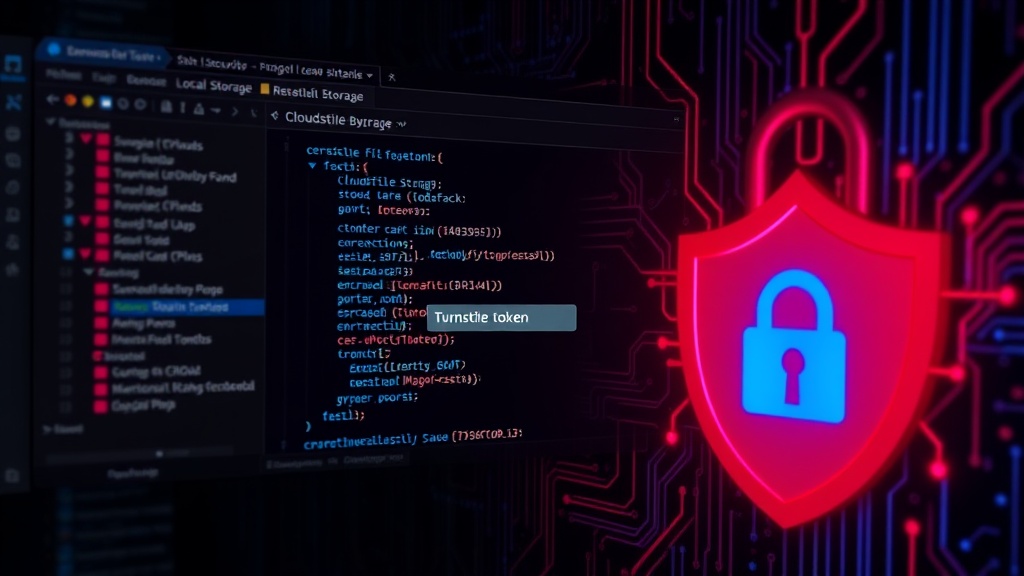
The process, as described by the researcher, is alarmingly straightforward. After successfully solving a Turnstile challenge on a target website (or Cloudflare's own demo site at demo.turnstile.workers.dev), the service stores a token in the browser's local storage. This token, identified by the key _cftscs_0x4AAAAAAADnPIDROrmt1Wwj, acts as proof of a successful human verification. The researcher found that by copying this specific token from the local storage of one browser and pasting it into the local storage of another browser session, even an incognito one, the Turnstile challenge would be bypassed upon page refresh. Crucially, the researcher noted that Cloudflare's implementation lacked checks for IP address or browser identity associated with the token, making it trivially transferable.
The researcher provided clear, actionable steps and even shared snippets of Cloudflare's own code, illustrating the absence of validation: localStorage.setItem( and _cftscs_${fe}, n.scs);ce = localStorage.getItem(scsKey);. The implication is stark: if the token exists, it's trusted, regardless of its origin.
Reporting the Flaw and the Unexpected Rejection
Armed with this discovery, the researcher followed standard procedure by reporting the vulnerability to Cloudflare, providing a proof-of-concept and detailed steps on how to replicate the bypass. Cloudflare's initial response, as recounted by the researcher, was affirmative: "we see it works." However, this acknowledgment was quickly followed by a denial of the bug bounty claim. Cloudflare's justification was that the issue was "out of scope," and the report was subsequently locked, preventing further discussion or clarification.
This outcome has left the researcher understandably frustrated. The core of their grievance lies in the fact that their discovery, a critical bypass that undermines the intended security of Turnstile, was deemed out of scope, yet Cloudflare is now reportedly fixing the vulnerability using the information provided. The researcher explicitly states, "They're fixing it now. Using my work. I get nothing." This situation highlights a common tension in the bug bounty ecosystem: the definition of 'scope' and the perceived fairness of bounty payouts when vulnerabilities, even critical ones, fall into a gray area of what the program intends to reward.
The Broader Implications of 'Out of Scope'
The classification of this bypass as 'out of scope' by Cloudflare raises important questions for the wider security community. Turnstile's primary purpose is to protect websites from automated abuse, spam, and malicious bots by distinguishing between human and bot traffic. A bypass that allows any attacker to simply copy and paste a token, effectively impersonating a verified human user, strikes at the heart of this protective function. If such a bypass is not considered critical enough for a bounty, it suggests a potential disconnect between the reported vulnerability's real-world impact and the bug bounty program's defined parameters.
For developers integrating Turnstile, this incident serves as a crucial reminder that no system is entirely foolproof. While Cloudflare is actively working to patch the identified weakness, the ease with which the bypass was discovered and executed underscores the importance of continuous security auditing and the potential for unforeseen vulnerabilities even in widely adopted services. The researcher's work, though unrewarded by a bounty, has undeniably contributed to improving the security of a service used by millions of websites. The situation prompts reflection on how bug bounty programs define scope and whether the spirit of incentivizing security research should sometimes extend beyond rigid, predefined boundaries, especially when a vulnerability demonstrably impacts a core security function.
The researcher's experience, while disappointing, is a valuable case study. It underscores the need for clear, transparent communication between security researchers and companies regarding bug bounty scope and the criteria for awarding bounties. It also highlights the inherent challenges in defining what constitutes a 'critical' vulnerability versus an 'out-of-scope' finding, particularly when the latter can be exploited to circumvent security measures. The fact that Cloudflare is implementing a fix based on the researcher's findings, despite the bounty denial, suggests the vulnerability's significance was recognized internally, even if not externally rewarded.