The Problem: Scalable Scheduled Notifications
Sending timely, personalized notifications at scale is a common challenge for SaaS products. Consider the requirement: deliver a useful product tip to every user every Tuesday at noon, respecting their local timezone, via Slack. The naive approach involves a central cron job. This job would periodically scan a user table, calculate each user's local noon based on their stored timezone, and then fan out Slack messages. This method has significant drawbacks. As the user base grows, the database scan becomes increasingly resource-intensive. Furthermore, any error in the cron job’s logic—a timezone calculation mistake, a missed user, or a failed message send—can lead to users silently missing their tips, degrading the perceived reliability of the service.
This approach creates a system that is brittle and scales linearly with user count. For GitNotifier, a product that aims to provide users with actionable insights from their Git repositories, this was an unacceptable bottleneck. They needed a solution that was robust, scalable, and avoided the pitfalls of traditional cron-based scheduling.
Cloudflare's Solution: Durable Objects and Alarms
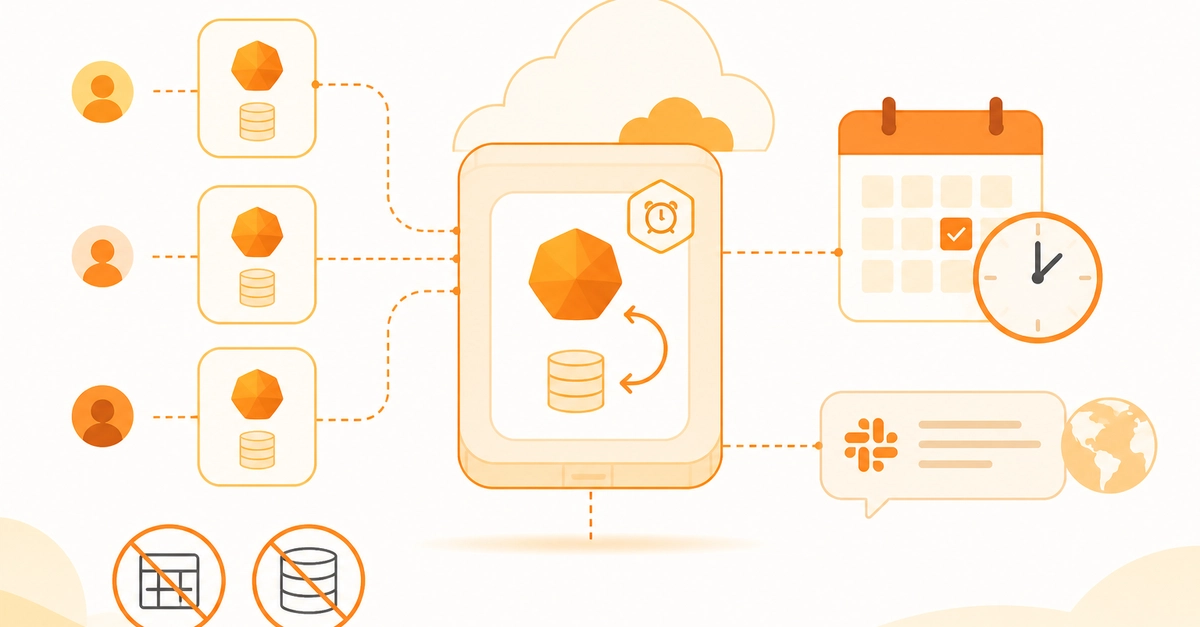
Cloudflare offers a more elegant and efficient solution using its Durable Objects and Alarms primitives. Instead of a single, monolithic cron job, the strategy is to decentralize the scheduling logic. Each user is assigned their own Durable Object. This object is stateful, meaning it can store data specific to that user. Critically, each Durable Object is equipped with a self-rescheduling alarm. This alarm acts as a personal timer for the object.
When a user is created, a Durable Object is instantiated for them. This object stores the user's preferences, including their timezone. The object then schedules an alarm to trigger at the user's local noon on Tuesday. When the alarm fires, the Durable Object executes a specific function: it sends the product tip to the user via Slack. Crucially, after sending the tip, the Durable Object immediately reschedules its alarm for the following Tuesday at the same local time. This creates a perpetual, self-managing system for each user. There is no central cron job to manage, no user table to scan, and no complex timezone calculations happening in a single, error-prone process. The complexity is distributed across thousands of individual objects, each managing its own schedule.
How It Works: The Technical Breakdown
The architecture hinges on a few key Cloudflare Workers concepts:
- Workers: These are stateless request handlers that run at the edge. While not directly handling the scheduling here, they serve as the entry point for requests to interact with Durable Objects and can be used to manage the initial creation or configuration of these objects.
- Durable Objects: These are unique, stateful objects that live in Cloudflare's global network. Each Durable Object has a unique ID, and all requests to a specific object are routed to the same instance, ensuring predictable state management. This is perfect for housing user-specific data and logic.
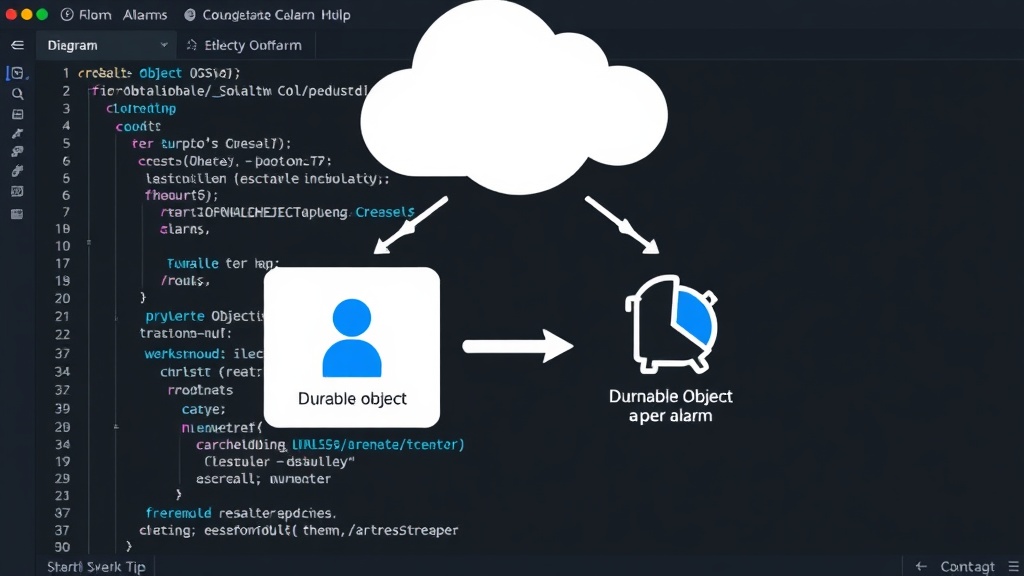
- Alarms: Durable Objects can schedule alarms to trigger at a specific time. When an alarm triggers, the Durable Object's `alarm()` method is called. This method is where the core scheduling logic resides. Importantly, alarms are persistent and can be rescheduled, enabling recurring tasks.
The workflow for sending a weekly tip looks like this:
- User Onboarding: When a new user signs up for GitNotifier, a new Durable Object is instantiated for them. This object is given a unique ID, often derived from the user’s ID.
- State Initialization: The Durable Object stores user-specific data, such as their Slack integration token and their preferred timezone.
- Initial Alarm Scheduling: Upon creation, the Durable Object calculates the timestamp for the upcoming Tuesday at noon in the user’s local timezone. It then schedules an alarm for that specific time using `this.storage.setAlarm(timestamp)`.
- Alarm Trigger: On Tuesday at noon (local time), the alarm fires. Cloudflare routes this event to the user's Durable Object instance, invoking its `alarm()` method.
- Tip Sending: Inside the `alarm()` method, the Durable Object uses the stored Slack token to send the pre-defined product tip to the user.
- Rescheduling: Immediately after sending the tip, the Durable Object calculates the timestamp for the *next* Tuesday at noon (local time) and reschedules the alarm using `this.storage.setAlarm(newTimestamp)`. This ensures the process repeats weekly without manual intervention.
Advantages Over Traditional Cron Jobs
This Durable Object and alarm-based approach offers several significant advantages:
- Scalability: The system scales horizontally. Adding more users means adding more Durable Objects, each operating independently. The load is distributed globally, avoiding the single point of failure and performance bottleneck of a central cron job.
- Reliability: Each user's tip delivery is managed by their dedicated object. If one object fails, it doesn't impact others. The self-rescheduling mechanism ensures that even if a server restarts or experiences a glitch, the alarm will eventually trigger and reschedule itself.
- Timezone Accuracy: By storing each user's timezone within their object and performing the calculation locally, the system guarantees accurate delivery at the user's local noon, regardless of the server's location.
- Simplicity: While the concept of Durable Objects might seem complex initially, the implementation for this specific use case is remarkably simple. It eliminates the need for complex cron expressions, user table scanning logic, and distributed task queues. The entire scheduling and delivery mechanism for a user is contained within their single Durable Object.
- Cost-Effectiveness: Durable Objects are billed based on usage (requests, storage, CPU time). For tasks like sending a weekly tip, the overhead per object is minimal, often falling within free tiers or being very inexpensive at scale, potentially making it more cost-effective than managing dedicated cron servers or complex scheduling infrastructure.
The Unanswered Question: Long-Term State Management
While this pattern elegantly solves the immediate problem of scheduled, timezone-aware notifications, a lingering question for developers building at scale on Durable Objects remains: what is the most robust strategy for managing the long-term state and potential lifecycle of millions of these small, autonomous objects? For instance, if a user deletes their account, how is their corresponding Durable Object's state efficiently cleaned up? While Durable Objects offer storage, proactive garbage collection or explicit deactivation mechanisms for objects tied to inactive users would further optimize resource utilization and cost. Cloudflare's current tooling primarily focuses on object creation and interaction, leaving the fine-grained lifecycle management of a vast number of objects to the developer's discretion.
Conclusion: A Modern Approach to Scheduling
Cloudflare's Durable Objects and Alarms provide a powerful and modern alternative to traditional cron jobs for event scheduling. By assigning each user a dedicated, stateful object with a self-rescheduling alarm, developers can build highly scalable, reliable, and timezone-aware notification systems. This pattern abstracts away the complexities of distributed scheduling, allowing engineers to focus on delivering value to their users rather than maintaining brittle infrastructure. For applications requiring personalized, time-sensitive communications, this approach represents a significant architectural improvement.